How Variable Pay Changed For CEOs Of Top Consumer Goods Makers Amid Slowdown

Target-driven variable pay fell for three of the six chief executive officers of the top consumer goods makers in 2018-19 as consumption started slowing in the economy.
That includes the head of Hindustan Unilever Ltd., India's largest consumer goods maker, and peers from Marico Ltd. and Godrej Consumer Products Ltd., according to data collated from annual reports—promoters running FMCG companies were excluded from the comparison. The variable pay remained unchanged for the chief executive of Britannia Industries Ltd., but rose for peers at Asian Paints Ltd. and ITC Ltd.
Consumption has been slowing in India since the last festival season as consumers are buying fewer cars and scooters to shampoos and biscuits. That was captured in the earnings of the last two quarters of the previous fiscal. And it reflected in the GDP growth as the economy expanded at the slowest pace in 20 quarters in the three months ended March.
Here's a look at how the variable pay changed for CEOs from the FMCG sector:
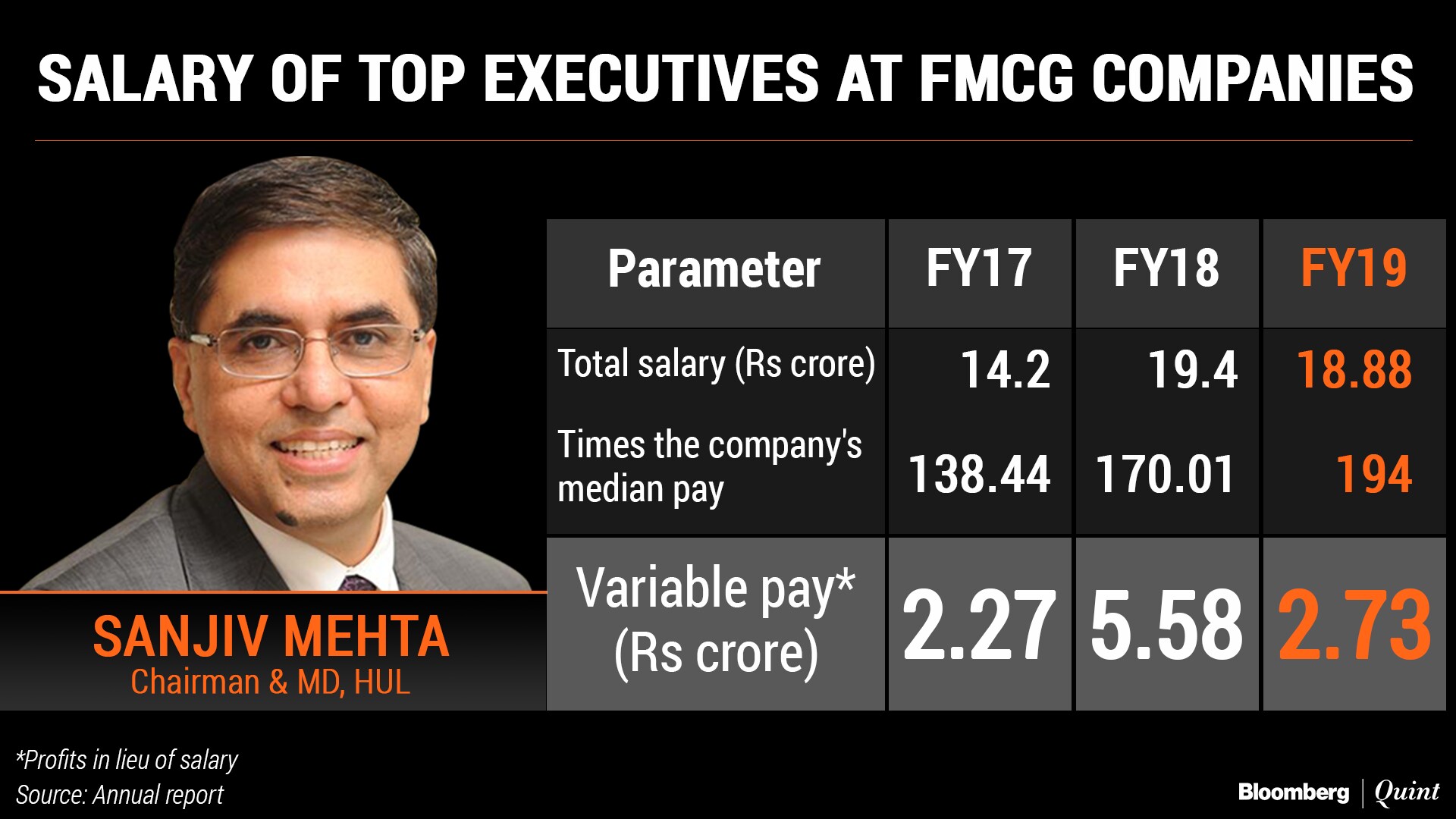
Sanjiv Mehta
Chairman & MD, Hindustan Unilever
Mehta's profits in lieu of salary—or payments over and above the fixed pay—stood at Rs 2.73 crore in FY19 against Rs 5.58 crore a year earlier. Mehta's overall salary also declined.
“We have seen a moderation in the growth rates,” Mehta had said after the earnings for the quarter ended March. “And if we look at how the market played out, there were a couple of quarters where the market was soft on the back of softness which crept in from stress in the rural markets.”
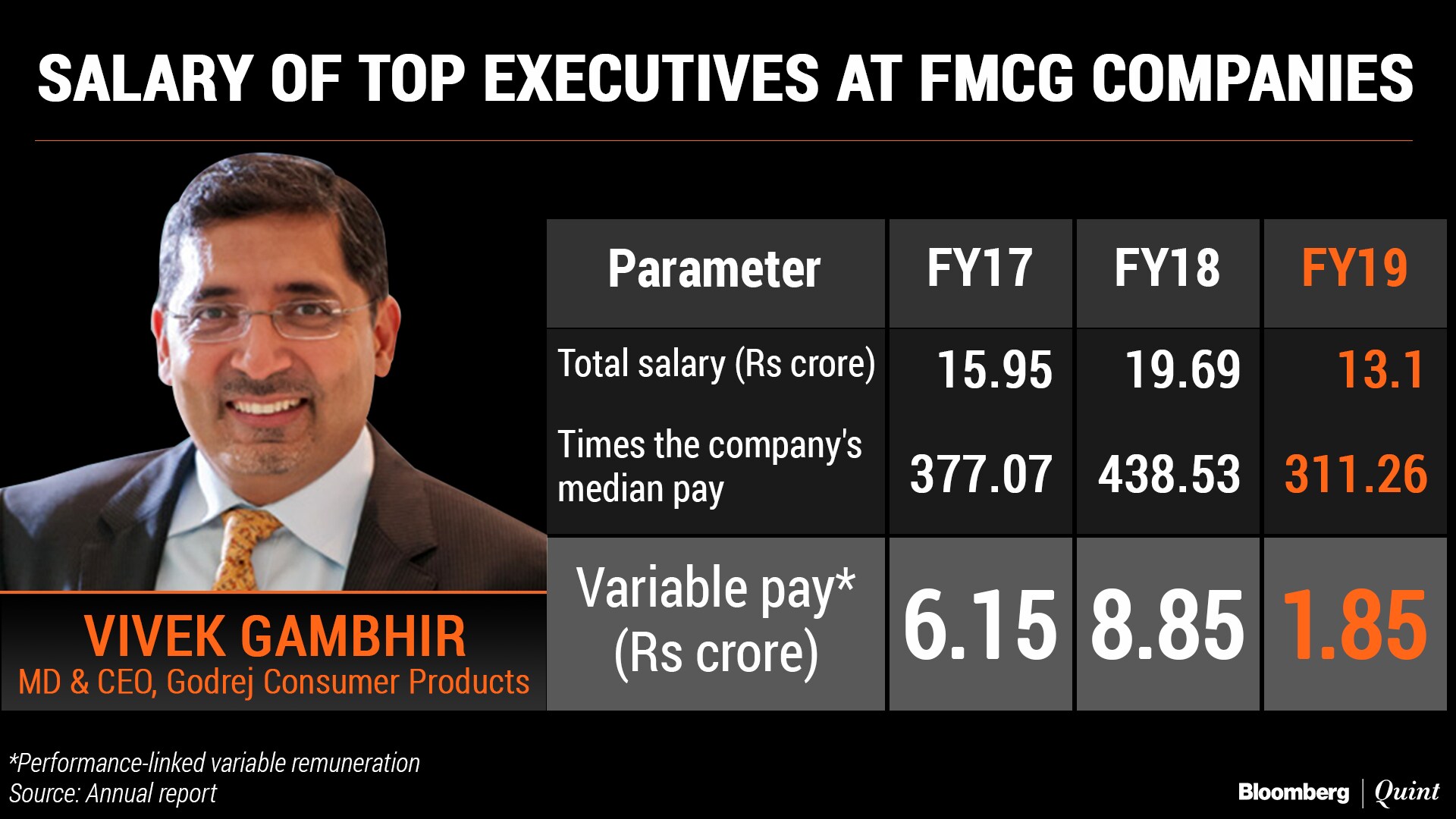
Vivek Gambhir
MD& CEO, Godrej Consumer Products
Performance-linked variable pay fell the most for Gambhir among peers.
Adi Godrej and Nisaba Godrej, members of the promoter family at the Godrej Group, also saw their variable pay decline.
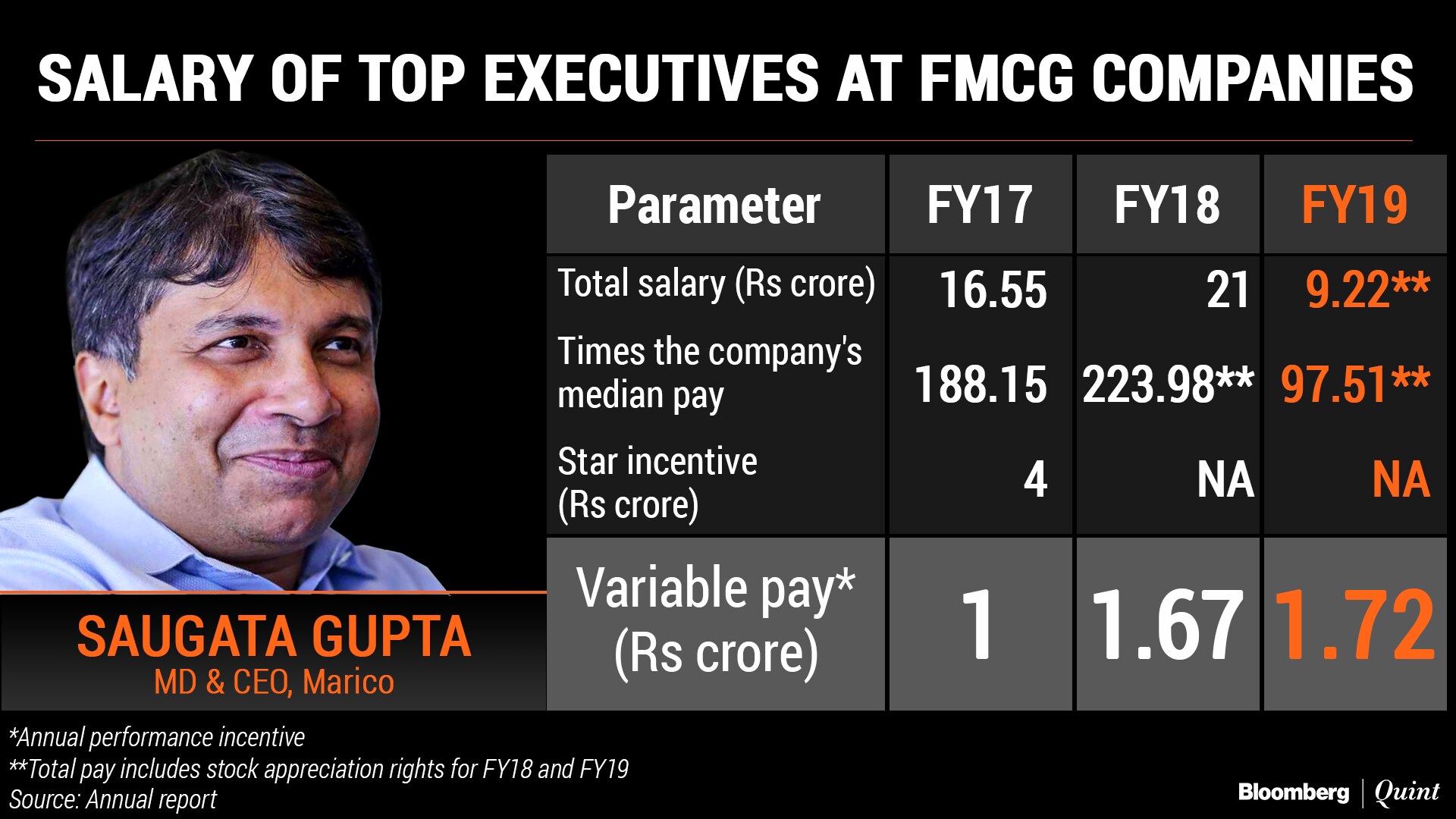
Saugata Gupta
MD & CEO, Marico
Gupta, managing director and CEO at the maker of Parachute coconut hair oil, saw his variable pay fall in FY19.
His overall salary also fell 55 percent to Rs 9.21 crore—it includes the perquisite value of the stock appreciation rights vested on him in 2018-19 worth Rs 2.4 crore compared with Rs 1.4 crore in FY18.
Excluding the perquisites, Gupta's pay stood at Rs 6.81 crore in FY19.
Harsh Mariwala, chairman and non-executive director at Marico, also saw his salary decline 19 percent to Rs 4.93 crore.
Gupta, in an investor call after the earnings for the quarter ended March, had acknowledged sluggishness in rural business.
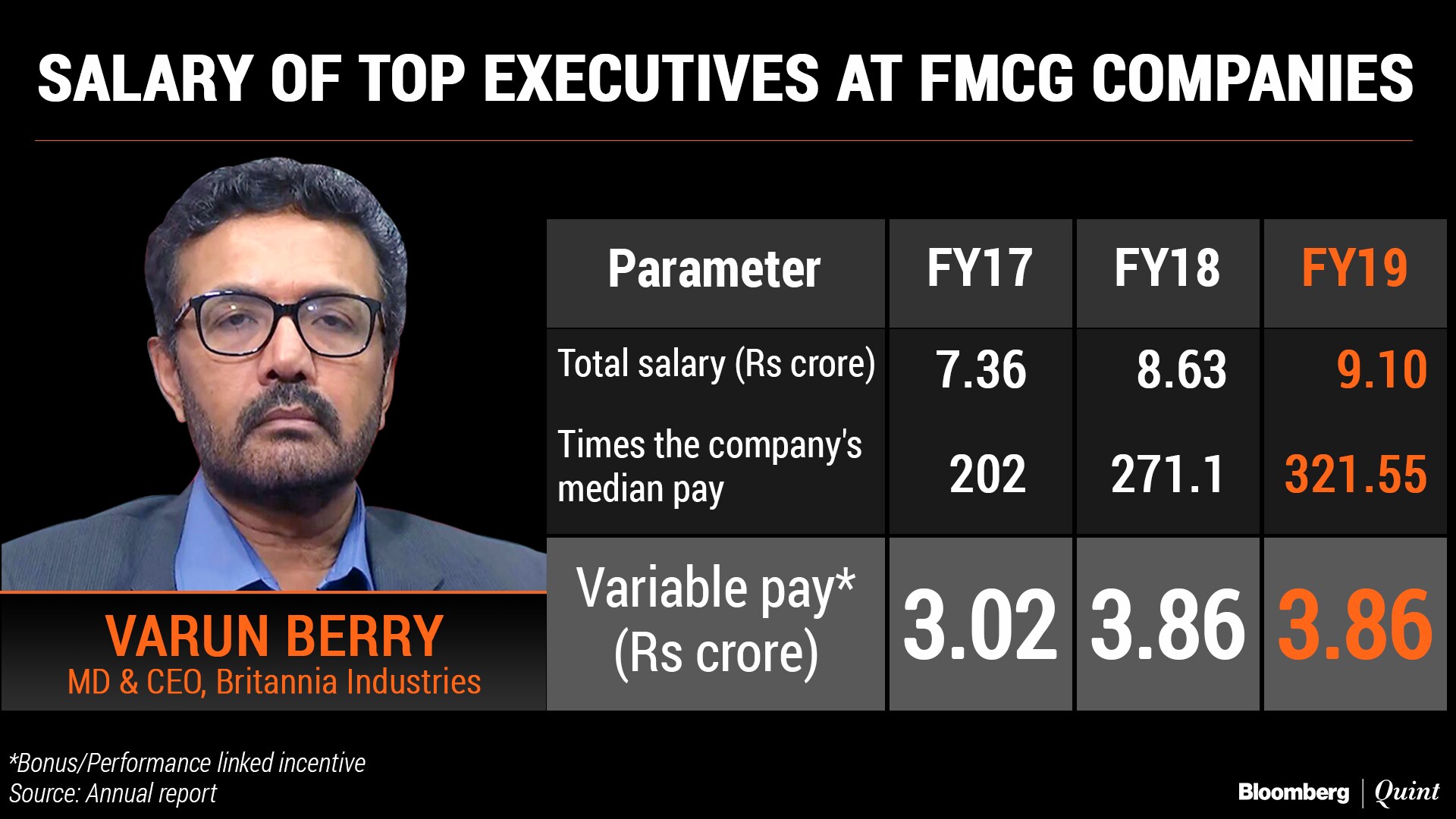
Varun Berry
MD & CEO, Britannia
Berry's performance-linked pay remained unchanged in FY19 even as his overall salary rose because of a higher fixed component.
The maker of Good Day biscuits had said that growth slowed in the second half of FY19, in line with falling consumption in the economy.
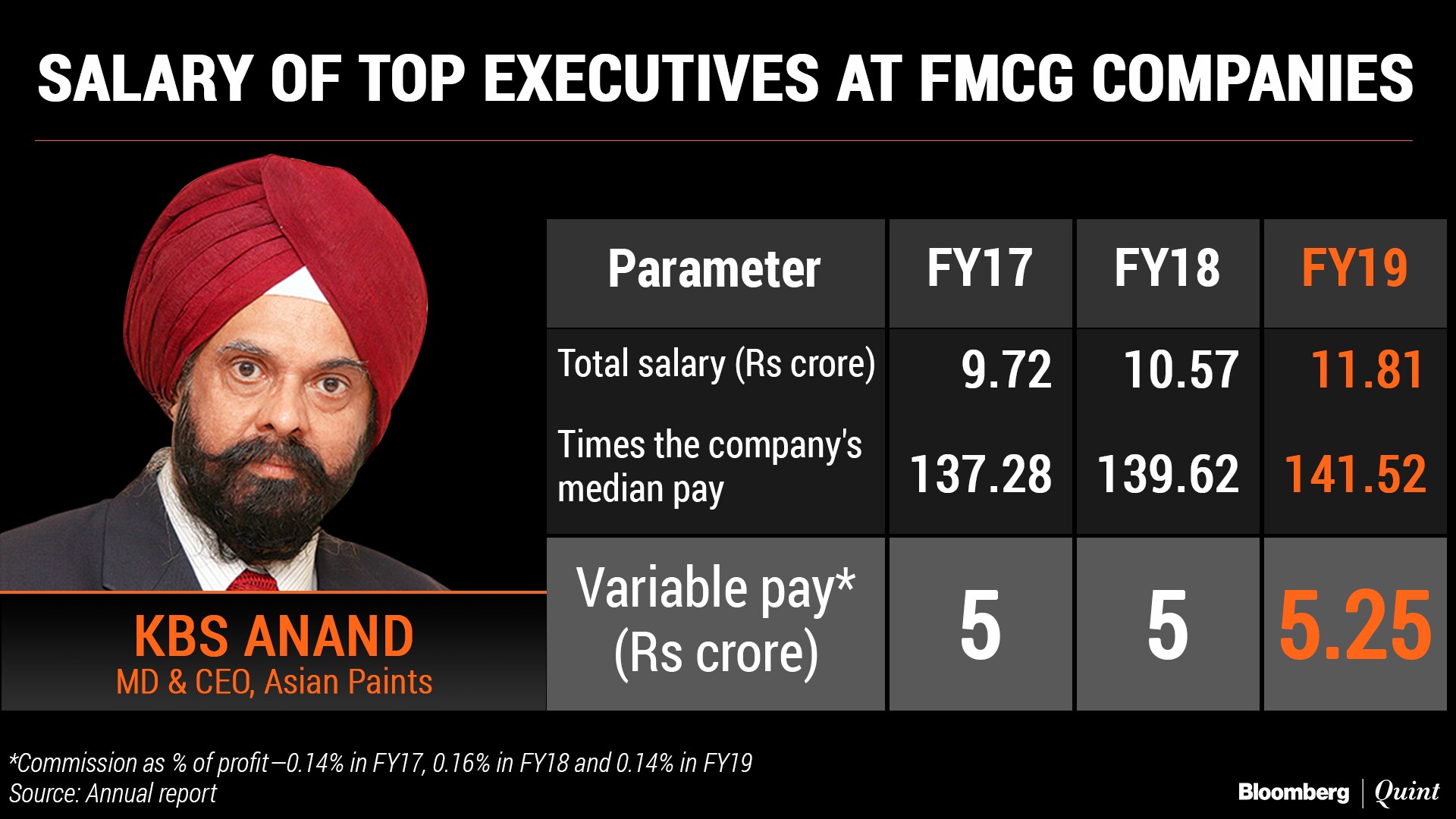
KBS Anand
MD & CEO, Asian Pains
Anand saw his variable pay jump in FY19 as it's linked to the company's profit, which rose. That was despite his commission as a percentage of profit fell to 0.14 percent from 0.16 percent a year earlier.
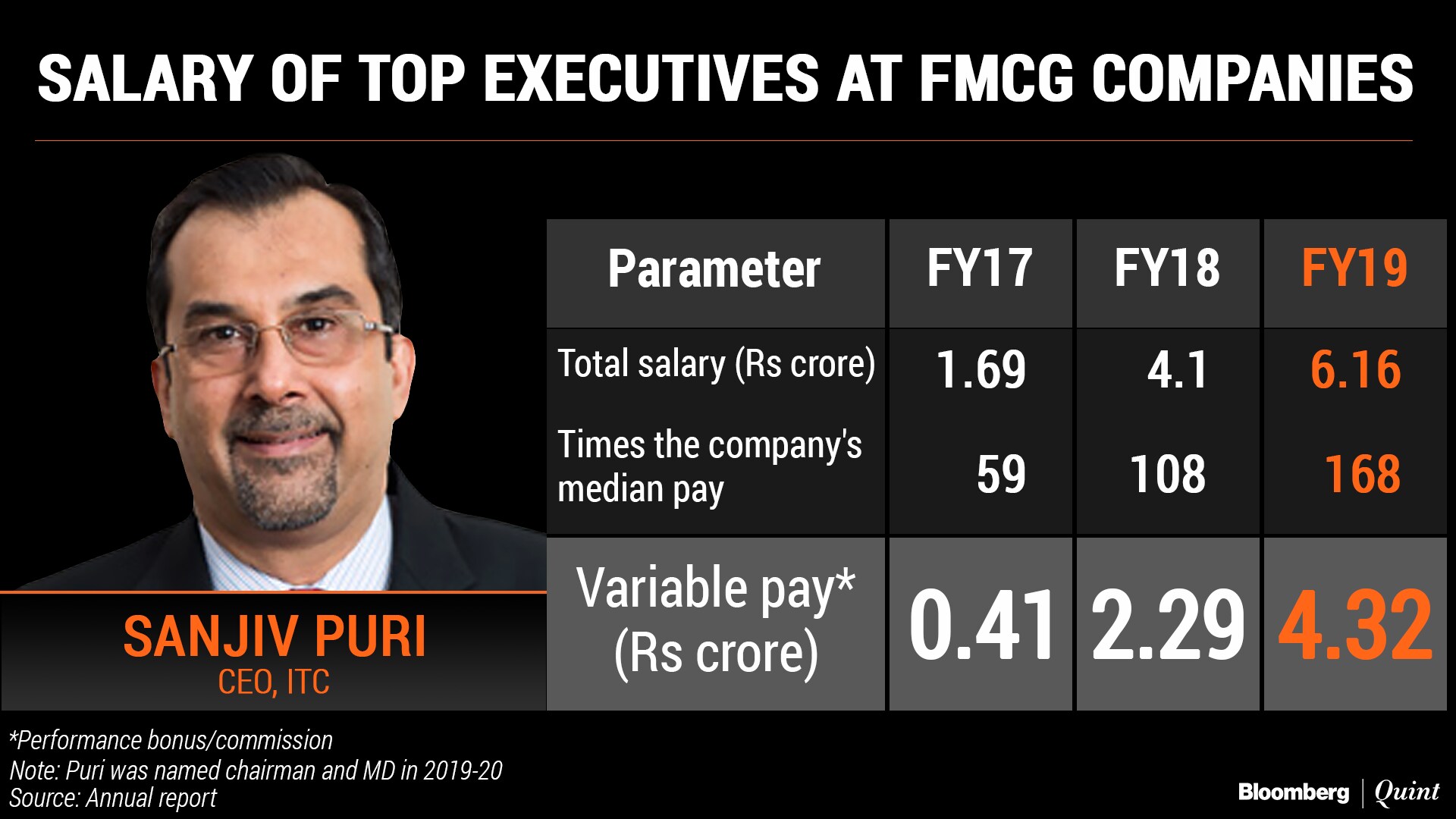
Sanjiv Puri
CEO, ITC (Puri was elevated as chairman & MD in May this year)
Puri's performance bonus and commission jumped about 88 percent in FY19.
The companies have yet to respond to BloombergQuint's emailed queries on CEO pay. Godrej Consumer Products declined to comment citing silent period ahead of earnings announcement.
Rituparna Chakraborty, co-founder at staffing firm Teamlease, said managements of FMCG companies have warned of a slowdown which crept in towards the end of 2018-19. “The moderation in the profit-linked remuneration is primarily because organisations are choosing to be prudent at this point in time,” she said.
But according to JN Gupta, co-founder and managing director at investor advisory services firm Stakeholders Empowerment Services, decision on performance-based remuneration cannot be generalised based on sectoral performance. That's because nomination and remuneration committee of each company has different yardsticks, he said. In promoter-dominated companies, he said, it's the arrangement between promoters that majorly determines their remuneration.

-
The Economic Imperative: Analysing The Material Driving Force Behind India-Canada Strategic Reset

This economic complementarity is further reinforced by deep institutional investment ties and talent mobility, which form the bedrock of the bilateral framework.
-
Medicine Pricing: Where Must Profit Stop?
India must confront excessive margins, hidden incentives and regulatory gaps that threaten the integrity of medicine.
-
Why Amazon And Flipkart Are Struggling To Beat Meesho In India's Smaller Cities
With 274 million users and lowest-cost logistics, Meesho is defending its value commerce crown against giants like Amazon and Flipkart.
-
High US Salaries, No Green Card Certainty: The Financial Calculation Facing Indian H-1B Families
The suspension of PERM processing at eight technology employers does not cancel existing H-1B visas. What it does is force a question many Indian families have been avoiding: is the US salary worth tying your career and family plans to one employer?
-
Swiggy vs Eternal: Food Delivery's Two Rivals Are No Longer In The Same Race
Eternal is building a private AI assistant, dark.ai. Swiggy is still working out how to make Instamart pay, with an operating loss of Rs 895 crore in the July-September quarter while Blinkit stayed profitable.
-
Where You Live Shapes How You Get To Work | The Reason Why
Two-wheelers are the most popular way to get to work in India, accounting for nearly 43% of workplace commutes.
-
Unhedged Position: Can India See An Indonesia-Style Time Correction?
The Nifty is trading below levels it first clocked in 2024. Is there, then, as I have suggested in the headline, potential that the current time correction drags on painfully for the next three-five, even ten years?
-
Navigating Friction And Energy Realities: An Analysis Of Marco Rubio's October Visit To India
Occurring at a critical juncture marked by stalled trade negotiations and escalating geopolitical pressures over global energy supplies, the visit offers a profound window into modern US-India relations.
-
India Exports Capital. Why Not Export Trusteeship?
The big question, then, is whether India can build an institution that global borrowers, investors, banks, and lawyers can trust, even without an Indian connection.
-
France's Economy & Politics Are In Crisis | The Reason Why
Let's look at how the French economy and politics evolved under Nicolas Sarkozy, Franois Hollande and Emmanuel Macron.










