The US Housing Drought Is Ending. What Does It Mean for Prices?

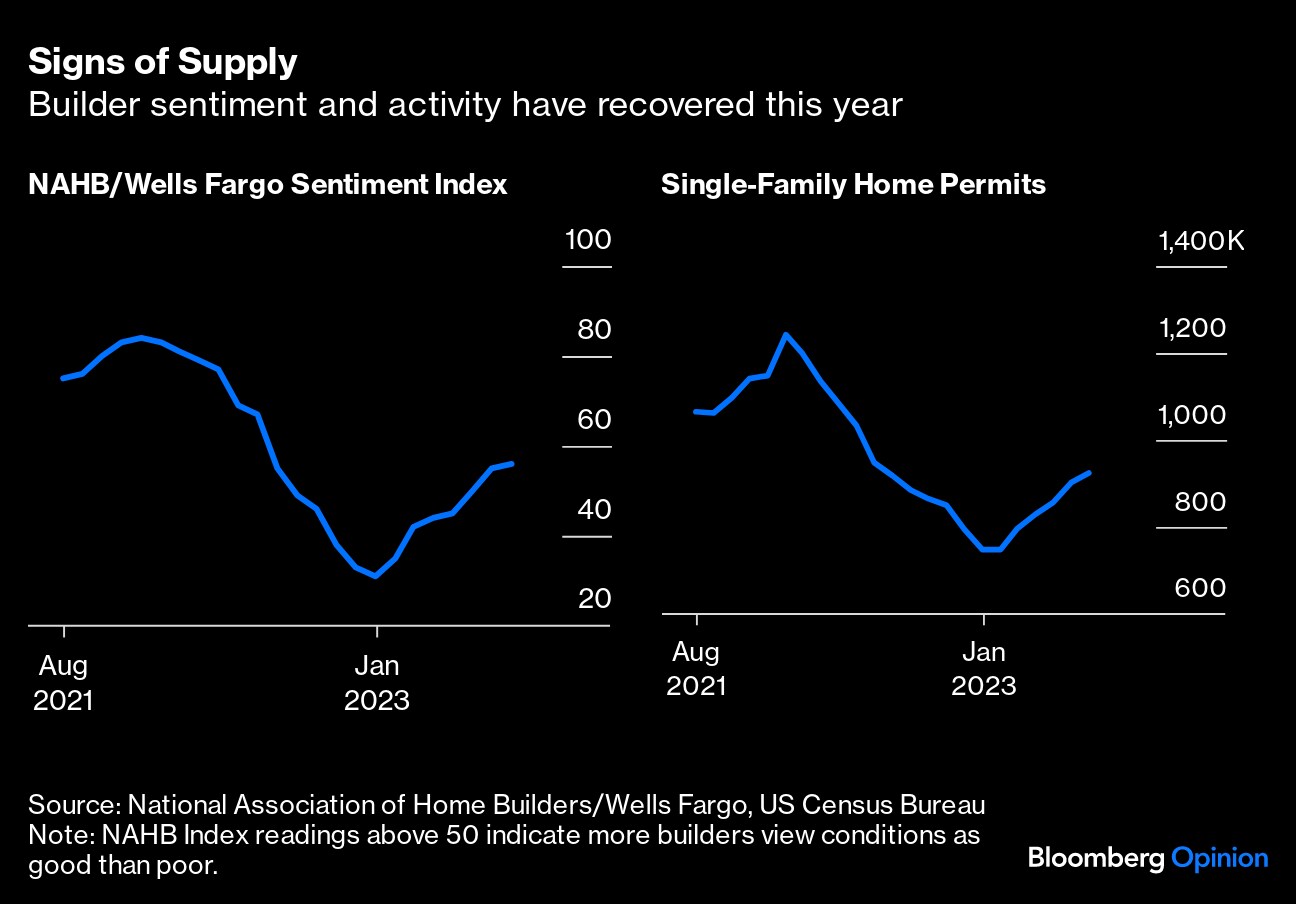
(Bloomberg Opinion) -- The story of US housing for hopeful buyers in 2023 has been one of frustration. A lack of supply has stabilized a market where affordability remains challenging.Homeowners with low mortgage rates have chosen not to sell, putting builders of new houses in a stronger position than they had anticipated last autumn when interest rates were surging and the market slowed. While I wouldn't count on supply conditions getting easy any time soon, there are growing signs that the picture in 2024 should be better, or at least “less bad.”Let's start with new homes. Builders braced for a challenging 2023 only to find that they were in some ways the only game in town in a supply-constrained market. Resilient prices have given the industry more confidence to increase production. A gauge of the market for new houses from the National Association of Home Builders and Wells Fargo, which measures sentiment on a scale from 0 to 100, surged from 31 in December — representing deep negativity — to 56, suggesting moderate optimism. Single-family housing starts have risen. Healing supply chains have shortened the time to build homes, meaning the ramp up in construction that's underway should put more completed homes on the market by the first half of 2024.
The resale market, which historically accounted for about 87% of all homes for sale and has seen an acute lack of inventory, is where a pickup in new listings would be most welcome. To be clear, I'm not looking for a wave of fresh supply, but any growth right now would be helpful — something we should start to see early next year.
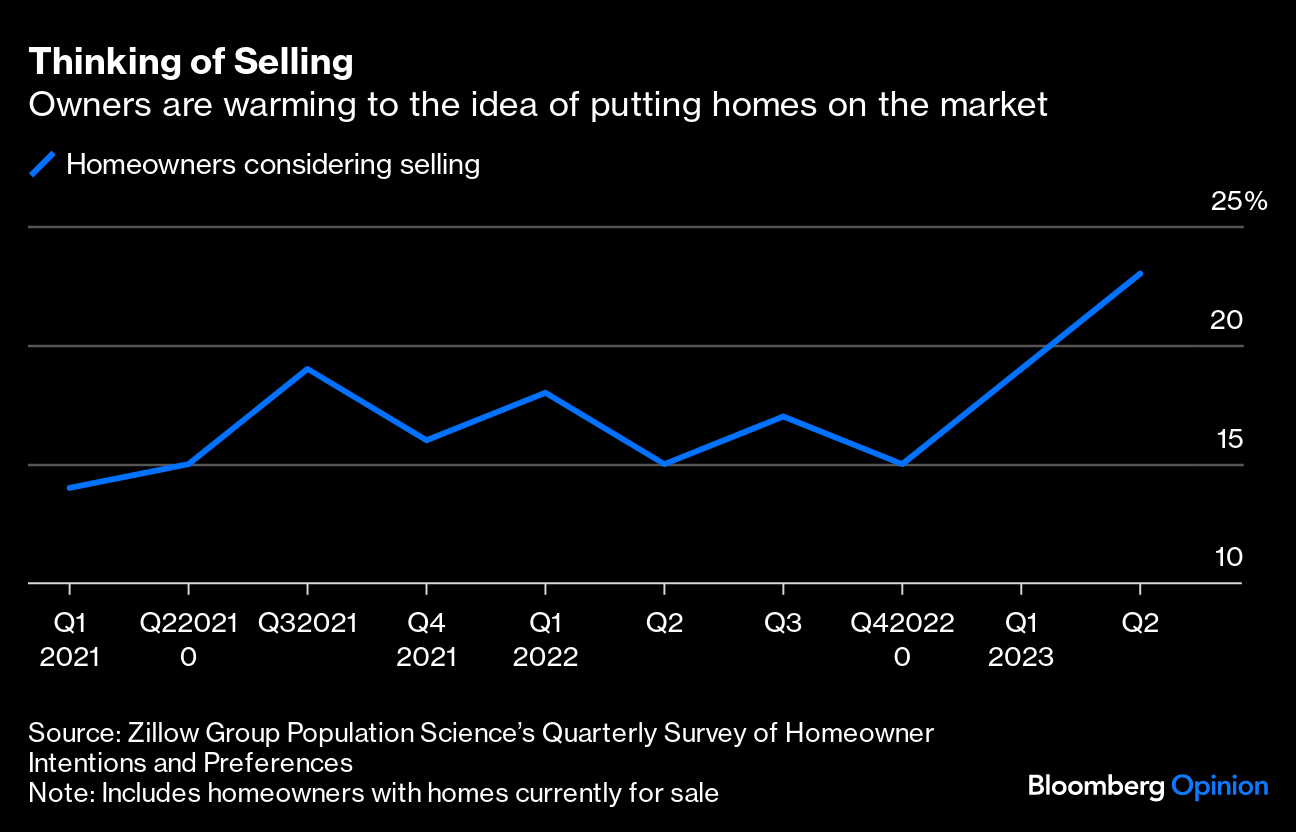
A quarterly survey from Zillow recently found that 23% of homeowners are already selling or considering selling over the next three years, the highest percentage since at least the beginning of 2021.
There are qualitative reasons why this would be the case. The first is that by October, mortgage rates will have been about flat year-over-year, since 30-year mortgage rates first hit 7% last October. People with low mortgage rates may not be in a hurry to sell, but it's unlikely that they'll be less willing to sell this October than they were last October. Every month homeowners pay down a little principal on their home loan and get a little older. Incomes have risen, increasing their buying power. Life happens — kids age in and out of school, people get married, divorced, and pass on. Any increase in resale supply from people with low mortgage rates may be modest, but 2023 should be the peak for the cheap mortgage lock-in effect.
Additionally, even as the level of home sales has fallen, around 5 million homes are still being sold in the US each year. By the end of this year, roughly 8 million homes will have sold since mortgage rates first began rising sharply in the spring of 2022 — those homeowners don't have the mortgage rate lock-in effect and can more easily make a move if life compels them.
Finally, the level of multi-family housing units under construction continues to set record highs. While the for-sale and for-rent markets aren't completely fungible, more rental units will give homeowners looking to downsize options. It will also relieve some buying pressure in the for-sale market as people choose to rent rather than buy given the growing affordability gap between the two markets.
To the extent that the supply shortage has put upward pressure on prices in recent months, this should take some steam out of the market. Private sector forecasts like one from Zillow project home prices will rise around 6% over the next year, but additional inventory may flatten that growth out again. The environment may become less favorable for homebuilders though they should still manage to sell all the homes they're planning on building. And there should be some positive second-order effects as inventory levels rise. I'm not willing to sell my home if there's nothing good for me to buy, so having more choices could lead to both more sales and purchases. It's going to take years to build enough to bring the housing market back into balance, but for the first time in a while there are reasons to think we're moving in the right direction.
More From Bloomberg Opinion:
- Can We Keep Living in Places Like Phoenix?: Mark Gongloff
- Popping Real Estate Bubbles Will Prove Painful: Lionel Laurent
- Home Loan Banks Are Adrift and Asking for Trouble: Editorial
This column does not necessarily reflect the opinion of the editorial board or Bloomberg LP and its owners.
Conor Sen is a Bloomberg Opinion columnist. He is founder of Peachtree Creek Investments.
More stories like this are available on bloomberg.com/opinion
©2023 Bloomberg L.P.

-
Signature Play: The Classic Cocktail Is Dead. Or Is It?

Classic cocktails are disappearing from India's cocktail menus. But they're still being ordered, taught to bartenders and borrowed from. So, who's really having the last drink?
-
A New Samvat Wishlist: Inclusive Prosperity And Human Development
India has strengthened its economic foundations through infrastructure, digital access and enterprise. Its next growth chapter must deepen productivity, create better livelihoods and widen participation in prosperity.
-
Love, Sex Aur Dhokha: The Audacious Plot To Spy On Jensen Huang
A Taipei dinner, a Singapore chip buyer and a suspected Chinese asset: inside the alleged spy operation that got close to NVIDIA's Jensen Huang.
-
Ten Things I Learnt This Samvat
Patience can be a trap. Cheap stocks can stay cheap. Leverage can wipe you out. What did Samvat 2082 teach us? Niraj Shah writes on 10 lessons from the year gone by.
-
Talking Points This Week: Tech Nerves, FII Buying, And A Faraway Banking Shock
The global markets are not shining this Diwali. The exception in the large markets is, India.
-
Midterm Rally Lasted A Day. The Hard Reality Of A Divided US May Last Two Years | Opinion
Between a contested AI boom, a debt ceiling that arrives in 2027 and a president with every incentive to act alone, the next two years may prove more volatile than the first day's rally suggests.
-
Blue Wave Will Derail the AI Trade but Won't Dismantle the AI Era | Unhedged Position
The Democrats' sweep of the US Congress will see politics collide with economic forces both over the long and short term.
-
It's Time To Take The GST Council's Bet On Trust Global
Payment records can prove India's services exports, and clear, proportionate rules can bring foreign digital sellers into the tax net.
-
Opinion | India at 38: From Innovation Overperformer to Innovation Powerhouse
India now has 453 VC-backed deep science startups, 18 of them late-stage, after 117 percent growth since 2020. Laurus Labs, at USD 9.3 billion, is the most valuable deep science company in any middle-income economy outside China.









