Holidays, Lost Business in Brazil World Cup's Lazy Days
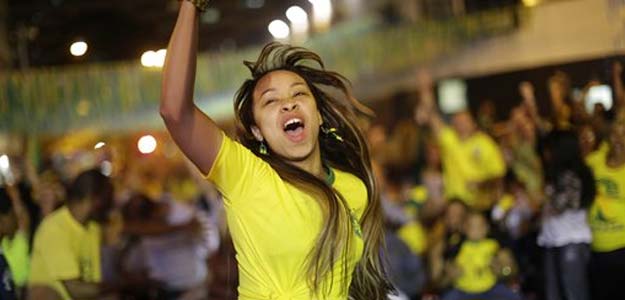
Lucky students in Chile went home early, many Brazilian offices and stores went dark, and across the megalopolis of Mexico City traffic was as calm as midnight. With three Latin American countries playing for their World Cup futures Monday, fans across the region succumbed to soccer fever, slowing regular business to a crawl.
Brazilians, who already are used to generous time off for Carnival celebrations and Catholic observances, have enjoyed even more holidays during the month-long soccer tournament.
When Brazil's national team plays, many workplaces across the country shut down. In host cities such as Rio de Janeiro, the government declared half- or full-day holidays on game days to clear the streets of commuters and enable soccer fans to move about with greater ease.
Last week, there were only two regular work days in Rio, a city of 12 million people. This week will be much the same.
On Monday, before Brazil defeated Cameroon 4-1 in Brasilia, Catia Santiago was soaking up the sunshine on the golden sands of Copacabana beach rather than head to work to sell hair products.
"I'm going to take a hit financially," Santiago said. "I'll probably earn about 30 to 50 per cent less, but I will have had 200 per cent more fun than usual."
Indeed, critics contend all of the time off is bad for business.
Financial newspapers have reported the volume of trade on Sao Paulo's Bovespa stock exchange began to slow even before the June 12-July 13 tournament. Fecomercio, a Sao Paulo-based group representing the goods, services and tourism sectors, warned that those businesses may lose up to $13.5 billion due to lost productivity and the need to pay double salaries to people who work government-declared holidays.
However, Brazil's Tourism Ministry has said the World Cup itself will inject that much money into the nation's economy, offsetting any such losses.
Katia Andrade, a saleswoman for a Rio online data storage company, complained that the extra time off was putting her way behind on her yearly revenue target.
"The World Cup is literally costing me money," Andrade said. "Since the beginning of the year, projects have been lagging behind, with everybody putting things off until after the Cup. And now, with almost every day a public holiday, it's totally impossible to get anything done."
Mexico City started to resemble a ghost town by midday Monday as locals geared up for the afternoon game between Mexico and Croatia in the northeastern Brazilian city of Recife, which Mexico won 3-1.
During the national team's matches, "one can cross Mexico City as if it were the middle of the night, stopping only at a few stoplights," taxi driver Alejandro Ramirez said, adding that traffic Monday morning already was about 20 per cent lighter than a regular day.
After the game, thousands of fans wearing the national team's green jersey and waving Mexican flags jammed the traffic circle around the Angel of Independence statue on the capital's main avenue, disrupting traffic in the business zone.
In Chile, some schools and universities suspended classes ahead of the national team's match with the Netherlands in Sao Paulo, while thousands of people congregated on a central square fitted with a giant screen to follow the game. Chile lost 2-0, but still advanced to the tournament's second round.
Schools in Brazil also pushed winter break forward to coincide with the World Cup, as the drop-off and pick-up of school children is a major source of traffic jams.
While students may be rejoicing, a recent column on the website of Veja, a right-leaning newsmagazine, called such school and business holidays a "confession of incompetence" - evidence that authorities' failure to build adequate infrastructure forced them to concoct a fix to Brazil's traffic woes.
"The government has seven years to prepare for the event - seven years! Of course they weren't capable," the column by Rodrigo Constantino said. "And now they adopt a typically Brazilian solution, which is jerry-rigging and cobbling together a way out.
"This is definitely not a serious country," he concluded.
Honduras' president also has been criticized for making an extended visit to Brazil, where his country's national team is playing in the World Cup for only the third time.
President Juan Orlando Hernandez skipped talks in Guatemala with US Vice President Joe Biden, sending his chief of staff to discuss a rise in unaccompanied children crossing into the United States while he attended Honduras' debut match against Ecuador.
The Central American country lost the game 2-1, and the US ambassador to Honduras, Lisa Kubiske, remarked, "You have a very important soccer game in Brazil, no one can deny it, but the country has priorities that need the one in command to be present."

-
Getting To Work Costs Women More | The Reason Why

It is not just about women paying more than men. It is about women paying much more in cities than in villages.
-
AI Bias In Investing Cannot Be Eliminated, But It Can Be Governed
Framing is a particularly important example as identical financial information presented in terms of gains rather than losses can lead an LLM to reach a different assessment.
-
Joining The Dots | Dark Skies, Steady Diya: Why Hope Holds This Diwali
With war, a weak rupee and foreign outflows weighing on sentiment, policymakers at the NDTV World Summit and market veterans at NDTV Profit Ignite: Diwali Edition offered the same advice: stay invested and filter out the noise.
-
The Curious Case of Equitas Small Finance Bank And A CEO Who Quit For Stock
PN Vasudevan believes persistent investor concerns over a perceived conflict of interest had become a governance overhang on Equitas Small Finance Bank's stock, even as the lender improved profitability and asset quality.
-
Talking Points This Week: AI Cash Burn, A Tiger Comeback And An India That Still Finds Its Own Path
India is not immune to higher oil or tighter global liquidity, yet its earnings base is broader, its domestic policy levers are still available.
-
Foreign Investors Own Half Of HDFC Bank and ICICI Bank. An LTCG Cut Could Matter Most Here
Foreign portfolio investors have US$115 billion parked in HDFC Bank, ICICI Bank. If the government cuts long-term capital gains tax, Jefferies says returning foreign money could land here first.
-
'Never Seen This Level Of Negativity': Sandeep Tandon Says The Next Rally May Be Closer Than You Think
Veteran investor Sandeep Tandon says foreign selling is easing, large-caps are due a comeback and mid-caps are crowded, while he turns positive on gold, power and pharma this Diwali.
-
Indians Stay With Family, Not In Hotels | The Reason Why
India still lacks enough clean, reliable and affordable hotels for budget-conscious travellers.
-
The Economic Imperative: Analysing The Material Driving Force Behind India-Canada Strategic Reset
This economic complementarity is further reinforced by deep institutional investment ties and talent mobility, which form the bedrock of the bilateral framework.
-
Medicine Pricing: Where Must Profit Stop?
India must confront excessive margins, hidden incentives and regulatory gaps that threaten the integrity of medicine.










