Higher Oil Prices Didn’t Help ONGC Stock. Here’s Why

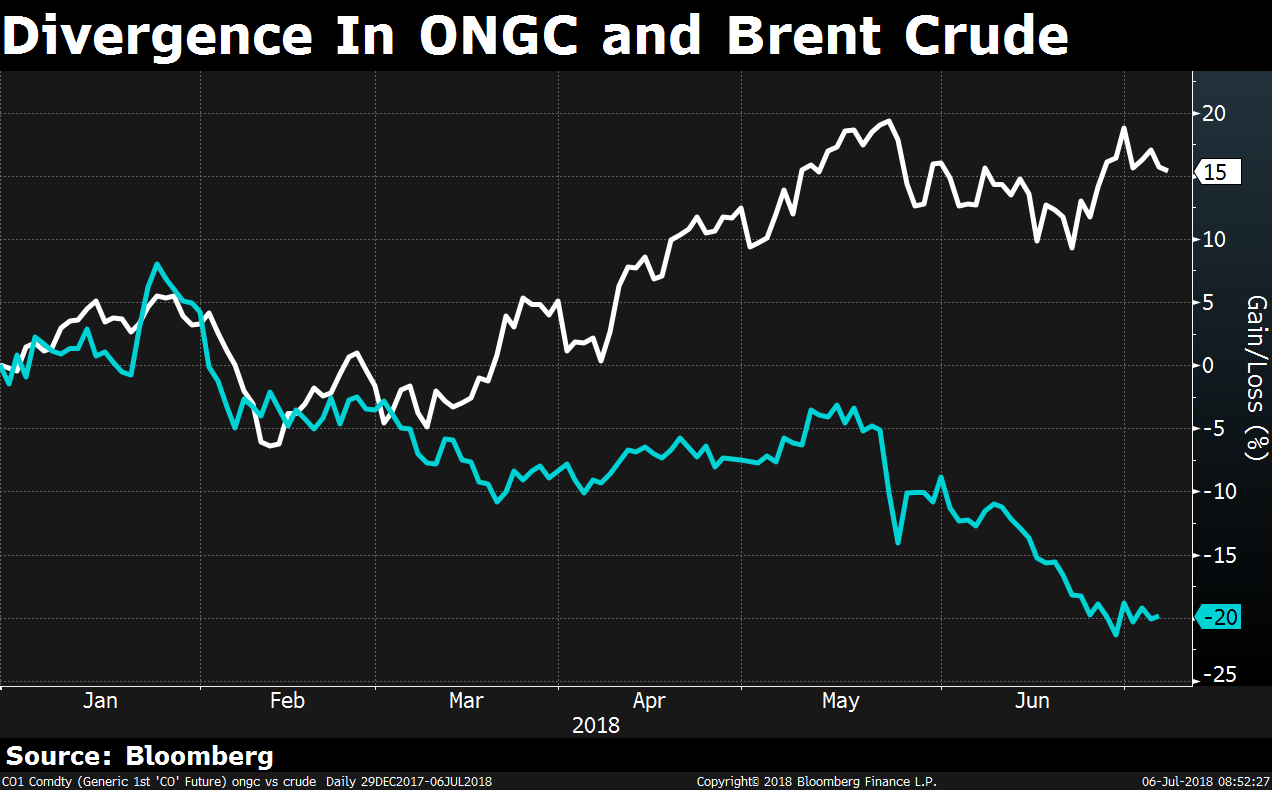
Oil and Natural Gas Corporation Ltd. should benefit from rising crude prices. But that doesn't reflect in its stock's performance as India's largest oil explorer has had the worst first half in a decade.
Shares of ONGC have declined 19 percent so far in 2018. That's when Brent Crude—the Asian benchmark for crude prices—rose 17 percent during the period.
And it's one of the most preferred stocks in the S&P BSE Oil & Gas Index, with nearly 31 of the 38 analysts tracked by Bloomberg rating it a ‘Buy'.
Here's a look at what went wrong for the stock:
Subsidy Sharing
The government's petroleum subsidy allocation for the current financial year may fall short as crude oil prices are expected to stay high. Crude is expected to be 31 percent more expensive in the current financial year over the previous year, according to data compiled by Bloomberg.
The government has allotted Rs 24,933 crore — Rs 20,377.8 crore for liquefied petroleum gas and Rs 4,555 crore for kerosene — towards subsidies in this financial year as compared with Rs 24,460 crore in the year ended March.
If the government falls short of budgeted estimates, ONGC can be asked to plug the gap. The oil and gas major used to share the subsidy burden with the government until the quarter ended September 2015. A shortfall in subsidy increases the earning risk for upstream companies if they were to share the burden, Morgan Stanley had said in a report. ONGC management had earlier said in an interview to BloombergQuint that they've not been asked to share the subsidy burden. The impact of subsidy could be limited, with the rising prices of subsidised fuels.
Weak Gas Prices
The rates of domestically produced gas are fixed and revised every six months under the government's new pricing regulations. After the government introduced the administered pricing mechanism in 2014, LPG prices have fallen by over 30 percent. Despite two recent price hikes, the prices are lesser than ONGC's average cost of production. The average cost of production of gas is close to $3.5 per million British Thermal Units as against a selling price of $3.06/mmBtu.
Cash Crunch
ONGC on average had surplus cash of over Rs 11,000 crore through the financial years 2010-17. In the year ended March 2018, it became indebted after it acquired the government's stake in Hindustan Petroleum Corporation Ltd., India's third largest oil and natural gas company, in a move intended to create an integrated oil company.
ONGC bought 51 percent stake in HPCL for Rs 36,915 crore, of which Rs 25,000 crore was paid through acquiring debt. It plans to spend close to Rs 32,000 crore as capital expenditure to boost oil and gas production in the country.
The company had plans to merge the downstream companies — HPCL and Mangalore Refinery and Petrochemicals Ltd. — after the acquisition. However, there has been no progress on the plan with the company still staying that it will evaluate potential restructuring of group companies.

-
'Never Seen This Level Of Negativity': Sandeep Tandon Says The Next Rally May Be Closer Than You Think

Veteran investor Sandeep Tandon says foreign selling is easing, large-caps are due a comeback and mid-caps are crowded, while he turns positive on gold, power and pharma this Diwali.
-
Indians Stay With Family, Not In Hotels | The Reason Why
India still lacks enough clean, reliable and affordable hotels for budget-conscious travellers.
-
The Economic Imperative: Analysing The Material Driving Force Behind India-Canada Strategic Reset
This economic complementarity is further reinforced by deep institutional investment ties and talent mobility, which form the bedrock of the bilateral framework.
-
Medicine Pricing: Where Must Profit Stop?
India must confront excessive margins, hidden incentives and regulatory gaps that threaten the integrity of medicine.
-
Why Amazon And Flipkart Are Struggling To Beat Meesho In India's Smaller Cities
With 274 million users and lowest-cost logistics, Meesho is defending its value commerce crown against giants like Amazon and Flipkart.
-
High US Salaries, No Green Card Certainty: The Financial Calculation Facing Indian H-1B Families
The suspension of PERM processing at eight technology employers does not cancel existing H-1B visas. What it does is force a question many Indian families have been avoiding: is the US salary worth tying your career and family plans to one employer?
-
Swiggy vs Eternal: Food Delivery's Two Rivals Are No Longer In The Same Race
Eternal is building a private AI assistant, dark.ai. Swiggy is still working out how to make Instamart pay, with an operating loss of Rs 895 crore in the July-September quarter while Blinkit stayed profitable.
-
Where You Live Shapes How You Get To Work | The Reason Why
Two-wheelers are the most popular way to get to work in India, accounting for nearly 43% of workplace commutes.
-
Unhedged Position: Can India See An Indonesia-Style Time Correction?
The Nifty is trading below levels it first clocked in 2024. Is there, then, as I have suggested in the headline, potential that the current time correction drags on painfully for the next three-five, even ten years?
-
Navigating Friction And Energy Realities: An Analysis Of Marco Rubio's October Visit To India
Occurring at a critical juncture marked by stalled trade negotiations and escalating geopolitical pressures over global energy supplies, the visit offers a profound window into modern US-India relations.










