Hero MotoCorp Vs Royal Enfield: The Better Bet Over The Next Five Years?
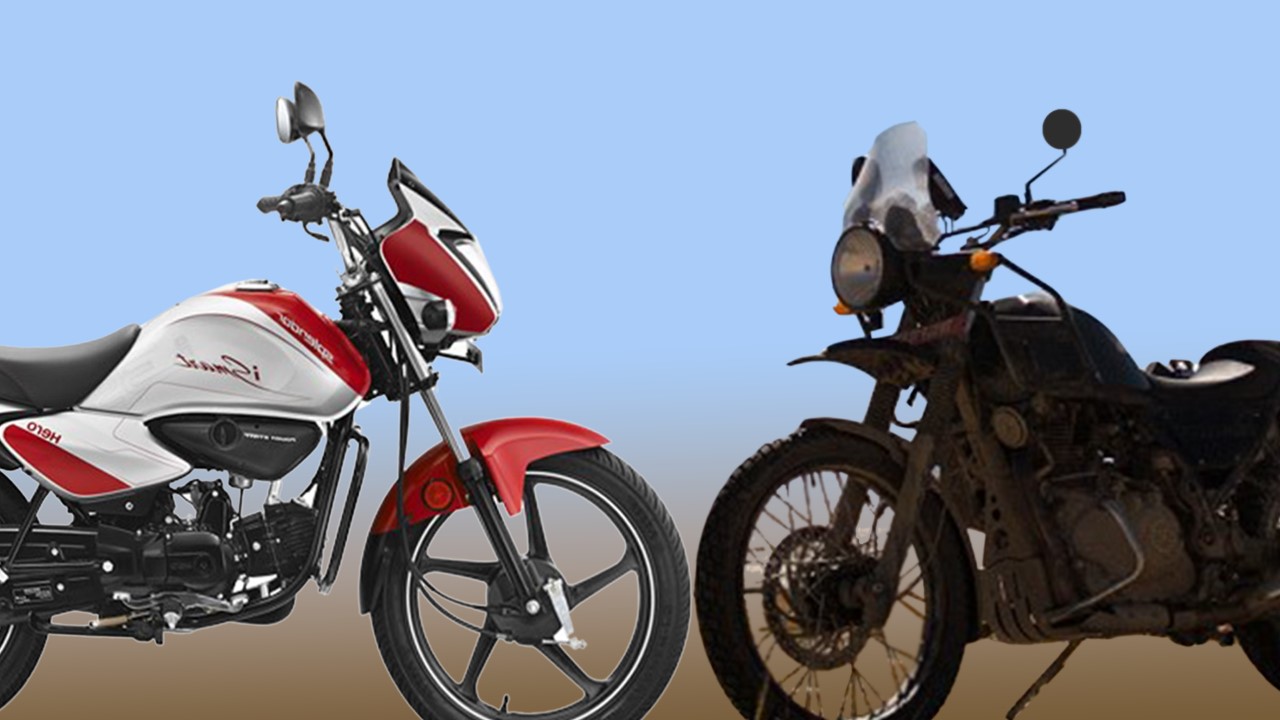
Is India's two-wheeler market maturing? A glance at Royal Enfield's sales volumes, waiting period, and operating margins would elicit an emphatic ‘yes'. The meteoric rise in the company's share price would only strengthen the argument.
On November 9, 2011, Eicher Motors Ltd., Royal Enfield's parent company, saw its shares close at Rs 1,715 as per data complied by Bloomberg. Exactly five years later, the counter closed at Rs 23,331 on November 9, 2016. In percentage terms the scrip's value has risen 1,260 percent.

November has not been a good month for the Eicher Motors' stock so far. The automaker's market capitalisation stood at Rs 63,370 crore by the end of trade on November 9, 2016. This figure was a tad lower than the country's largest two-wheeler manufacturer, Hero MotoCorp Ltd.'s market cap of Rs 64,616 crore on the same day. But the story was different on October 5, 2016 when Eicher Motors' market capitalisation touched Rs 71,422 crore, edging past Hero MotoCorp's Rs 69,692 crore figure. What's surprising is that this was not even the first time Eicher had trumped Hero MotoCorp. It had surpassed Hero MotoCorp a couple of times earlier in 2015, and in early 2016.
Why Is That Surprising?
To put things in perspective, Hero MotoCorp sold 34.82 lakh units in the April-September period, while Royal Enfield sold less than one-tenth of that at 3,07,150 units.
It doesn't end there. For all practical purposes, it is just the start.

Royal Enfield is present in the mid-range segment in terms of engine displacement, whereas Hero MotoCorp calls commuter segment motorcycles and scooters its bread and butter.
On an average, Royal Enfield products have a waiting period of 2-4 months, while Hero MotoCorp's average waiting period is between 1-2 weeks. The production capacities of the two manufacturers mirror their monthly sales numbers. Hero MotoCorp has an installed capacity to produce 76.5 lakh two-wheelers per year, while Royal Enfield has an annual manufacturing capacity of 6.20 lakh units. Going by this data, it seems like the demand for Royal Enfield motorcycles is proportionally higher.
In terms of operating margins, the difference is stark. While Hero MotoCorp had an earnings before interest, tax, depreciation, and amortisation (EBITDA) margin of 16.2 percent during the quarter-ended September, Eicher Motors reported an EBITDA margin of 30.9 percent.
Some of the credit would go to Royal Enfield's cult status in the country, but one could, at the same time, argue that Hero MotoCorp is the most preferred choice of the average Indian two-wheeler commuter, who outnumber Royal Enfield lovers.
The Ride Ahead
Thus far, both Hero MotoCorp and Royal Enfield have done well in their respective segments. In Hero MotoCorp's favour was its first-mover advantage in the commuter motorcycle segment and its gargantuan production capacity, while lack of competition and well-positioned products did the trick for Royal Enfield. But times are changing.

Hero MotoCorp today has its erstwhile partner Honda Motorcycle and Scooter India Pvt. Ltd. breathing down its neck. Sales in the month of October are proof enough. While Hero MotoCorp sold 6,63,153 units in the month gone by, Honda Motorcycle inched closer with sales of 4,92,367 units. The month of September was even closer, when Hero MotoCorp sold 6,54,581 units, and Honda Motorcycle's despatches were at 5,38,473 units.
Royal Enfield, on the other hand, faces competition from several manufacturers such as Bajaj Auto Ltd., which plans to launch products in the 400cc segment, and Mahindra & Mahindra Ltd. (M&M), which is looking to relaunch the once-iconic Jawa brand of motorcycles in India.
The lifestyle motorcycle brand also faces stiff competition from cruiser manufacturers such as Harley Davidson and Triumph, and with a rise in income levels, these high-end players have begun to make inroads into the Indian market. Though largely limited to urban areas so far, it is a cause for concern for Royal Enfield.
Another challenge for Royal Enfield is its limited production capacity. The company's plant on the outskirts of Tamil Nadu's capital, Chennai, can churn out only up to 60,000 units a month, but the demand is way higher. While Managing Director and Chief Executive Officer Siddhartha Lal had said recently that the company has plans to stick to the 60,000-unit output for a few months, the increasing waiting period for each of its products may begin to deter buyers.
In terms of future products, the company is working on a 750cc twin-cylinder motorcycle, and has been spotted testing it, which suggests that the commercial launch shouldn't be far away. Thus far, the product with the highest displacement was its flagship cafe racer Continental GT with a 535cc motor. A 750cc block would pit Royal Enfield right against Harley Davidson's Street 750 motorcycle, pushing it into unexplored territory. On the bright side, it would also mean higher margins.
Itall depends upon its (Royal Enfield's) performance in the future. It didn'thave competition so far, but competition is expected now, with Bajaj havingplans to launch motorcycles in that segment and also with M&M relaunchingthe Jawa brand. It is important to see how Royal Enfield focuses on its product and distribution strategy going ahead.AbdulMajeed, Partner - Assurance, Pricewaterhouse Coopers
Hero MotoCorp faces a different challenge, in the form of lack of in-house technology. The manufacturer still sources engine technology for some of its products from Honda Motorcycle and pays royalty to the Japanese auto major for the same, which is a drag on its bottomline. And though it has set up its own R&D plant and started launching two-wheelers with in-house technology, it's still a relatively small portion of its entire product range.
Also, unlike in the past, when one knew who his competition was, today automobile manufacturers are in the land of the unknown, where a Tesla pops up out of nowhere and throws the product strategy of a giant like Mercedes-Benz in complete and utter disarray. Technological advancements have no doubt gathered speed over the past few years, but the same seems to be peaking towards an unknown crescendo now; from self-drive vehicles to electric motors, and from flying drones to 1,000-bhp monsters being made out of modest 1.6-litre V6 motors, the possibilities in the world of transport multiply by the day.
It is here that both, Hero MotoCorp and Royal Enfield, are likely to face their biggest challenge. While both manufacturers have displayed concept designs based on some basic adaptations of the electricity-powered motors, a full-fledged product is not likely to see light of day in the near future.
Hero MotoCorp seems to be the better poised between the two companies when it comes to adapting to new technology, considering it recently acquired at least 26 percent stake in an Indian startup, Ather Energy, which manufactures electric scooters, and has a full fledged R&D facility at its centre in Jaipur, Rajasthan. Majeed agreed,
Both(Hero MotoCorp and Royal Enfield) have their strong points and areas they need to focus on. Hero has abroad basing of products, and has been making acquisitions in the R&Dspace, with Ather (Ather Energy) being the latest one.Abdul Majeed, Partner - Assurance, Pricewaterhouse Coopers
“Hero MotoCorp is likely to be the winner between the two over five years because of its adaptability. Royal Enfield has not shown strong signs to adapt and explore new spaces. So, Hero would be my pick,” said a researcher on the condition of anonymity, considering the nature of the call.
Royal Enfield's strategy so far could best be described by the name of one its products - classic. While the automaker has made some advancements in the technology space, its products still are nowhere close to the most modern in the market, and Siddhartha Lal has shown clear intent to not venture into that space. He has said time and again that Royal Enfield products would continue to exist in the mid-range in terms of affordability and engine displacement.
One area where Hero MotoCorp is likely to lose out to Royal Enfield is in the growing trend of ‘premiumisation'. A look at historic data shows how the Indian two-wheeler market has grown in terms of engine displacement preferred by commuters. From times when the 100cc segment used to have a relative monopoly, a clear trend of moving towards the 125cc and higher has now emerged.

RoyalEnfield will be better placed in future because of premiumisation takingplace in the Indian market. Royal Enfield has higher (engine) capacity, and itis more aspirational. Also, branding is very important. Hero (MotoCorp) is amass-market brand.NiteshSharma, Research Analyst, Phillip Capital India
Hero MotoCorp, since its split with Honda Motorcycle in 2010, hasn't launched any market-shaking products, and its sales still rely on established brands such as Splendor.
Thebiggest challenge for Hero MotoCorp is going to be attacking and gaining sharein the premium segment. Premiumisation is the theme; consumer preferences havegone up.Nitesh Sharma, Research Analyst, Phillip Capital India
The Jury Is Out
BloombergQuint spoke to an even number of analysts, exactly half of whom sided with the respective manufacturers as their pick over a five-year race, in terms of which stock would be a better investment. The reasons cited were similar, and so were the challenges.
The emerging theme was one where Hero MotoCorp must look to make breakthroughs in the space of R&D and look to gain presence in segments with higher engine displacement, while Royal Enfield needs to look behind its shoulder towards upcoming competition, and broaden its portfolio as a hedge.

-
AI Bias In Investing Cannot Be Eliminated, But It Can Be Governed

Framing is a particularly important example as identical financial information presented in terms of gains rather than losses can lead an LLM to reach a different assessment.
-
Joining The Dots | Dark Skies, Steady Diya: Why Hope Holds This Diwali
With war, a weak rupee and foreign outflows weighing on sentiment, policymakers at the NDTV World Summit and market veterans at NDTV Profit Ignite: Diwali Edition offered the same advice: stay invested and filter out the noise.
-
The Curious Case of Equitas Small Finance Bank And A CEO Who Quit For Stock
PN Vasudevan believes persistent investor concerns over a perceived conflict of interest had become a governance overhang on Equitas Small Finance Bank's stock, even as the lender improved profitability and asset quality.
-
Talking Points This Week: AI Cash Burn, A Tiger Comeback And An India That Still Finds Its Own Path
India is not immune to higher oil or tighter global liquidity, yet its earnings base is broader, its domestic policy levers are still available.
-
Foreign Investors Own Half Of HDFC Bank and ICICI Bank. An LTCG Cut Could Matter Most Here
Foreign portfolio investors have US$115 billion parked in HDFC Bank, ICICI Bank. If the government cuts long-term capital gains tax, Jefferies says returning foreign money could land here first.
-
'Never Seen This Level Of Negativity': Sandeep Tandon Says The Next Rally May Be Closer Than You Think
Veteran investor Sandeep Tandon says foreign selling is easing, large-caps are due a comeback and mid-caps are crowded, while he turns positive on gold, power and pharma this Diwali.
-
Indians Stay With Family, Not In Hotels | The Reason Why
India still lacks enough clean, reliable and affordable hotels for budget-conscious travellers.
-
The Economic Imperative: Analysing The Material Driving Force Behind India-Canada Strategic Reset
This economic complementarity is further reinforced by deep institutional investment ties and talent mobility, which form the bedrock of the bilateral framework.
-
Medicine Pricing: Where Must Profit Stop?
India must confront excessive margins, hidden incentives and regulatory gaps that threaten the integrity of medicine.
-
Why Amazon And Flipkart Are Struggling To Beat Meesho In India's Smaller Cities
With 274 million users and lowest-cost logistics, Meesho is defending its value commerce crown against giants like Amazon and Flipkart.










