Here's Why Maruti Is Not Participating In The EV Race
Over the weekend, I was reading a blog by my favourite author, Morgan Housel. I came across an interesting conversation which the author's friend had with Warren Buffett during the backdrop of 2008 global financial crisis.
The author's friend was driving around Omaha with Buffett in late 2009. The global economy was crippled at this point, and Omaha was no exception. Stores were closed and business shut down.
The authors friend asked Buffett, "It's so bad right now. How does the economy ever bounce back from this?"
Buffett replied with a question of his own, "Do you know what the best-selling candy bar was in 1962?"
"No", his friend replied.
"Snickers," said Buffett. "And do you know what the best-selling candy bar is today?", asked Buffett.
"No", his friend replied.
"Snickers," said Buffett.
And that was the end of conversation.
Here's the take away from this simple conversation.
Focusing on what's never going to change is more important than trying to anticipate how something might change.
While its important to understand and predict how technology is going to alter our lives, isn't it equally important to focus on things which will never be replaced?
When we talk about change, EV is at the top of the list.
I'm sure, you must have read countless articles written about why EVs are the next billion-dollar opportunity and the best EV stocks to buy in India.
So, this time, let me play the devils advocate and try to figure out why is India's largest car maker Maruti Suzuki not jumping the EV bandwagon.
Tata Motors is in the news almost every month with refreshes and new EV launches. On the other hand, Maruti is going the hybrid way with its new launch Maruti Suzuki Grand Vitarra.
Tata Motors is the undisputed market leader in the passenger EV space. Maruti doesn't have even a single EV product. Its first EV will be launched in 2024-25.
So, this is the billion dollar question...
Is Maruti Behind the Curve in the EV Race?
To answer this question, let's look at the numbers.
Apart from factors such as lack of charging infrastructure, I've analysed the cost dynamics of owning an EV in the table below.
It will take 16 years to recover the incremental cost of purchasing an EV.
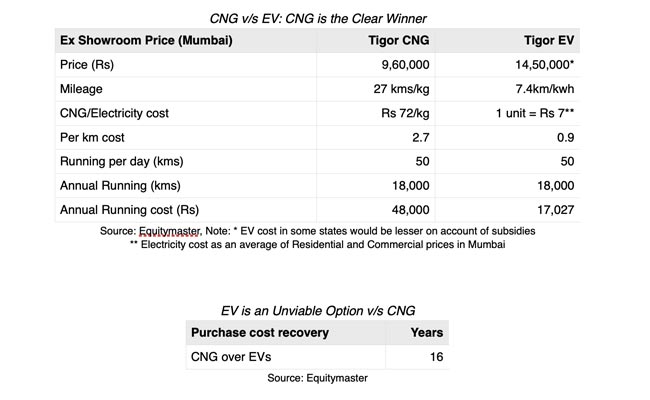
It looks like Maruti's focus on targeting the growth of CNG segment is right.
CNGs contribution to the total passenger car industry stood at 8.5% in FY22. But CNG cars contributed to 17% of the total domestic sales for Maruti in the same period.
After all, majority of CNG cars are small cars which account for 40-45% of total industry volumes. The important statistic here is that Maruti's market share in the small car segment is above 70%.
Isn't that a smart move to target the small car segment, where you are the market leader, in which the share in CNG fuel is increasing?
But there is a catch here...
The way the industry is shaping up, the share of small cars is going down and the share of SUVs are rising.
In the SUV segment, Maruti has launched hybrid technology which is battery plus petrol as opposed to its competitor Tata Nexon which is a pure EV.
The cost dynamics here are in favour of EVs.
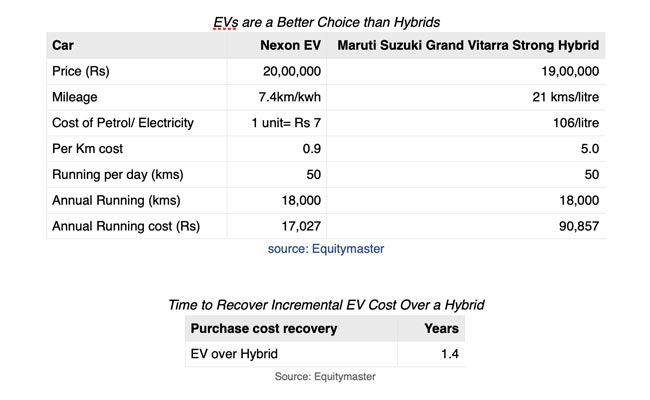
While it takes 1.4 years to recover incremental cost of electric vehicle, the cost savings on using an EV are huge post the initial cost recovery. EVs cost only 20% to run compared to a hybrid as can be seen in our calculation.
I've not included the battery replacement cost for an EV which in my view is Rs 0.5-0.6 m as of today. The reason is the replacement is going to happen after 5 years, and by then, the cost of battery would be drastically lower than what it is today.
Also, most vehicle owners replace their vehicles after 6-7 years.
So, to conclude...
CNG > EVs
EVs > Hybrid
Where does Maruti stand in the EV v/s CNG v/s Hybrid race?
Maruti is the leader in the hatchback segment which accounts for 45% of total car volumes. Thus the company's strategy in targeting CNG fuel and not electric vehicle makes sense. Market leadership along with favourable cost dynamics works for Maruti.
But...
If we exclude the battery replacement aspect, it makes more sense to buy EVs than hybrids.
However, this argument gets diluted when we talk about the lack of EV infrastructure. This is because often convenience precedes cost.
Also, Maruti's plan of using hybrids as a bridge between combustion engines and electric vehicles could work as the ecosystem takes time to evolve.
I guess not having a first mover advantage could work, as is evident in the two-wheeler sector.
What do you think dear reader? Is Maruti on the right track by taking the hybrid approach and going slow in EVs?
(Disclaimer: This article is for information purposes only. It is not a stock recommendation and should not be treated as such.)
This article is syndicated from Equitymaster.com

-
We May Need Another Tukaram Mundhe To Fight Air Pollution | The Reason Why

Developers may install basic measures such as sprinklers and green nets, resume work, and continue violating rules when this equipment stops working.
-
Extracting Value From Battery Scrap Could Be Challenging For India | The Reason Why
A discarded lithium-ion battery still contains valuable materials such as lithium, nickel and cobalt. These can be recovered and reused. When such batteries are crushed and shredded, they produce a dark powder called black mass.
-
One El Nino, India Can Handle. Two Could Break The Granary
India's grain stocks can absorb one bad year, but a second El Nino could drain the buffer in two to three years, economists say.
-
India's Troika Of Good Luck | Joining The Dots
As Jensen Huang's exit drags Nvidia down, a cooling AI trade and resilient earnings have revived investor interest in India. A likely RBI rate hike looms.
-
Talking Points This Week: Leadership Shock At Nvidia, Earnings Strength, And The Fog Over Hormuz
The Anthropic IPO pricing and first trading day, Nvidia's upcoming earnings, and any fresh signals from Iran will set the tone for the following week.
-
Signature Play: The Classic Cocktail Is Dead. Or Is It?
Classic cocktails are disappearing from India's cocktail menus. But they're still being ordered, taught to bartenders and borrowed from. So, who's really having the last drink?
-
A New Samvat Wishlist: Inclusive Prosperity And Human Development
India has strengthened its economic foundations through infrastructure, digital access and enterprise. Its next growth chapter must deepen productivity, create better livelihoods and widen participation in prosperity.
-
Love, Sex Aur Dhokha: The Audacious Plot To Spy On Jensen Huang
A Taipei dinner, a Singapore chip buyer and a suspected Chinese asset: inside the alleged spy operation that got close to NVIDIA's Jensen Huang.
-
Ten Things I Learnt This Samvat
Patience can be a trap. Cheap stocks can stay cheap. Leverage can wipe you out. What did Samvat 2082 teach us? Niraj Shah writes on 10 lessons from the year gone by.
-
Talking Points This Week: Tech Nerves, FII Buying, And A Faraway Banking Shock
The global markets are not shining this Diwali. The exception in the large markets is, India.