Hedge Funds ‘Throwing In Towel’ on Stocks as Rally Forces Unwind
(Bloomberg) -- For stock-picking hedge funds coping with 2023's loopy markets, risks are starting to outweigh the rewards.
Pro managers who make both bullish and bearish equity wagers last week slashed positions on both sides of their book, also known as de-grossing, according to data compiled by JPMorgan Chase & Co.'s prime brokerage unit. The rush to tweak positions was frantic enough to push total client stock flows to the highest level since the retail-fomented short squeeze in 2021.
Morgan Stanley's hedge fund clients showed a similar pattern of risk reduction, albeit at a slower pace. Their de-grossing activity for the week was the largest this year. At Goldman Sachs Group Inc., fund clients pared positions in 12 of the past 14 sessions.
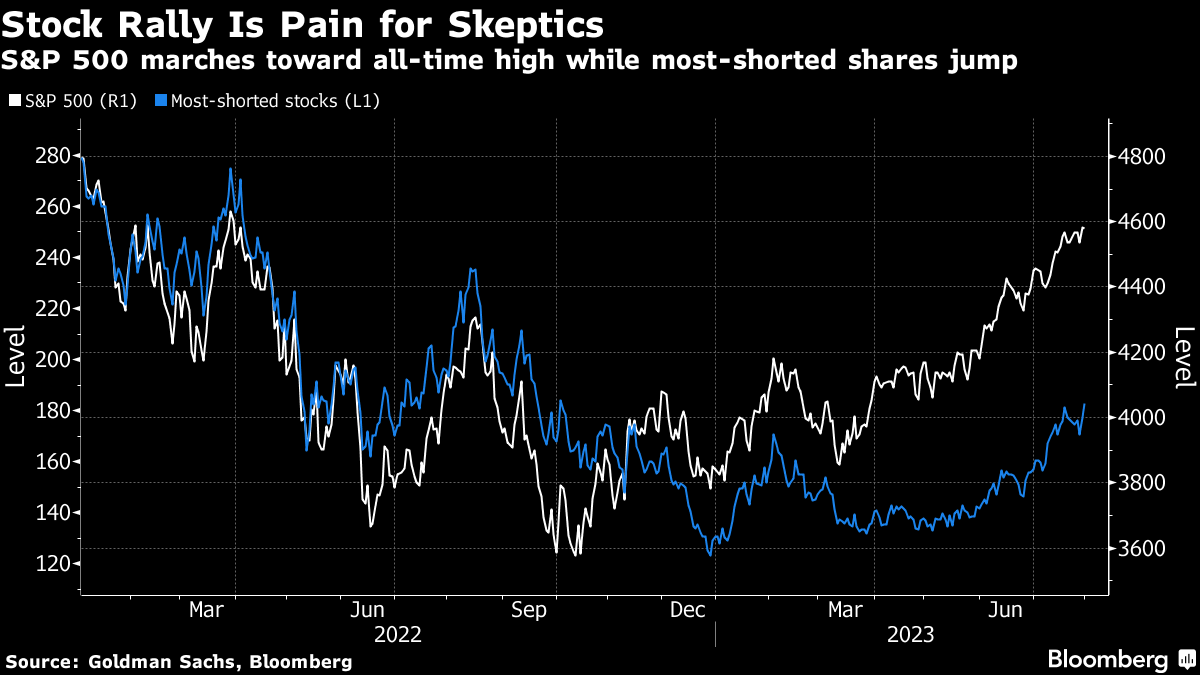
The retreat may mark a sentiment shift in a market where almost everyone started 2023 defensively before being forced to adjust to the gravity-defying advance. Up in all but two months since October, the S&P 500 has climbed 28% over the stretch, sitting roughly 200 points away from fully erasing 2022's bear market.
“While the equity rally might be good for those who are long the market, it's been quite challenging for HF shorts and the rally seems to be inducing broad capitulation in the form of de-grossing,” JPMorgan's team including John Schlegel wrote in a note titled
It's the latest dose of pain that 2023's rally has inflicted. Rather than sinking like most forecasters predicted, stocks have instead surged as the economy stood up to the Federal Reserve's aggressive inflation-fighting campaign. Along the way, fast-money managers were compelled to cover shorts and chase gains, while strategists scrambled to raise their year-end price targets for the S&P 500.
With all the negativity in December setting the stage for a rousing advance, the question on everyone's mind now is whether the sentiment pendulum has swung to the other extreme. Investor positioning has been a better predictor of market direction for most of the year amid economic and policy uncertainty.
One group of early bulls may run out of ammunition, according to Morgan Stanley's sales and trading team including Christopher Metli. Rules-based funds that make asset allocations based on volatility or trend signals have rushed to snap up stocks, with their net leverage now standing higher than 80% of the time in the past five years, their estimates show.
With exposure elevated, Metli and his colleagues see the risk of systemic macro managers turning into big sellers if turmoil erupts. While they expect the group to produce flat global equity flows in coming days on a net basis, a 5% daily drop in the S&P 500 could lead to $180 billion of share disposal in the following week.
Elsewhere, a sense of caution lingers. Hedge funds saw their net equity exposure slip to 47% from 49% last week as they continued to take profits in recent winners such as software shares, according to client data from Morgan Stanley.
Eric Boucher, co-head of sales at Renaissance Macro Research LLC, detected similar sentiment.
“I've been to a lot of summer lunches and my takeaway is folks still have not positioned for a bull market,” he said. “They're still concerned about the macro picture,” such as a potential wave of bond defaults should the economy lose its momentum, he added.
That said, this market levitation has lured many to join the party. Retail investors are back with their affection for meme stocks. Options traders are flocking to bullish contracts to play the upside. In a poll by the National Association of Active Investment Managers (NAAIM), equity exposure just increased to the highest since November 2021.
For hedge funds betting against stocks, the blow is getting harder to endure. Long-short funds have experienced nine consecutive days of negative alpha, or below-market returns, the longest period of subpar performance since January 2017, according Goldman data. Scott Rubner, a managing director at the firm who has studied flow of funds for two decades, attributes it to wrong-footed wagers on the short side as well as a deterioration in performance on the long side.
Given the weak market seasonality in August and an upward bias in 10-year bond yields, Rubner is telling clients to either reload on shorts or put on downside hedges.
“I am so bullish, that I am actually bearish now for August. I am looking for a small-ish equity market correction in August,” he wrote in a note. “My core behavioral view is that I no longer speak to any ‘macro' bears. Positioning and sentiment is no longer Pessimistic, it is Euphoric.”
More stories like this are available on bloomberg.com
©2023 Bloomberg L.P.

-
Signature Play: The Classic Cocktail Is Dead. Or Is It?

Classic cocktails are disappearing from India's cocktail menus. But they're still being ordered, taught to bartenders and borrowed from. So, who's really having the last drink?
-
A New Samvat Wishlist: Inclusive Prosperity And Human Development
India has strengthened its economic foundations through infrastructure, digital access and enterprise. Its next growth chapter must deepen productivity, create better livelihoods and widen participation in prosperity.
-
Love, Sex Aur Dhokha: The Audacious Plot To Spy On Jensen Huang
A Taipei dinner, a Singapore chip buyer and a suspected Chinese asset: inside the alleged spy operation that got close to NVIDIA's Jensen Huang.
-
Ten Things I Learnt This Samvat
Patience can be a trap. Cheap stocks can stay cheap. Leverage can wipe you out. What did Samvat 2082 teach us? Niraj Shah writes on 10 lessons from the year gone by.
-
Talking Points This Week: Tech Nerves, FII Buying, And A Faraway Banking Shock
The global markets are not shining this Diwali. The exception in the large markets is, India.
-
Midterm Rally Lasted A Day. The Hard Reality Of A Divided US May Last Two Years | Opinion
Between a contested AI boom, a debt ceiling that arrives in 2027 and a president with every incentive to act alone, the next two years may prove more volatile than the first day's rally suggests.
-
Blue Wave Will Derail the AI Trade but Won't Dismantle the AI Era | Unhedged Position
The Democrats' sweep of the US Congress will see politics collide with economic forces both over the long and short term.
-
It's Time To Take The GST Council's Bet On Trust Global
Payment records can prove India's services exports, and clear, proportionate rules can bring foreign digital sellers into the tax net.
-
Opinion | India at 38: From Innovation Overperformer to Innovation Powerhouse
India now has 453 VC-backed deep science startups, 18 of them late-stage, after 117 percent growth since 2020. Laurus Labs, at USD 9.3 billion, is the most valuable deep science company in any middle-income economy outside China.









