HDFC's Interest Margin To Be Under Pressure For A Quarter: Deepak Parekh
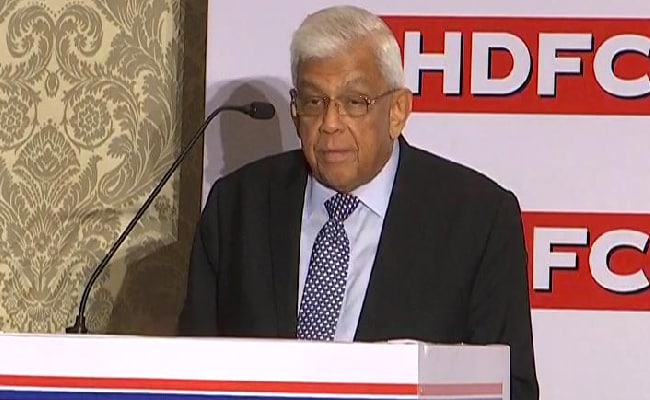
HDFC Chairman Deepak Parekh on Thursday said the largest pure-play home financier may face a compression of its Net Interest Margin (NIM) in the short term as it is unable to immediately pass on the impact of RBI's rate hike to borrowers.
Parekh, however, exuded confidence that the spreads and margins which the corporation makes on loans sold by it will stabilise over the medium to long term.
It can be noted that the RBI has hiked interest rates by a cumulative 0.90 per cent in two successive actions since May with an eye to tame the rising inflation, as it tries to rollback the accommodative measures taken during the pandemic.
Parekh said the impact on the NIM, which stood at 3.5 per cent for the March quarter and 3.7 per cent for June 2021 quarter, will be for a "quarter or so".
"The manner in which interest rates have moved resulted in some transmission lag and this may have a short term impact on margins, largely in comparison with the corresponding quarter of the previous year," Parekh said addressing HDFC's shareholders at its Annual General Meeting (AGM) conducted virtually.
"When the RBI increases the interest rates, our cost of borrowing goes up immediately, but there is a few months' lag before we can increase the interest rates," he said.
Replying to shareholders' queries, he said HDFC had explored the possibility of listing its insurance subsidiary HDFC Ergo, but it's German partner feels it is not the right time, so there are no plans to go for the IPO anytime soon.
Parekh said a slew of factors augur well for India's growth at present, but the mood is "sombre" because of the volatility in the equity markets.
The risk-averse foreign portfolio investors are selling aggressively to cover for losses they are booking in other emerging markets, which has led to the difficulties, he said.
Fortunately for the country, the increased interest from domestic institutional investors and retail investors has helped support the equity markets, Parekh, a veteran of the financial services space, said.
The positives which augur well for the economy, which is projected to grow at over 7 per cent, are government's commitment to higher capital expenditure, food security and capacity utilisation touching 75 per cent which portends the beginning of a new private capex cycle, he said.
Parekh said unusual measures were taken because of the unusual times that we passed through, and the same are currently being withdrawn in a calibrated manner, and seemed to welcome the RBI and government acting in tandem.
Indian inflation, which has been consistently breaching the RBI targets, is not because of excess demand but is attributable to the supply side issues emanating from surge in oil prices due to the geopolitical tensions, Parekh said, exuding confidence that price rise will trend downwards once the current problems ease.
In such a context, there is an immense demand for housing in the country which will also translate into demand for home loans, Parekh said, pointing out that in March this year, HDFC witnessed the highest demand for a single month in its history.
Parekh said a separate meeting will be arranged for shareholders' approval for merging the corporation with HDFC Bank, and requested shareholders to show patience at Thursday's AGM, and address questions regarding the merger at the special meeting to be held subsequently.
The merger, which was announced in early April, requires a series of approvals from financial sector regulators, including RBI and IRDAI, he said.
The company's management has been advised by the lawyers not to speak about the merger at the AGM. With the merger ratio being already decided, there is no way that requests like a bonus or rights issue of HDFC shares can be considered, Parekh said.
He further said that applications have been made to Competition Commission of India, Reserve Bank of India and Sebi for the merger, and it will take up to 15 months for it to be completed.
All the HDFC employees will be absorbed by the bank as there is hardly much of duplication between the two entities, Parekh said, adding that the bank will also take over the liabilities like the over Rs 1,800 crore of masala bonds, deposits etc and pay as per decided terms.
Terming the merger as a positive step in the best interest of both the institutions, Parekh said a request has also been made to the RBI to make HDFC's current subsidiaries a part of HDFC Bank as subsidiaries.
(Except for the headline, this story has not been edited by NDTV staff and is published from a syndicated feed.)

-
Why Swapping Your Old Gold Can Trigger A Rs 5 Lakh Tax Bill, And How You Can Avoid It Legally

Swapping old gold for new is taxed as a sale and a fresh purchase. Getting your own gold remade can cut most of that bill, though it has its own costs.
-
The AI Trade is Done. The Real Opportunity for Investors Starts in 2027 | Unhedged Position
As pureplay AI stocks plunge and circular, capex-led financing unwinds, 2027 is set to be a year of reckoning for AI companies. Yet the bust clears the way for a better opportunity for investors in 2027 -- shifting the spotlight from AI builders to the companies using AI.
-
Leadership As Mission: Why The Age Of AI Demands More Human Leadership
Debjani Ghosh examines how AI is changing leadership, arguing that its success must be measured by its impact on people and the accountability of those guiding its use.
-
We May Need Another Tukaram Mundhe To Fight Air Pollution | The Reason Why
Developers may install basic measures such as sprinklers and green nets, resume work, and continue violating rules when this equipment stops working.
-
Extracting Value From Battery Scrap Could Be Challenging For India | The Reason Why
A discarded lithium-ion battery still contains valuable materials such as lithium, nickel and cobalt. These can be recovered and reused. When such batteries are crushed and shredded, they produce a dark powder called black mass.
-
One El Nino, India Can Handle. Two Could Break The Granary
India's grain stocks can absorb one bad year, but a second El Nino could drain the buffer in two to three years, economists say.
-
India's Troika Of Good Luck | Joining The Dots
As Jensen Huang's exit drags Nvidia down, a cooling AI trade and resilient earnings have revived investor interest in India. A likely RBI rate hike looms.
-
Talking Points This Week: Leadership Shock At Nvidia, Earnings Strength, And The Fog Over Hormuz
The Anthropic IPO pricing and first trading day, Nvidia's upcoming earnings, and any fresh signals from Iran will set the tone for the following week.
-
Signature Play: The Classic Cocktail Is Dead. Or Is It?
Classic cocktails are disappearing from India's cocktail menus. But they're still being ordered, taught to bartenders and borrowed from. So, who's really having the last drink?
-
A New Samvat Wishlist: Inclusive Prosperity And Human Development
India has strengthened its economic foundations through infrastructure, digital access and enterprise. Its next growth chapter must deepen productivity, create better livelihoods and widen participation in prosperity.









