The Return Of Protests
Are you asking what will happen if we do not rise?
With these words, the audio message was off to a good start. It asked us to show up at a traffic island at the base of a railway over-bridge that stoically bears its noisy, gridlocked burden. The island, hurriedly constructed a few months ago with knee-high concrete dividers and courtesy a new traffic policeman, changed the way cars flowed into our quiet East Bangalore locality.

It was the perfect spot to grab the attention of motorists getting off the bridge; it enclosed a safe space in the middle of an intersection, large enough for a modest-sized protest. The protestors even gave it a name worthy of its new purpose: Aman Dweepa or Island of Peace.
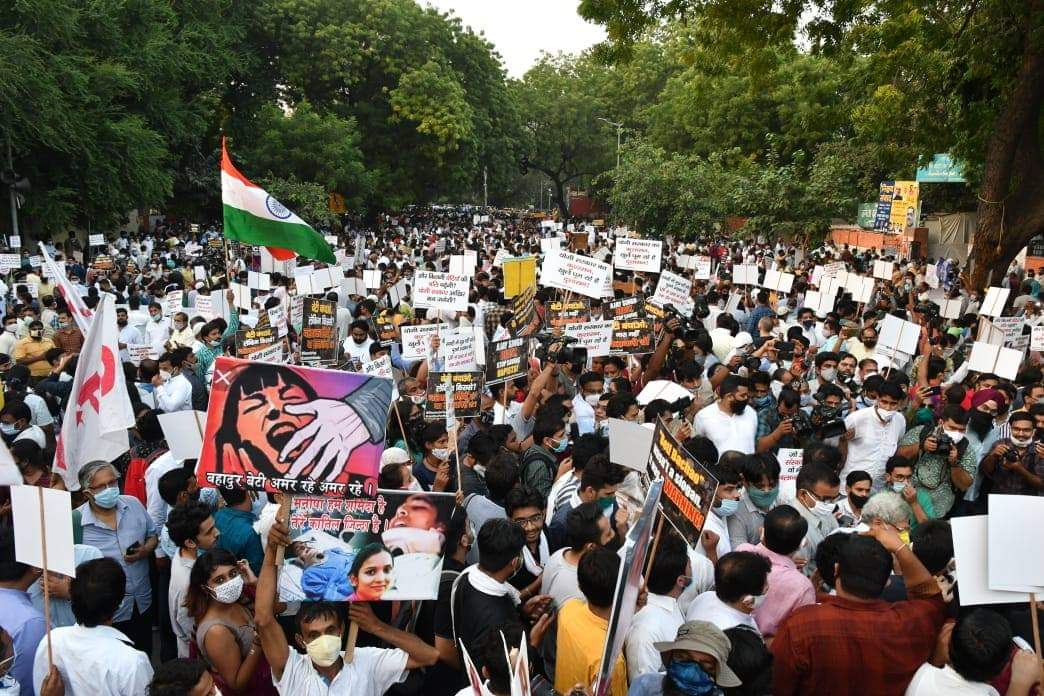
Women have decided to go there from 9 pm to 10 pm daily to demand justice for the horrific caste crime in Hathras, Uttar Pradesh. Most commuters who stopped to ask why the women were there hadn't heard of Hathras. Give it some time. After all, before December 2019, how many of us were familiar with the Delhi pin code 110020? Now everyone knows Shaheen Bagh.
Urban India's relationship with dissent altered last year when many raised their voices against the Citizenship Amendment Act 2019, relinquishing their protest virginity.

Now, even as the Delhi Police work overtime to pin the blame of the February riots on students and activists who protested against the CAA in the months before the pandemic, the people are gathering again. This time they are led by Dalit women and farmers – the latter protesting three bills that deregulate agriculture and give big business a hefty advantage.
Of course, the establishment-as-underdog theme is playing out simultaneously. The upper caste Savarna Jago protest held outside Hathras has eerie echoes of the MAGA protests in the United States in support of President Donald Trump. UP Chief Minister Yogi Adityanath has cited “conspiracies” against his government and blamed “anarchists” for promoting communal violence.
In the post-truth age, it's okay for anyone to play victim except the truly oppressed.
Our protests are just following the mood of a world in which demonstrations continue despite the pandemic. Carnegie Endowment for International Peace noted in June that after a brief pause and, “despite the seemingly unfavorable conditions for protests, mass demonstrations have begun to return at a notable rate and scale…”

The organisation's global protest tracker records about a 100 “significant anti-government” protests since 2017. India is one of 18 countries where protests are currently active. In June, the New York Times said the #BlackLivesMatter protests are “the largest movement in the country's history”. Will the world's most populous democracy be inspired to #SmashBrahminicalPatriarchy? Listen at 34 mins to why Thenmozhi Soundararajan, executive director of Equity Labs, says she doesn't use #DalitLivesMatter and why she thinks justice is more likely in the U.S. than in India.
“Protest has been an important way to express both dissent and solidarity with the marginalised,” says student leader Damini Kain. “Unfortunately, the space of debate, dissent, and discussion is being attacked by the ruling regime through draconian laws such as the anti-terror law Unlawful Activities Prevention Act, sedition, or through extensive and brutal police force.” Kain, 22, who stood for the Delhi University Student Union last year, says since the pandemic shut down colleges, it's become tougher to attend protests. “I used to attend all protests by saying I'm going to college. Never clearly told [parents] about the politics and activism I'm engaged in.”
Kain believes that in an ailing democracy, “it becomes the responsibility of every vigilant citizen of the country to raise their voice against injustice.”
Our neighbourhood protest was one of many across the country, held two days after thousands converged at Jantar Mantar, New Delhi on Oct. 2, to demand the resignation of Adityanath. The crowd swelled steadily despite the pandemic and a late change in venue after the state prohibited dissenters from meeting at India Gate.

A poster displayed at the protest—of a policeman handing a burning pyre on a plate to Adityanath sitting at the table—referenced the hurried early morning cremation of the 19-year-old Dalit gang-rape victim by the administration without the consent or presence of her family.
Its 32-year-old creator, a freelance illustrator who goes by the name Smish Designs on Instagram, says she was overwhelmed by the way people—especially women protestors—responded. “They got out their lipsticks and wrote shame all over the artwork,” she says. “Their rage was channelised through this interaction and I think here, the art became a medium of expression for them. It was really powerful.”
View this post on InstagramIndian Instagram lit up with revolutionary art during the CAA protests. Digital artists and students who gave public spaces politically-charged art makeovers were the creative spine of the movement.
Actor Swara Bhasker who attended the Oct. 2 protest in Delhi says it was heartening to see disparate groups and opposition political parties come together that day. “There really is a lot of anger in the people, people don't know where to channelise it and I think that's why these protests are important and that's why these united, collective calls are important,” she says. “This is the time for making allies across the spectrum. It means you put your differences aside at that moment and ally on the issue.”
Priya Ramani is a Bengaluru-based journalist and is on the editorial board of Article-14.com.
The views expressed here are those of the author and do not necessarily represent the views of BloombergQuint or its editorial team.

-
'Never Seen This Level Of Negativity': Sandeep Tandon Says The Next Rally May Be Closer Than You Think

Veteran investor Sandeep Tandon says foreign selling is easing, large-caps are due a comeback and mid-caps are crowded, while he turns positive on gold, power and pharma this Diwali.
-
Indians Stay With Family, Not In Hotels | The Reason Why
India still lacks enough clean, reliable and affordable hotels for budget-conscious travellers.
-
The Economic Imperative: Analysing The Material Driving Force Behind India-Canada Strategic Reset
This economic complementarity is further reinforced by deep institutional investment ties and talent mobility, which form the bedrock of the bilateral framework.
-
Medicine Pricing: Where Must Profit Stop?
India must confront excessive margins, hidden incentives and regulatory gaps that threaten the integrity of medicine.
-
Why Amazon And Flipkart Are Struggling To Beat Meesho In India's Smaller Cities
With 274 million users and lowest-cost logistics, Meesho is defending its value commerce crown against giants like Amazon and Flipkart.
-
High US Salaries, No Green Card Certainty: The Financial Calculation Facing Indian H-1B Families
The suspension of PERM processing at eight technology employers does not cancel existing H-1B visas. What it does is force a question many Indian families have been avoiding: is the US salary worth tying your career and family plans to one employer?
-
Swiggy vs Eternal: Food Delivery's Two Rivals Are No Longer In The Same Race
Eternal is building a private AI assistant, dark.ai. Swiggy is still working out how to make Instamart pay, with an operating loss of Rs 895 crore in the July-September quarter while Blinkit stayed profitable.
-
Where You Live Shapes How You Get To Work | The Reason Why
Two-wheelers are the most popular way to get to work in India, accounting for nearly 43% of workplace commutes.
-
Unhedged Position: Can India See An Indonesia-Style Time Correction?
The Nifty is trading below levels it first clocked in 2024. Is there, then, as I have suggested in the headline, potential that the current time correction drags on painfully for the next three-five, even ten years?
-
Navigating Friction And Energy Realities: An Analysis Of Marco Rubio's October Visit To India
Occurring at a critical juncture marked by stalled trade negotiations and escalating geopolitical pressures over global energy supplies, the visit offers a profound window into modern US-India relations.










