Hard To Do Business In India, But Will Remain Here: AirAsia CEO
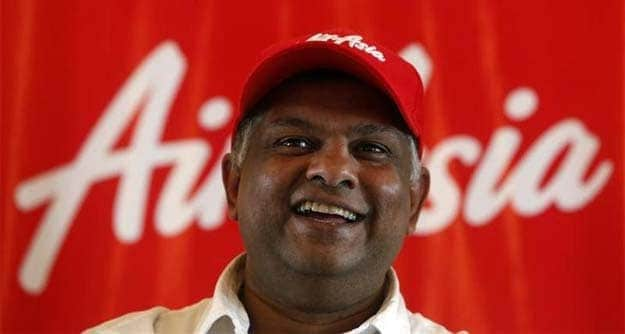
New Delhi: AirAsia group chief Tony Fernandes has said it was hard to do business in India due to protectionist policies and "vested interests", but his joint venture carrier AirAsia India was here for a long haul.
Defending the slow-paced growth of AirAsia India, he said the aviation sector here was a "double marathon" and not a "sprint".
"I am not going to storm in like a bull in China shop like Vijay Mallya did and get caught. Now we have a (civil aviation) policy and the policy is very clear on what we have to do. So talk to us in a few years' time," he told PTI when asked about the growth plans for his airlines.
Observing that the BJP-led government has "at least delivered 80 per cent of what it talked about" in the draft aviation policy, the AirAsia chief said "it is hard (to do business) in India (as) there are so many vested interest who were trying to keep some of the incumbents happy".
"So at least they changed it (norm for international flying by domestic carriers) and we are clear what we need to do. And I would not be dead by the time 5 years come along with 20 aircraft we had before," the AirAsia (Berhad) Group chief executive officer told PTI on the sidelines of the Farnborough International Airshow in the UK last week.
Mr Fernandes, who is also among the pioneers of the low-cost airline model in Asia, minced no words in criticising the Indian government for "protectionism in the skies" while at the same time heaping praise on the new civil aviation policy, particularly the doing away of the '5/20' norm.
"Don't protect airlines. Get more air traffic rights, get more tourism into India and create more jobs. I think the Modi Government has to be brave in going all the way and getting rid of vested interests and protectionism," he said.
To questions on AirAsia India's slow progress as compared to its peer group, he said earlier there was no clarity on what the policy was going to be. "This is not a sprint this a marathon. India is a double marathon. So I think we have been smart, we are cautious, we built it slowly," Mr Fernandes said.
"Look at how quickly we grew. I started with two planes in Malaysia. But I did not have a 5/20 rule. I was not sued every day. I did not have Naresh Goyal on my back. How long I have been in India? Two years. How long has the government of India been around? You have been a country of a long time, right? Wait, patience. Must not rush," Mr Fernandes said.
He said he needed to know what the government's aviation policy was going to be before expanding AirAsia India's fleet and network.
AirAsia India, which started operations in June 2014, is co-owned by Tata Sons (49 per cent) and AirAsia Berhad (49 per cent). The rest of two per cent is held by airline's board members S Ramadorai and R Venkataramanan. The airline flies to 10 domestic destinations with a fleet of six Airbus A320 aircraft.
"I have to congratulate (the government). ... It (doing away with 5/20 rule) is a good step forward for Indian aviation and hopefully most of the measures (proposed in the policy) will be going to be enforced," Mr Fernandes said.
The new aviation policy, announced last month, did away with the 5/20 rule which allowed global operations by an Indian carrier having 20 aircraft and five years of domestic operations. The policy now allows overseas operations by any Indian airline with 20 aircraft which keeps aside 20 per cent of its fleet exclusively for domestic operations.
The proposed regional connectivity scheme was also a good step just like the government's decision to come up with regional airports which would bring down airport charges, which at present along with taxes on jet fuel are "too high," he said.
Terming the policy as "quite impressive," the AirAsia group chief said India also needed to open up in terms of international traffic rights.
Mr Fernandes also said he wanted to expand Malaysian carrier AirAsia's operations in India.
"We (AirAsia) would love to go to many more Indian cities but Indian government is not giving us any more route rights at the moment. So, I think that is something the government has to look at."
"They (government) are very worried about Middle East and all it, they are trying to protect Air India, and I think that comes at a cost, at the cost tourism and jobs. So we will wait and see whether India (government) give us more rights. Right now, we have fully exploited

-
AI Bias In Investing Cannot Be Eliminated, But It Can Be Governed

Framing is a particularly important example as identical financial information presented in terms of gains rather than losses can lead an LLM to reach a different assessment.
-
Joining The Dots | Dark Skies, Steady Diya: Why Hope Holds This Diwali
With war, a weak rupee and foreign outflows weighing on sentiment, policymakers at the NDTV World Summit and market veterans at NDTV Profit Ignite: Diwali Edition offered the same advice: stay invested and filter out the noise.
-
The Curious Case of Equitas Small Finance Bank And A CEO Who Quit For Stock
PN Vasudevan believes persistent investor concerns over a perceived conflict of interest had become a governance overhang on Equitas Small Finance Bank's stock, even as the lender improved profitability and asset quality.
-
Talking Points This Week: AI Cash Burn, A Tiger Comeback And An India That Still Finds Its Own Path
India is not immune to higher oil or tighter global liquidity, yet its earnings base is broader, its domestic policy levers are still available.
-
Foreign Investors Own Half Of HDFC Bank and ICICI Bank. An LTCG Cut Could Matter Most Here
Foreign portfolio investors have US$115 billion parked in HDFC Bank, ICICI Bank. If the government cuts long-term capital gains tax, Jefferies says returning foreign money could land here first.
-
'Never Seen This Level Of Negativity': Sandeep Tandon Says The Next Rally May Be Closer Than You Think
Veteran investor Sandeep Tandon says foreign selling is easing, large-caps are due a comeback and mid-caps are crowded, while he turns positive on gold, power and pharma this Diwali.
-
Indians Stay With Family, Not In Hotels | The Reason Why
India still lacks enough clean, reliable and affordable hotels for budget-conscious travellers.
-
The Economic Imperative: Analysing The Material Driving Force Behind India-Canada Strategic Reset
This economic complementarity is further reinforced by deep institutional investment ties and talent mobility, which form the bedrock of the bilateral framework.
-
Medicine Pricing: Where Must Profit Stop?
India must confront excessive margins, hidden incentives and regulatory gaps that threaten the integrity of medicine.
-
Why Amazon And Flipkart Are Struggling To Beat Meesho In India's Smaller Cities
With 274 million users and lowest-cost logistics, Meesho is defending its value commerce crown against giants like Amazon and Flipkart.










