GST Jurisdiction A Difficult Issue, Hopeful Of April Rollout: Arun Jaitley
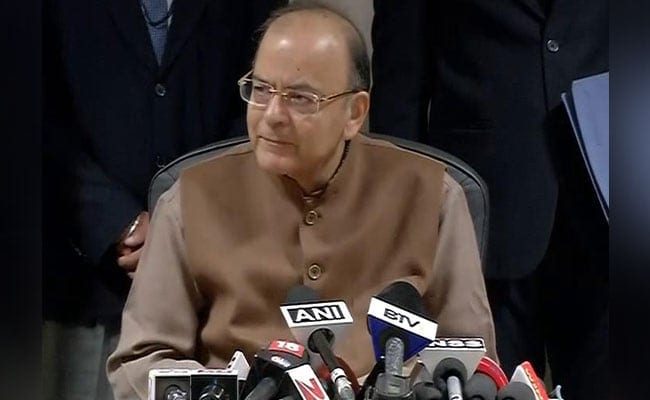
New Delhi: Pinning hopes on quick resolution of the "difficult issue" of tax jurisdiction with states, Finance Minister Arun Jaitley on Wednesday said that Goods and Services Tax regime will be rolled out from April next year.
Jaitley said the implementation of GST is bounded by a calendar deadline as the Constitutional Amendment provides that the existing indirect tax regime can continue only till September 16, 2017.
"It (GST jurisdiction) is a difficult issue. But I have always believed that in politics, logjams exist only to be resolved and in this case we have a calendar deadline. We are hoping that all will be resolved and we should be able to implement it by April 1," he said at the Petrotech conference here.
Jaitley said that the Centre and states are working out the mode of tax administration under which a tax payer would be assessed only once and that assessment has to be accepted by both the taxing authorities.
The all powerful GST Council in their three successive meetings failed to break the deadlock over administrative control on assessees in the new tax regime.
"The Constitution Amendment passed earlier this year says that the old taxation system can only be continued for a year. And that is one year from September 16, 2016. So from September 16, 2017, with regard to the old taxation system, the curtains will be down and the constitutional necessity of switching over to a new system does arise," Jaitley said.
"This issue of empowerment, which is essentially an administrative issue, is not a very impossible issue to resolve. I am quite certain would get resolved in near future," he said.
As per the GST Constitution Amendment Bill, which was notified on September 17, 2016, the government is required to complete the process of implementation of GST within a year.
Jaitley said most of the issues as far as GST is concerned has been sorted out and the final drafts of legislations are being discussed.
The GST Council, which has Union Finance Minister and state representatives as members, met last weekend to discuss the tax jurisdiction, the model GST law, Integrated GST (IGST) law and compensation law. But consensus eluded the meet.
The Council will meet again on December 11 and 12 to work out a middle path.
The finalisation of these laws will pave the way for introduction of GST legislations in the ongoing Winter Session of Parliament, which ends on December 16.
In November, the Council agreed on a four-slab structure - 5, 12, 18 and 28 per cent - along with a cess on luxury and 'sin' goods such as tobacco.
States like West Bengal, Kerala, Uttarakhand, Uttar Pradesh and Tamil Nadu have insisted on exclusive control over small taxpayers, who earn less than Rs 1.5 crore in annual revenue, for both goods and services. But Centre is reluctant to divide the assessment on the basis of turnover.
(This story has not been edited by NDTV staff and is auto-generated from a syndicated feed.)

-
Signature Play: The Classic Cocktail Is Dead. Or Is It?

Classic cocktails are disappearing from India's cocktail menus. But they're still being ordered, taught to bartenders and borrowed from. So, who's really having the last drink?
-
A New Samvat Wishlist: Inclusive Prosperity And Human Development
India has strengthened its economic foundations through infrastructure, digital access and enterprise. Its next growth chapter must deepen productivity, create better livelihoods and widen participation in prosperity.
-
Love, Sex Aur Dhokha: The Audacious Plot To Spy On Jensen Huang
A Taipei dinner, a Singapore chip buyer and a suspected Chinese asset: inside the alleged spy operation that got close to NVIDIA's Jensen Huang.
-
Ten Things I Learnt This Samvat
Patience can be a trap. Cheap stocks can stay cheap. Leverage can wipe you out. What did Samvat 2082 teach us? Niraj Shah writes on 10 lessons from the year gone by.
-
Talking Points This Week: Tech Nerves, FII Buying, And A Faraway Banking Shock
The global markets are not shining this Diwali. The exception in the large markets is, India.
-
Midterm Rally Lasted A Day. The Hard Reality Of A Divided US May Last Two Years | Opinion
Between a contested AI boom, a debt ceiling that arrives in 2027 and a president with every incentive to act alone, the next two years may prove more volatile than the first day's rally suggests.
-
Blue Wave Will Derail the AI Trade but Won't Dismantle the AI Era | Unhedged Position
The Democrats' sweep of the US Congress will see politics collide with economic forces both over the long and short term.
-
It's Time To Take The GST Council's Bet On Trust Global
Payment records can prove India's services exports, and clear, proportionate rules can bring foreign digital sellers into the tax net.
-
Opinion | India at 38: From Innovation Overperformer to Innovation Powerhouse
India now has 453 VC-backed deep science startups, 18 of them late-stage, after 117 percent growth since 2020. Laurus Labs, at USD 9.3 billion, is the most valuable deep science company in any middle-income economy outside China.









