GST Council To Discuss Tax Rate On COVID Essentials, Compensation To States
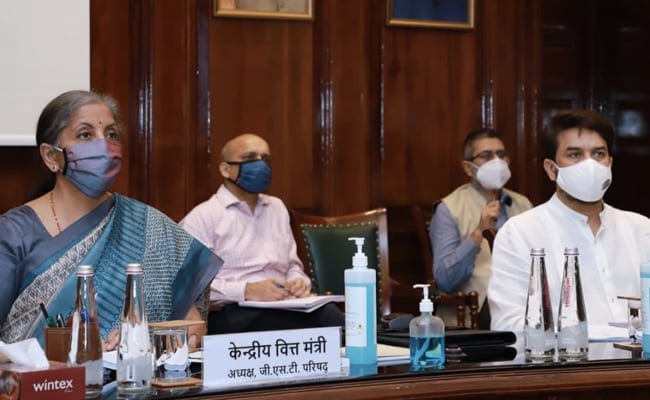
The GST Council is likely to discuss on Friday a reduction in the tax rate on Covid medicines, vaccines, and medical equipment, as well as means to make up for the shortfall in revenues, promised to states. Ahead of the first meeting of the top decision-making body, finance ministers of eight states ruled by non-BJP and like-minded parties -- Rajasthan, Punjab, Chhattisgarh, Tamil Nadu, Maharashtra, Jharkhand, Kerala, and West Bengal -- have devised a joint strategy to press for a zero tax rate on Covid essentials, sources said.
The Council, which is headed by Union Finance Minister Nirmala Sitharaman and includes representatives of all states and Union territories, is meeting for the first time in nearly eight months. Besides discussion on tax rates, the Council may also deliberate on the estimated Rs 2.69 lakh crore that states need to be provided as per the promise in 2017 to make good any loss in revenue they suffer because of giving up their right to levy VAT and other taxes.
Sources said the Fitment Committee on GST rates, comprising tax officers of Centre and states, has also given its report to the Council listing out the pros and cons of waiver and zero-rating of Covid vaccines, drugs and other equipment.
Exempting final products from GST would deny manufacturers the option to claim the benefit of the input tax credit on raw materials and hence not much benefit accrues to consumers. In 2018, the Council, following demands from various women's organisations, had exempted GST on sanitary napkins from an earlier rate of 12 per cent. However, not much of the rate cut benefits accrued to consumers as manufacturers could not claim the benefit of taxes paid along the supply chain.
Earlier this week, Punjab Finance Minister Manpreet Singh Badal, in a letter to Sitharaman, said that many goods, including protective garments, digital thermometers, laboratory sanitisers/disinfectants and paper bed sheets, which are needed to fight the Covid pandemic attract a basic customs duty of 20 per cent and a Goods and Services Tax (GST) of up to 18 per cent.
On top of that, a 10 per cent social welfare surcharge is levied on such items. As IGST is charged on taxable value, which includes import duties, the effective burden exceeds by another 2-3 per cent, Badal said. "It is baffling that despite the crisis our country currently finds itself in... taxes this high continue to apply on basic essentials needed to overcome this life-threatening disease...," Badal said in the letter.
Earlier this month, Sitharaman virtually ruled out exempting Covid vaccines, medicines and oxygen concentrators from GST, saying such an exemption will make the lifesaving items costlier for consumers as manufacturers will not be able to offset the taxes paid on inputs.
Currently, domestic supplies and commercial imports of vaccines attract a 5 per cent GST while COVID drugs and oxygen concentrators attract a 12 per cent levy. With regard to the issue of compensation payable to states, the Centre has estimated the shortfall at Rs 2.69 lakh crore.
The Centre expects to collect over Rs 1.11 lakh crore through cess on luxury, demerit and sin goods which will be given to the states to compensate them for the shortfall in revenue arising out of GST implementation. The remaining Rs 1.58 lakh crore would have to be borrowed to meet the promised compensation.
As per the agenda note shared with the states ahead of the GST council meeting on Friday, the Centre has estimated that although the GST revenues may see a recovery in the current financial year, there will still be a gap between the compensation need and the amount raised through cess. The 2021-22 Budget has assumed 17 per cent growth in GST revenues, translating into monthly gross GST revenue of Rs 1.1 lakh crore.
Based on this assumption, it has been estimated that for the period February 2021 to January 2022, the gap between projected revenue and the actual revenue after the release of the compensation would be around Rs 1.6 lakh crore. In the last fiscal, the Centre had borrowed on behalf of the states and released Rs 1.10 lakh crore to compensate for the GST revenue shortfall. Another Rs 68,700 crore was collected by way of levy of cess.
Under the GST law, states were guaranteed to be compensated bi-monthly for any loss of revenue in the first five years of the GST implementation from July 1, 2017. The shortfall is calculated assuming a 14 per cent annual growth in GST collections of states over the base year of 2015-16.
With states still continuing to face a shortfall in revenue as GST collections declined on account of slowing economic activity mainly due to Covid, the GST compensation cess would continue beyond the first five years of GST implementation.

-
We May Need Another Tukaram Mundhe To Fight Air Pollution | The Reason Why

Developers may install basic measures such as sprinklers and green nets, resume work, and continue violating rules when this equipment stops working.
-
Extracting Value From Battery Scrap Could Be Challenging For India | The Reason Why
A discarded lithium-ion battery still contains valuable materials such as lithium, nickel and cobalt. These can be recovered and reused. When such batteries are crushed and shredded, they produce a dark powder called black mass.
-
One El Nino, India Can Handle. Two Could Break The Granary
India's grain stocks can absorb one bad year, but a second El Nino could drain the buffer in two to three years, economists say.
-
India's Troika Of Good Luck | Joining The Dots
As Jensen Huang's exit drags Nvidia down, a cooling AI trade and resilient earnings have revived investor interest in India. A likely RBI rate hike looms.
-
Talking Points This Week: Leadership Shock At Nvidia, Earnings Strength, And The Fog Over Hormuz
The Anthropic IPO pricing and first trading day, Nvidia's upcoming earnings, and any fresh signals from Iran will set the tone for the following week.
-
Signature Play: The Classic Cocktail Is Dead. Or Is It?
Classic cocktails are disappearing from India's cocktail menus. But they're still being ordered, taught to bartenders and borrowed from. So, who's really having the last drink?
-
A New Samvat Wishlist: Inclusive Prosperity And Human Development
India has strengthened its economic foundations through infrastructure, digital access and enterprise. Its next growth chapter must deepen productivity, create better livelihoods and widen participation in prosperity.
-
Love, Sex Aur Dhokha: The Audacious Plot To Spy On Jensen Huang
A Taipei dinner, a Singapore chip buyer and a suspected Chinese asset: inside the alleged spy operation that got close to NVIDIA's Jensen Huang.
-
Ten Things I Learnt This Samvat
Patience can be a trap. Cheap stocks can stay cheap. Leverage can wipe you out. What did Samvat 2082 teach us? Niraj Shah writes on 10 lessons from the year gone by.
-
Talking Points This Week: Tech Nerves, FII Buying, And A Faraway Banking Shock
The global markets are not shining this Diwali. The exception in the large markets is, India.









