Government Sharply Increases Borrowing To Rs 12 Lakh Crore
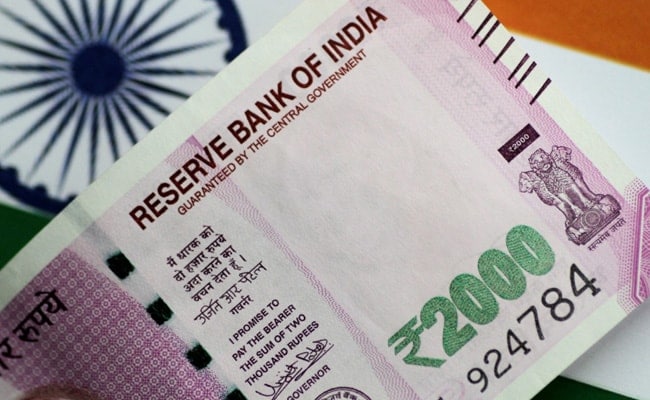
The government plans to borrow Rs 12 lakh crore ($160 billion) in the fiscal year to March 2021, up from the previously budgeted Rs 7.8 lakh crore to cushion the blow from the new coronavirus pandemic, it said on Friday.
The "revision in borrowings has been necessitated on account of the COVID-19 pandemic", the government and the Reserve Bank of India said in two separate releases.
The government will now borrow Rs 30,000 crore via a sale of bonds each week, sharply higher than the Rs 19,000 crore- Rs 21,000 crore scheduled as per the calendar released at end-March.
"The upward revision in borrowings for the remainder of FY2021, although sharp, was inevitable given the estimated extent of revenue loss following the lockdowns related to the COVID-19 pandemic," said Aditi Nayar, principal economist at ICRA.
The country is in a lockdown for eight weeks, causing massive economic losses and prompting Moody's to forecast a 0 per cent growth for this year.
Traders said bond yields are likely to open sharply higher on Monday if there is no announcement from the central bank on how it plans to support this borrowing program.
"The announcement though expected has come a bit early. Market reaction depends on what the RBI does," said A. Prasanna, economist with ICICI Securities Primary Dealership.
"Else we could see a 25 bps selloff on Monday and then further sell off. But RBI has two days to manage this."
Several traders too agreed the market would open a minimum 10-15 basis points higher on Monday. Earlier in the day, the existing benchmark 10-year bond yield closed 6 bps lower at 5.97 per cent, its lowest level since Jan. 27, 2009.
The government sold a new 10-year paper at 5.79 per cent at an auction amid aggressive buying by state-run banks but the bullishness was likely to wane following the higher borrowing announcement.
Market participants are also eagerly awaiting the announcement of a second stimulus package from the government to gauge the extent of fiscal slippage that may happen.
"Higher borrowings are likely to push up yields, unless OMOs (open market operations) or other instruments are deployed by the RBI to absorb a part of the higher issuance, and crowd out borrowings by state governments and corporates," Ms Nayar said.
"However, less pressure on expenditure compression to offset the expected revenue shortfall, would allow economic activity to display some semblance of recovery in the latter part of this fiscal year."

-
The Economic Imperative: Analysing The Material Driving Force Behind India-Canada Strategic Reset

This economic complementarity is further reinforced by deep institutional investment ties and talent mobility, which form the bedrock of the bilateral framework.
-
Medicine Pricing: Where Must Profit Stop?
India must confront excessive margins, hidden incentives and regulatory gaps that threaten the integrity of medicine.
-
Why Amazon And Flipkart Are Struggling To Beat Meesho In India's Smaller Cities
With 274 million users and lowest-cost logistics, Meesho is defending its value commerce crown against giants like Amazon and Flipkart.
-
High US Salaries, No Green Card Certainty: The Financial Calculation Facing Indian H-1B Families
The suspension of PERM processing at eight technology employers does not cancel existing H-1B visas. What it does is force a question many Indian families have been avoiding: is the US salary worth tying your career and family plans to one employer?
-
Swiggy vs Eternal: Food Delivery's Two Rivals Are No Longer In The Same Race
Eternal is building a private AI assistant, dark.ai. Swiggy is still working out how to make Instamart pay, with an operating loss of Rs 895 crore in the July-September quarter while Blinkit stayed profitable.
-
Where You Live Shapes How You Get To Work | The Reason Why
Two-wheelers are the most popular way to get to work in India, accounting for nearly 43% of workplace commutes.
-
Unhedged Position: Can India See An Indonesia-Style Time Correction?
The Nifty is trading below levels it first clocked in 2024. Is there, then, as I have suggested in the headline, potential that the current time correction drags on painfully for the next three-five, even ten years?
-
Navigating Friction And Energy Realities: An Analysis Of Marco Rubio's October Visit To India
Occurring at a critical juncture marked by stalled trade negotiations and escalating geopolitical pressures over global energy supplies, the visit offers a profound window into modern US-India relations.
-
India Exports Capital. Why Not Export Trusteeship?
The big question, then, is whether India can build an institution that global borrowers, investors, banks, and lawyers can trust, even without an Indian connection.
-
France's Economy & Politics Are In Crisis | The Reason Why
Let's look at how the French economy and politics evolved under Nicolas Sarkozy, Franois Hollande and Emmanuel Macron.










