Government 'Owed' Demonetisation To Nation, Says Nirmala Sitharaman
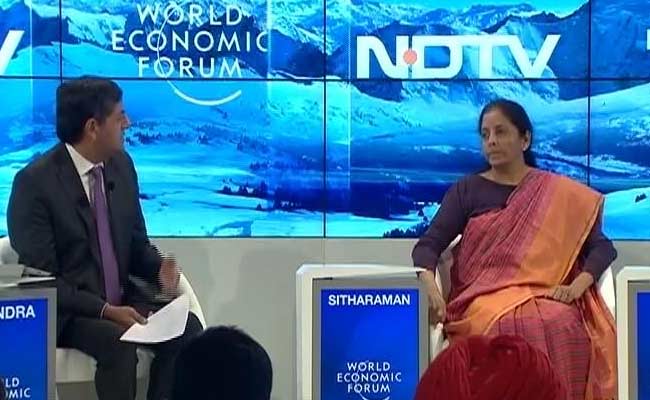
Davos, Switzerland: Prime Minister Narendra Modi's government "owed" demonetisation to the nation in its fight to eradicate black money and to bring hoarded cash back into the banking system, Union Commerce Minister Nirmala Sitharaman said at the World Economic Forum in Davos.
Participating in a panel discussion on "India's Time to Transform" which was moderated by NDTV's Vikram Chandra, the minister said, "Even if it sounds propagandist" one needs a strong leadership to take "such a bold step".
She said the ban on old high denomination notes was part of the "electoral promise we made to check the black money menace".
"Right after coming to power, we started with setting up the special investigation team, came out with scheme for declaration of undisclosed money, tightened tax treaties with different countries to check round tripping of money. We took all these steps."
"This step of demonetisation was absolutely necessary... 87 per cent of our economy was informal," the minister said, adding that only about 50 lakh people pay tax and all others who file the returns do not pay any tax.
"Can we survive if this kind of tax-to-GDP ratio continues? We had to do it, we owed it to the country and we do not regret it."
Also participating in the panel discussion was State Bank of India chief Arundhati Bhattacharya, who said "there were many small and medium businesses that were earning profit but were not paying tax".
"We need to convince them that they come into the tax net if they are earning enough for paying taxes," Ms Bhattacharya added.
Kenneth Rogoff, Professor of Economics and Public Policy at Harvard University, said the same step could have been done in a more systematic manner.
On why demonetiation could not have been taken with more public planning, Ms Sitharaman said Indians are "smart" and they would have "sensed" it and people could have stashed the money somewhere.
From 2006 and 2016, the portion of banknotes of high denomination rose considerably to 86 per cent, she added.
Ms Sitharaman said no part of the country faced any problem because the ministers and officials were moving around the country to take stock of situation and to take necessary measures throughout this 50-day period.
Argentina's central bank governor Federico Sturzenegger praised the Indian government for the bold step.
Speaking on the sudden move on old notes, Ms Sitharaman said it was a "one-time attack on the stock" and it worked.
"The moment the money has come into banks, it is no more anonymous and it has to be identified with somebody. In India, unaccounted cash or black money is a major issue," the minister said.
Carmen M Reinhart, Professor at Harvard Kennedy School of Government, said she concurred with the view that demonetisation was "short-run pain and long-run gain".
Ms Reinhart said India is also undertaking “another extremely bold initiative” of GST (Goods and Services Tax), adding, "I would have preferred the GST to be introduced before the currency conversion.”
On whether GST could have been done earlier, Ms Sitharaman said the new indirect tax regime is going through a process and the government is confident it will get through from July 1.
"There was no choosing between the two," she said.
About steps being taken to improve the ease of doing business, Ms Sitharaman said the government is "at it" and is an ongoing work.
Ms Bhattacharya of SBI said: "To say how much successful it (demonetisation) has been, it needs to be seen how things pan out. We are already seeing a huge surge in the quantum of card transactions. But the day the ATM limits were raised to Rs 10,000, the card transactions began to fall."
Ms Bhattacharya also said that studying all the accounts that could have been used to launder money was a humongous task.
NITI Aayog CEO Amitabh Kant said India is on the cusp of a major revolution as one would need just his or her thumb to transact and this has not happened anywhere in the world and would leave cards and PoS (point of sale) machines etc totally redundant.
Every single mobile will have a thumb and iris impressions that will make "each one of us a walking ATM", he said.

-
Signature Play: The Classic Cocktail Is Dead. Or Is It?

Classic cocktails are disappearing from India's cocktail menus. But they're still being ordered, taught to bartenders and borrowed from. So, who's really having the last drink?
-
A New Samvat Wishlist: Inclusive Prosperity And Human Development
India has strengthened its economic foundations through infrastructure, digital access and enterprise. Its next growth chapter must deepen productivity, create better livelihoods and widen participation in prosperity.
-
Love, Sex Aur Dhokha: The Audacious Plot To Spy On Jensen Huang
A Taipei dinner, a Singapore chip buyer and a suspected Chinese asset: inside the alleged spy operation that got close to NVIDIA's Jensen Huang.
-
Ten Things I Learnt This Samvat
Patience can be a trap. Cheap stocks can stay cheap. Leverage can wipe you out. What did Samvat 2082 teach us? Niraj Shah writes on 10 lessons from the year gone by.
-
Talking Points This Week: Tech Nerves, FII Buying, And A Faraway Banking Shock
The global markets are not shining this Diwali. The exception in the large markets is, India.
-
Midterm Rally Lasted A Day. The Hard Reality Of A Divided US May Last Two Years | Opinion
Between a contested AI boom, a debt ceiling that arrives in 2027 and a president with every incentive to act alone, the next two years may prove more volatile than the first day's rally suggests.
-
Blue Wave Will Derail the AI Trade but Won't Dismantle the AI Era | Unhedged Position
The Democrats' sweep of the US Congress will see politics collide with economic forces both over the long and short term.
-
It's Time To Take The GST Council's Bet On Trust Global
Payment records can prove India's services exports, and clear, proportionate rules can bring foreign digital sellers into the tax net.
-
Opinion | India at 38: From Innovation Overperformer to Innovation Powerhouse
India now has 453 VC-backed deep science startups, 18 of them late-stage, after 117 percent growth since 2020. Laurus Labs, at USD 9.3 billion, is the most valuable deep science company in any middle-income economy outside China.









