Government Working On Rationalisation Of Personal Income Tax Rates: Nirmala Sitharaman
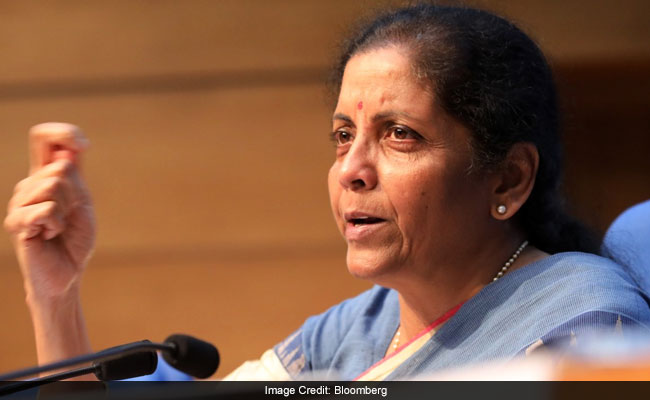
Finance Minister Nirmala Sitharaman said on Saturday that the government is working on more steps, including rationalisation of personal income tax rates, to revive the sagging economy.
The GDP growth slowed down to more than six-year low of 4.5 per cent in the second quarter of the current fiscal from 5 per cent recorded in the first quarter.
The government has taken several measures during August and September to boost the economy, she said at the HT Leadership Summit.
She also pointed out that public sector banks have disbursed nearly Rs 5 lakh crore without compromising on prudential norms in the last two months to boost consumption in the hinterland.
"So there are ways of giving stimulus for consumption. We are adopting a direct method and also the method through which we are spending on infrastructure, whose spillover can go to core industries, labour and so on," she said.
Asked if there could be more measures to bolster economic activity, she said, "If I say yes, it will be when and if I say yes it's also going to be back to me saying are you not too close to the budget. So I don't want to say yes although I wish I can say. At the same time, I will not say no, because we are working on more."
When asked if the government is considering rationalization of the personal income tax rate for putting more money in the hands of people, the Finance Minister said, "One among many things that we are thinking of."
Following the reduction in corporate tax in September, there has been a growing demand for slashing personal income tax to buttress consumption.
In the biggest reduction in 28 years, the government in September slashed corporate tax rates up to 10 percentage points as it looked to pull the economy out of a six-year low growth with a Rs 1.45 lakh crore tax break.
Base corporate tax for existing companies has been reduced to 22 per cent from 30 per cent, and to 15 per cent from 25 per cent for new manufacturing firms incorporated after October 1, 2019, and starting operations before March 31, 2023.
Assuring that there will be no harassment of taxpayers, Ms Sitharaman said the intent of the government is to further simplify the taxation system, including removal of exemption.
Besides, she said the government has introduced faceless assessment of direct tax and this will soon be introduced in indirect tax to eliminate harassment.
On the Goods and Services Tax (GST), the Finance Minister said the rate structure will have to be decided by the GST Council.
Eventually, the rates have to be rationalized and the entire tax system has to be simplified, she added.
"One, the tax per se, is getting complicated because of this unstructured bringing down of rates. Another, it's also getting complicated because you want to be sure that you're doing everything correct, but ending up asking for so much more information in a technology-driven system. People just get fed up of wanting to give so much information. So, we have problems in both hands," she said.
With regard to apprehension raised on the genuineness of data, the Finance Minister said, "There's no doubt, we need to bring credibility back to the data."
The government is aware of the ongoing debate on data and its credibility, she said, adding the intention is to make sure that any kind of inappropriate methodology coming into the data will have to be addressed.
"So we will have to work towards better credibility, we have to work towards making available data without any obstruction," she said.
Asked how she reacts to criticism from various quarters, she said "I do not allow it to worry me. I'm not inhuman. I do sometimes get affected by it, but I suppose it's part of the job. So, I can't really wish it away. It comes, let it keep coming. I handled it."

-
Gold Is Rs 22,000 Cheaper Than A Month Ago. Should You Buy Amid The Wedding Season?

Gold's potential slide to $3,500 could save around Rs 4,700 per 10 grams, but a soft inflation print could just as easily push prices back up. One way to split the risk is to buy in parts, some now and the rest after the Fed's Dec. 9 decision.
-
AI Agents Are Gaining Power. Who Governs Them?
Artificial intelligence agents promise to transform productivity by moving machines from assisting decisions to executing them. But as organisations delegate greater authority to these AI-agents, they must first establish who controls that authority and who remains accountable when things go wrong.
-
Why Swapping Your Old Gold Can Trigger A Rs 5 Lakh Tax Bill, And How You Can Avoid It Legally
Swapping old gold for new is taxed as a sale and a fresh purchase. Getting your own gold remade can cut most of that bill, though it has its own costs.
-
The AI Trade is Done. The Real Opportunity for Investors Starts in 2027 | Unhedged Position
As pureplay AI stocks plunge and circular, capex-led financing unwinds, 2027 is set to be a year of reckoning for AI companies. Yet the bust clears the way for a better opportunity for investors in 2027 -- shifting the spotlight from AI builders to the companies using AI.
-
Leadership As Mission: Why The Age Of AI Demands More Human Leadership
Debjani Ghosh examines how AI is changing leadership, arguing that its success must be measured by its impact on people and the accountability of those guiding its use.
-
We May Need Another Tukaram Mundhe To Fight Air Pollution | The Reason Why
Developers may install basic measures such as sprinklers and green nets, resume work, and continue violating rules when this equipment stops working.
-
Extracting Value From Battery Scrap Could Be Challenging For India | The Reason Why
A discarded lithium-ion battery still contains valuable materials such as lithium, nickel and cobalt. These can be recovered and reused. When such batteries are crushed and shredded, they produce a dark powder called black mass.
-
One El Nino, India Can Handle. Two Could Break The Granary
India's grain stocks can absorb one bad year, but a second El Nino could drain the buffer in two to three years, economists say.
-
India's Troika Of Good Luck | Joining The Dots
As Jensen Huang's exit drags Nvidia down, a cooling AI trade and resilient earnings have revived investor interest in India. A likely RBI rate hike looms.
-
Talking Points This Week: Leadership Shock At Nvidia, Earnings Strength, And The Fog Over Hormuz
The Anthropic IPO pricing and first trading day, Nvidia's upcoming earnings, and any fresh signals from Iran will set the tone for the following week.









