Government May Have Curbed Spending By Over Rs 1 Lakh Crore To Meet Fiscal Deficit Target
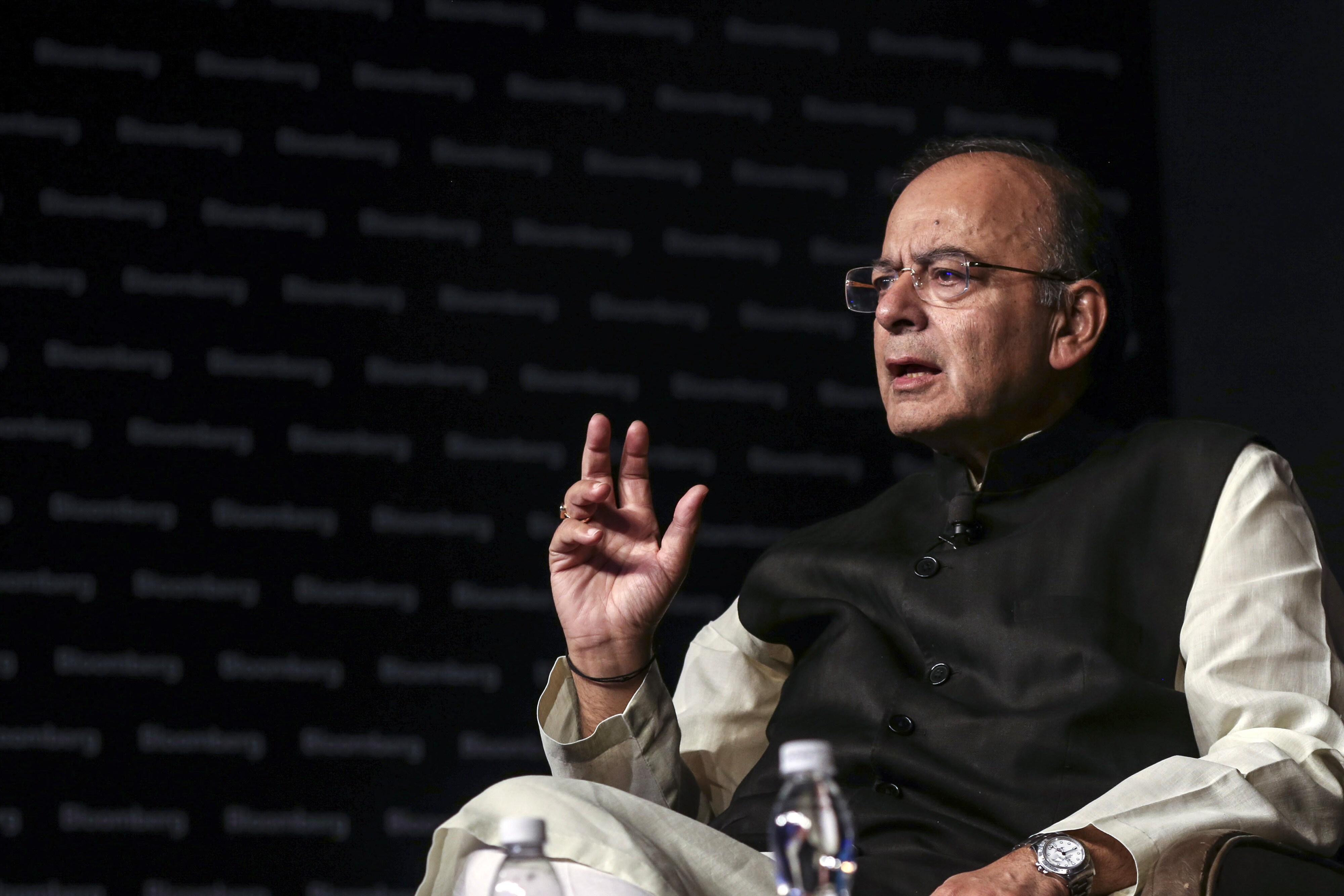
The Indian government may have had to cut back on spending of nearly Rs 1 lakh crore in order to meet Finance Minister Arun Jaitley's fiscal deficit target of 3.4 percent of gross domestic product in 2018-19.
The government's tax collections were around Rs 1.6 lakh crore lower than the target due to weak direct tax and goods and services tax mop up, a government official said on condition of anonymity. That would have forced the government to rein-in expenditure or re-route unutilised funds from various government departments.
Expenditure rollovers and unutilised funds would have helped in meeting the target, the official said.
The fiscal deficit target would have otherwise shot up to around 3.8 percent of GDP, according to BloombergQuint's calculations. The calculation has been done assuming:
- Government has met its target for non-tax revenue—which includes dividend payouts to the government, among others—of Rs 2.45 lakh crore for 2018-19.
- Government would have met non-debt capital receipts, which includes recovery from past loans and other receipts of Rs 93,155 crore.
“A massive shortfall of Rs 1.6 lakh crore in tax revenue would effectively increase the actual fiscal deficit to 3.9 percent,” former Finance Minister P Chidambaram was quoted as saying in a Congress party's press release dated May 8. The economy is expected to slow down further, he added while explaining the consequence of expenditure cuts by the government.
The government's capital expenditure stood at 86 percent of its revised budget estimate of 2.73 lakh crore as of Feb. 28, according to government data. Revenue expenditure was 89 percent of its revised budgeted target of Rs 21.41 lakh crore as on February-end. This suggests that the government had room to cut a part of the remaining Rs 42,347 crore in capital expenditure, and about Rs 2.26 lakh crore in revenue expenditure in March 2019.
Reports by Comptroller and Auditor General of India point out that the government rolls over a large part of food subsidy to the successive year, said NR Bhanumurthy, professor at National Institute of Public Finance and Policy. On the revenue side, Bhanumurthy said, the government has been receiving interim dividend from the Reserve Bank of India and other state-run entities, which is a future income.
“The government overestimates its revenue and underestimates its expenditure,” Bhanumurthy said, adding that if one looks at the correct expenditure and revenue numbers, adjusted fiscal deficit would be close to 4 percent of GDP in 2018-19.
Not The First Time
In four out of five years till 2017-18, the government's actual tax revenue fell short of the revised tax collection target in the budget. In two out of the five fiscals—2015-16 and 2017-18—the government had increased its revised revenue estimate from the budgeted forecast. In 2013-14 and 2014-15, government lowered its revised revenue estimates from what was budgeted and still failed to meet them.
Direct Tax Revenue
The government's direct tax collection was Rs 11.38 lakh crore up to March 31, 2019, against the revised target of Rs 12 lakh crore, according to the first official cited earlier. The government in the interim budget 2019-20, had revised the target upwards by Rs 50,000 crore anticipating higher collections from corporate tax.
The government has almost met the revised corporate tax target, but there was a shortfall in personal income tax, said a second senior government official. That was due to anticipated higher growth in personal income tax, keeping in view growth after demonetisation, the official said. That primarily led to the shortfall as growth in personal income tax wasn't as good as witnessed after demonetisation. It's thus facing a shortfall of nearly Rs 60,000 crore from personal income tax.
Indirect Tax
The government has collected about 90 percent of the targeted central goods and services tax of Rs 5.03 lakh crore in 2018-19. The first official cited earlier said it was around Rs 4.6 lakh crore. The integrated goods and services tax collection has been dismal after settlement between states and the centre, the first official cited earlier said. The government had estimated Rs 50,000 crore from IGST for 2018-19. Excise duty collections have fallen short by 10 percent to around Rs 2.32 lakh crore.
The customs collections have been slightly higher than the estimated Rs 1.30 lakh crore. Compensation cess—levied on demerit goods—was also higher at Rs 94,678 crore against the targeted Rs 90,000 crore.
Total indirect tax collections fell short of the targeted Rs 10.45 lakh crore by 10 percent.
Between A Rock And A Hard Place
Faced with slower revenue growth, the government would had little choice but to cut spending. The alternative would have been to miss a once-revised fiscal deficit target for the year.
FY19 was the second consecutive year that the government has revised its original fiscal deficit target. It has also pushed back the medium term goal of bringing down the fiscal deficit target to 3 percent of GDP.
Economists and analysts believe that FY20 will remain fiscally challenging as well. Tanvee Gupta Jain, economist at UBS, believes the post-election budget will be a tough balancing act. The choice, Gupta wrote in a note on Thursday, appears to be between a short term growth boost through fiscal expansion or a further growth slowdown from pursuing fiscal consolidation.

-
The Curious Case of Equitas Small Finance Bank And A CEO Who Quit For Stock

PN Vasudevan believes persistent investor concerns over a perceived conflict of interest had become a governance overhang on Equitas Small Finance Bank's stock, even as the lender improved profitability and asset quality.
-
Talking Points This Week: AI Cash Burn, A Tiger Comeback And An India That Still Finds Its Own Path
India is not immune to higher oil or tighter global liquidity, yet its earnings base is broader, its domestic policy levers are still available.
-
Foreign Investors Own Half Of HDFC Bank and ICICI Bank. An LTCG Cut Could Matter Most Here
Foreign portfolio investors have US$115 billion parked in HDFC Bank, ICICI Bank. If the government cuts long-term capital gains tax, Jefferies says returning foreign money could land here first.
-
'Never Seen This Level Of Negativity': Sandeep Tandon Says The Next Rally May Be Closer Than You Think
Veteran investor Sandeep Tandon says foreign selling is easing, large-caps are due a comeback and mid-caps are crowded, while he turns positive on gold, power and pharma this Diwali.
-
Indians Stay With Family, Not In Hotels | The Reason Why
India still lacks enough clean, reliable and affordable hotels for budget-conscious travellers.
-
The Economic Imperative: Analysing The Material Driving Force Behind India-Canada Strategic Reset
This economic complementarity is further reinforced by deep institutional investment ties and talent mobility, which form the bedrock of the bilateral framework.
-
Medicine Pricing: Where Must Profit Stop?
India must confront excessive margins, hidden incentives and regulatory gaps that threaten the integrity of medicine.
-
Why Amazon And Flipkart Are Struggling To Beat Meesho In India's Smaller Cities
With 274 million users and lowest-cost logistics, Meesho is defending its value commerce crown against giants like Amazon and Flipkart.
-
High US Salaries, No Green Card Certainty: The Financial Calculation Facing Indian H-1B Families
The suspension of PERM processing at eight technology employers does not cancel existing H-1B visas. What it does is force a question many Indian families have been avoiding: is the US salary worth tying your career and family plans to one employer?
-
Swiggy vs Eternal: Food Delivery's Two Rivals Are No Longer In The Same Race
Eternal is building a private AI assistant, dark.ai. Swiggy is still working out how to make Instamart pay, with an operating loss of Rs 895 crore in the July-September quarter while Blinkit stayed profitable.










