Gorakhpur, Phulpur, Araria: Lessons Of 2009 For PM Modi And Rahul Gandhi
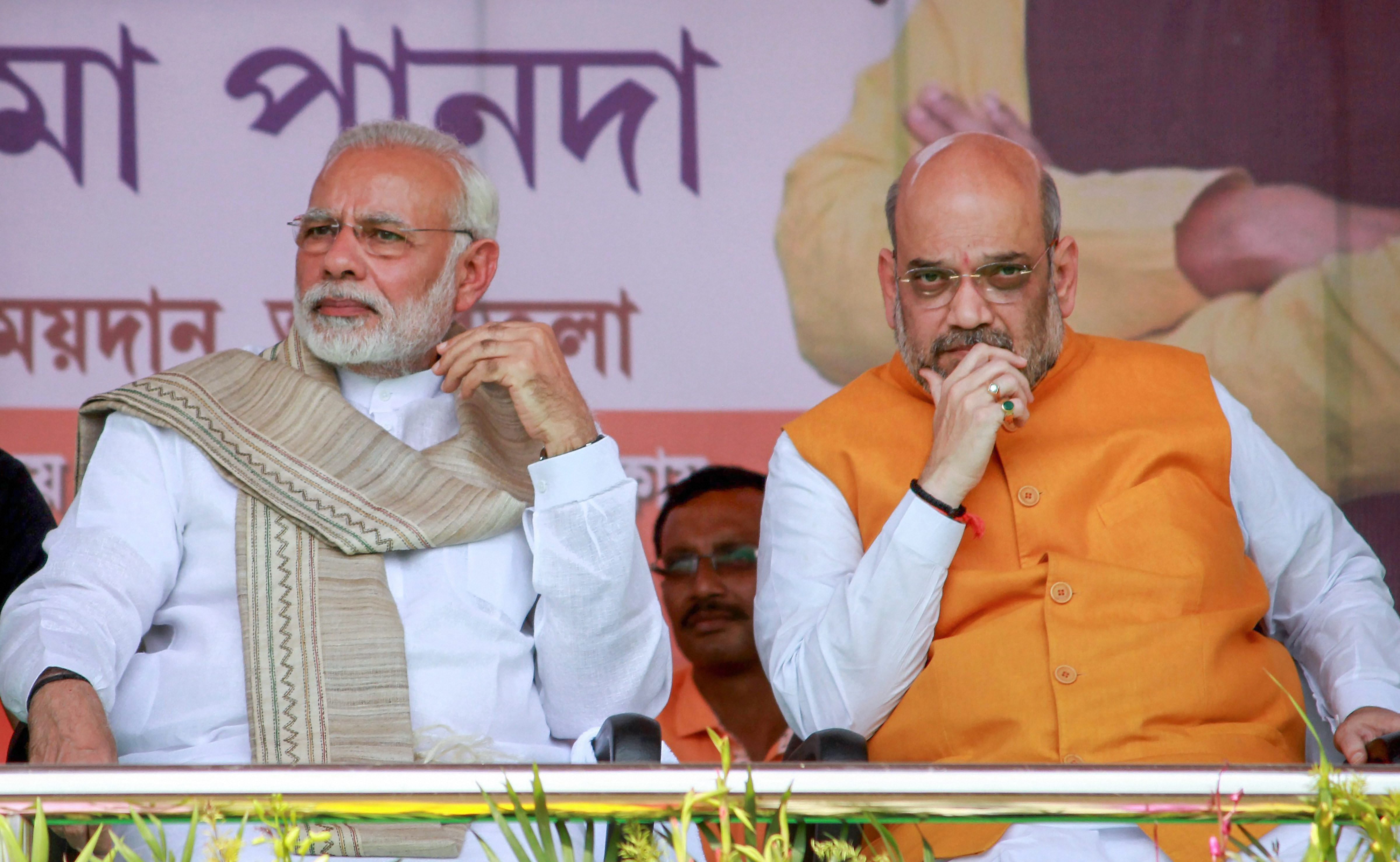
Prime Minister Modi, Chief Minister Yogi, and BJP President Amit Shah got shellacked today, in perhaps the most dramatic political reversal in independent India's electoral history. Never before has an ‘invincible' leadership got so soundly thrashed on its home turf within one year of a record-breaking triumph. And to blithely fob it off to ‘alliance arithmetic' will be a lie (bought and repeated ad nauseam by television propagandists), because the earlier victories were achieved with 52 percent-plus votes, so an ‘arithmetic defeat' was impossible unless there was a real erosion of votes.
So… I will now leave it for my worthy colleagues to dissect and trisect the voting data from today's eye-rubbing Gorakhpur, Phulpur, and Araria by-polls (read along with the recent Gujarat Assembly, Rajasthan and Madhya Pradesh by-polls).

Also Read: Gorakhpur Bypoll: In ‘Unexpected Result', SP Wins Yogi's Bastion
But I would like to move on to…
What's The Political Message From Today's Poll Statistics For The 2019 General Elections?
Statistics can often be stranger than fiction. Here's a political quiz that I am sure most of you will flunk. Before I pose the question, let's agree on the benchmark:
- How shall we define ‘political success'? By the fact of ‘re-election to the office', right?
- And how shall we define the ‘biggest' political success? As re-election to office by the ‘largest increase in mandate', right?
No quarrel up to this point, right? If a politician gets re-elected with the largest increase in his mandate, that should, incontrovertibly, allow him to claim the mantle of 'being the most successful', right?
Okay, now that the ground rules of our quiz have been defined, here's the Kaun Banega Crorepati (million dollar) question:
You have three chances to give the correct answer. So here goes:
Answer 1: Pandit Nehru? No, although he got re-elected more than once, he did not appreciably increase his (already awesome) mandate over his respective previous tenures.
Answer 2: Indira Gandhi? No, she got re-elected after she cut short her tenure in 1971, but added only 36 percent (from 259 in 1967 to 352 seats) to her previous mandate.
Answer 3: Atal Bihari Vajpayee? No, he got re-elected in 1999, but the BJP's numbers in parliament hardly budged.
Three chances up, guys, you failed to give the right answer. It's now Computerji's turn. And the sahi jawab (correct answer), hold your breath, is Manmohan Singh!
He got re-elected in 2009 by increasing his previous mandate of 2004 by a gravity-defying 45 percent (from 141 to 206 seats).
Hey hey, please exhale before you choke. And yes, give it up for Manmohan Singh, widely described as India's weakest prime minister, but who, on cold quantitative stats, can justifiably claim to be the biggest success in that office!
I told you, statistics can be stranger than fiction.
Also Read: Phulpur Bypoll: SP Wins By A Margin Of 59,613 Votes, BJP Comes Second

The Under-Analysed But Spectacular Lok Sabha Polls Of 2009
Post-1991, ie post-liberalisation and coalition era, India has had six general elections. While the polls of 1996, 1998 and 1999 have been analysed and modeled to death by the pundits, the 2009 one has stayed, relatively, in the shadows. And that's been a mystery to me because look at just a few of the political discontinuities it threw up:
- Congress swept urban areas. (7 out of 7 in Delhi and 5 out the 5 it contested in Mumbai!)
- With 21 seats, Congress was the second-largest party in Uttar Pradesh – yes, U.P., of all the states – ahead of BSP and more than double BJP's tally. (go figure!)
- Both the contending alliances, UPA and BJP, had declared prime ministerial candidates – Manmohan Singh and LK Advani – making it the first ‘presidential' contest in independent India.
- The communists collapsed from 59 seats to 24, punished by the electorate for their political betrayal (more on that in a jiffy) and pre-Cold War era shibboleths.
Most pundits have trotted out rather obvious analyses for the Congress' amazing re-election in 2009. The two most quoted reasons are the three continuous years of 9 percent-plus GDP growth and the farm loan waiver just before the voting. I concede that these were primary causes of Congress' victory. But very short shrift is given to what, in my opinion, was the elemental reason, i.e. that people simply loved Singh's act of political defiance over the Indo-U.S. Nuclear Deal. They saw in him a status quo defying politician who could herald change on a massive scale for an electorate tired of cliché' spewing leaders.
Also Read: 2019 Versus 1996: Lessons For Rahul Gandhi From Sitaram Kesri's Congress
Singh Was Nuclear King
July 2008: Unfortunately for Prime Minister Manmohan Singh, his Left coalition partners saw red over the Indo-U.S. Nuclear Agreement, and withdrew support in parliament, pushing the government into a minority. Singh's own Congress party balked. Opposing spin masters tried to paint Singh as an ‘American lackey' who was also ‘anti-Muslim'. But he stood firm. He had pulled off a diplomatic coup which enhanced India's soft and hard power across the globe.

He sought a vote of confidence in parliament for his minority government. Some deft political management saw the Congress get new allies on board, including the Samajwadi Party. Three young muslim MPs from across the aisle – MIM's Owaisi, PDP's Mehbooba Mufti and NC's Omar Abdullah – supported the government, effectively neutralizing the ‘anti-Muslim' thrust.
When the vote was counted late at night on July 22, 2008, Singh had won 275-256. His beaming face and exultant V wave became Singh's political signature for the 2009 polls; across the country, he was feted as ‘Singh is King' (the title of a blockbuster Hindi film).
Very few understood, or cared, about the nuclear nuance. What they latched on to was Singh's ability to stand up to blackmail in the pursuit of modernity and change.
Alas, the Congress misread its mandate and harked back to the stasis of garibi hatao (poverty) politics, handing a neat walk-over to Narendra Modi in 2014, who instinctively understood the political message of 2009 better than the victors themselves.
With supernatural energy, Modi amplified Singh's incipient bravado into a political hurricane of ‘achhe din' (good days), the promise of transformational change. The rest is history.
Final Lessons From 2009, 2014, Alwar, Ajmer, Tripura, Gorakhpur, Phulpur And Araria
As Prime Minister Modi and opposition challenger Rahul Gandhi get ready to square off in 2019, they must internalise what the electorate has been screaming in their ears across the general elections of 2009 and 2014, state elections of Tripura and North East a fortnight back, and the by-polls of Alwar, Ajmer, Madhya Pradesh, Gorakhpur, Phulpur, and Araria:
Raghav Bahl is the co-founder and chairman of Quintillion Media, including BloombergQuint. He is the author of two books, viz ‘Superpower?: The Amazing Race Between China's Hare and India's Tortoise', and ‘Super Economies: America, India, China & The Future Of The World'.

-
AI Bias In Investing Cannot Be Eliminated, But It Can Be Governed

Framing is a particularly important example as identical financial information presented in terms of gains rather than losses can lead an LLM to reach a different assessment.
-
Joining The Dots | Dark Skies, Steady Diya: Why Hope Holds This Diwali
With war, a weak rupee and foreign outflows weighing on sentiment, policymakers at the NDTV World Summit and market veterans at NDTV Profit Ignite: Diwali Edition offered the same advice: stay invested and filter out the noise.
-
The Curious Case of Equitas Small Finance Bank And A CEO Who Quit For Stock
PN Vasudevan believes persistent investor concerns over a perceived conflict of interest had become a governance overhang on Equitas Small Finance Bank's stock, even as the lender improved profitability and asset quality.
-
Talking Points This Week: AI Cash Burn, A Tiger Comeback And An India That Still Finds Its Own Path
India is not immune to higher oil or tighter global liquidity, yet its earnings base is broader, its domestic policy levers are still available.
-
Foreign Investors Own Half Of HDFC Bank and ICICI Bank. An LTCG Cut Could Matter Most Here
Foreign portfolio investors have US$115 billion parked in HDFC Bank, ICICI Bank. If the government cuts long-term capital gains tax, Jefferies says returning foreign money could land here first.
-
'Never Seen This Level Of Negativity': Sandeep Tandon Says The Next Rally May Be Closer Than You Think
Veteran investor Sandeep Tandon says foreign selling is easing, large-caps are due a comeback and mid-caps are crowded, while he turns positive on gold, power and pharma this Diwali.
-
Indians Stay With Family, Not In Hotels | The Reason Why
India still lacks enough clean, reliable and affordable hotels for budget-conscious travellers.
-
The Economic Imperative: Analysing The Material Driving Force Behind India-Canada Strategic Reset
This economic complementarity is further reinforced by deep institutional investment ties and talent mobility, which form the bedrock of the bilateral framework.
-
Medicine Pricing: Where Must Profit Stop?
India must confront excessive margins, hidden incentives and regulatory gaps that threaten the integrity of medicine.
-
Why Amazon And Flipkart Are Struggling To Beat Meesho In India's Smaller Cities
With 274 million users and lowest-cost logistics, Meesho is defending its value commerce crown against giants like Amazon and Flipkart.










