Google's Pivotal IPO Launched a Decade of Big Bets
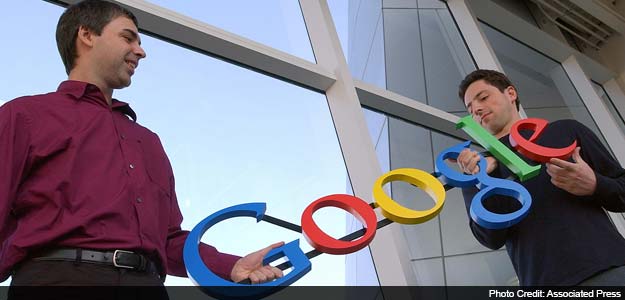
Google's IPO, a decade ago this week, launched the company on a trajectory that continues to reshape its business and much of the world in its orbit.
And CEO Larry Page is determined to push even further.
Mr Page's vision is that Google's products and services will become the control center of people's lives:
The company's driverless cars will chauffeur people around safer roads and deliver goods within hours of an online order. People won't even have to bother leaving their homes, which will be made more comfortable and enjoyable through the use of smart appliances. Robots will handle tedious chores and other jobs, freeing up time for people to enjoy lives prolonged by health-management tools and disease-fighting breakthroughs engineered by Google.
Internet-connected eyewear and watches will supplement the smartphones that ensure Google is a constant companion capable of anticipating questions and desires.
Although Mr Page has been taking risks since he co-founded Google with Sergey Brin 1998, the stakes probably wouldn't be as high if not for the company's pivotal IPO on August 19, 2004.
Besides raising about $1.2 billion in cash, the IPO empowered Google Inc. with a stock that the company used to attract more brainy engineers and buy promising companies such as YouTube. Google now employs 52,000 workers, some 20 times more than at the time of the IPO and has snapped up more than 250 companies in the past 10 years.
The ambitious expansion has extended Google's empire far beyond the influential search engine that processes more than 100 billion queries each month and still brings in most of the company's projected $67 billion in revenue this year. Google is also a leader in email, Web browsers, Internet video and mobile computing now.
The company already has amassed so much power that it has been the subject of broad antitrust investigations in the U.S. and Europe amid allegations that it uses its size and stature to stifle competition. The Federal Trade Commission absolved Google of wrongdoing last year while the European Commission is still examining the issue.
Rocky Road to Wall Street
When Google filed its IPO paperwork in April 2004, the iconoclasm of Mr Page and Mr Brin shone through the legalese and standard boilerplate language. The duo included an "owner's manual" that declared Google's intent to remain an unconventional company that pampered its employees, made risky gambles on long-term projects at the expense of short-term earnings growth and paid little heed to the unwritten Wall Street rules that prod executives to offer financial forecasts each quarter.
In another break from tradition, Mr Page and Mr Brin set up a bidding process known as a "Dutch auction" designed to give a larger pool of investors an opportunity to determine the IPO price and buy the stock before it began trading on Nasdaq. This differed from the usual system that depends on bankers to set the IPO price and distribute the pre-trading shares to their preferred clients, who often expected to get them at a slight discount.
Mr Page and Mr Brin didn't help Google's cause. They showed up to investor presentations in casual attire and then answered questions with off-the-cuff remarks that provided little information. Things got even more complicated when a Playboy interview done with Page and Brin in April came out in early August as the IPO was heading into the stretch. The piece revealed that Google hadn't properly registered millions of its shares with California regulators. Officials initially viewed the interview as breach of rules that forbid companies from sharing key information outside of IPO documents, but eventually the agency backed down when Google included the entire Playboy interview in an amended filing.
Google's IPO ended up being priced at $85, well below the company's earlier target range of $108 to $135.
Boon for Bargain Shoppers
Investors who bought Google's stock on the first day of trading have been richly rewarded. The shares rose 18 per cent to close at slightly above $100 on in their Wall Street debut and have never fallen below the IPO price. Adjusted for a split completed earlier this year, Google's stock has risen roughly 14-fold, leaving the company with a market value of nearly $400 billion. Only Exxon Mobil Corp. and Apple Inc. are worth more.
Apple didn't fare quite as well as Google in the first decade after its December 1980 IPO. Apple's stock merely tripled in value during its first 10 years of trading. By comparison, Microsoft Corp.'s stock had soared 90-fold a decade after its March 1986 IPO and Amazon.com Inc.'s stock had climbed 40-fold a decade after its May 1997 IPO.
Google's performance helped stoke demand for the IPOs of other rapidly growing Internet companies. Facebook Inc. would never have been able to command a market value of $104 billion when it went public in May 2012, nor would Chinese e-commerce conglomerate Alibaba Group's expected IPO value be at $150 billion if Google's IPO hadn't performed as well as it had, said longtime IPO expert and University of Florida finance professor Jay Ritter.
Google's IPO turned most of the company's roughly 2,500 employees at the time of the IPO into millionaires, including its head chef and masseuse. Even more wealth has been created as Google helped turn the Internet and mobile devices into gold mines for workers with programming skills and ingenuity.

-
Gold Is Rs 22,000 Cheaper Than A Month Ago. Should You Buy Amid The Wedding Season?

Gold's potential slide to $3,500 could save around Rs 4,700 per 10 grams, but a soft inflation print could just as easily push prices back up. One way to split the risk is to buy in parts, some now and the rest after the Fed's Dec. 9 decision.
-
AI Agents Are Gaining Power. Who Governs Them?
Artificial intelligence agents promise to transform productivity by moving machines from assisting decisions to executing them. But as organisations delegate greater authority to these AI-agents, they must first establish who controls that authority and who remains accountable when things go wrong.
-
Why Swapping Your Old Gold Can Trigger A Rs 5 Lakh Tax Bill, And How You Can Avoid It Legally
Swapping old gold for new is taxed as a sale and a fresh purchase. Getting your own gold remade can cut most of that bill, though it has its own costs.
-
The AI Trade is Done. The Real Opportunity for Investors Starts in 2027 | Unhedged Position
As pureplay AI stocks plunge and circular, capex-led financing unwinds, 2027 is set to be a year of reckoning for AI companies. Yet the bust clears the way for a better opportunity for investors in 2027 -- shifting the spotlight from AI builders to the companies using AI.
-
Leadership As Mission: Why The Age Of AI Demands More Human Leadership
Debjani Ghosh examines how AI is changing leadership, arguing that its success must be measured by its impact on people and the accountability of those guiding its use.
-
We May Need Another Tukaram Mundhe To Fight Air Pollution | The Reason Why
Developers may install basic measures such as sprinklers and green nets, resume work, and continue violating rules when this equipment stops working.
-
Extracting Value From Battery Scrap Could Be Challenging For India | The Reason Why
A discarded lithium-ion battery still contains valuable materials such as lithium, nickel and cobalt. These can be recovered and reused. When such batteries are crushed and shredded, they produce a dark powder called black mass.
-
One El Nino, India Can Handle. Two Could Break The Granary
India's grain stocks can absorb one bad year, but a second El Nino could drain the buffer in two to three years, economists say.
-
India's Troika Of Good Luck | Joining The Dots
As Jensen Huang's exit drags Nvidia down, a cooling AI trade and resilient earnings have revived investor interest in India. A likely RBI rate hike looms.
-
Talking Points This Week: Leadership Shock At Nvidia, Earnings Strength, And The Fog Over Hormuz
The Anthropic IPO pricing and first trading day, Nvidia's upcoming earnings, and any fresh signals from Iran will set the tone for the following week.









