Google CEO Shunned A Large Stock Award After Lavish Payouts
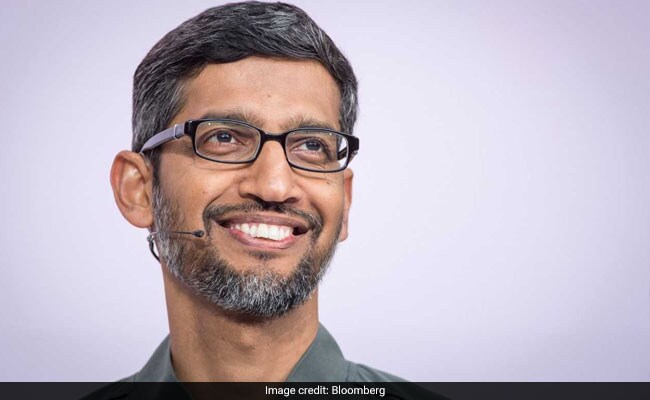
Sundar Pichai was, for years, one of the world's highest-paid corporate executives. Now he's facing the opposite reality: No big paychecks at all.
The Google chief executive officer hasn't received an equity award in more than two years. A key reason is that Mr Pichai turned down a big new grant of restricted stock in 2018 because he felt he was already paid generously, according to a person familiar with the decision.
It's unclear how much he passed up. But another giant payday -- on top of hundreds of millions of dollars in previous awards -- could have sparked a new round of controversy for the mild-mannered executive.
Technology companies are being increasingly blamed for all sorts of societal ills -- including rising income inequality. Since getting the top job in 2015 for his engineering prowess, Mr Pichai has had to address these concerns, while juggling a host of other politically charged issues.
"He may have looked at these numbers and said: 'I've had enough' -- or he might just be trying to manage the optics of his pay," said David Larcker, a professor who researches corporate governance at Stanford Graduate School of Business.
The board of Google parent Alphabet Inc. is scheduled to revisit the CEO's pay later this year, said the person, who asked not to be identified discussing private matters. By then, almost all Mr Pichai's previous stock awards will have vested. That makes him an anomaly among U.S. corporate leaders, and is even raising questions about what's next for the 46-year-old.
"Clearly there's very little retentive effect left for Pichai," said Fabrizio Ferri, an associate professor at the University of Miami who studies executive pay.
A Google spokeswoman declined to comment, and said the Alphabet board won't comment either. The company and its directors have said nothing publicly about the CEO leaving any time soon. Mr Pichai has never mentioned moving on either.
Google is known for its willingness to pay lavishly to attract and keep talented employees in the executive suite and beyond. Top bosses receive almost all of their compensation in the form of restricted shares, usually granted in even-numbered years. Mr Pichai had been among the main beneficiaries.
In 2014, shortly before Mr Pichai was promoted to take over many of Google co-founder Larry Page's responsibilities, he received restricted stock worth about $250 million. The following year, when he became Google CEO, he got $100 million of stock. And in 2016, Mr Pichai received another grant worth almost $200 million.
That was the year the Google CEO job began to morph from a technical leadership role into a political minefield. Employees marched in protest of U.S. President Donald Trump's immigration plan in early 2016. Less than a year later, a memo from Google engineer James Damore claiming the company was biased against conservatives exploded into a national scandal.
In 2018, Google workers revolted over a military contract and a proposed censored search engine in China. In the fall of that year, thousands of staff walked out of their offices after discovering the company had given big bonuses to executives accused of sexual harassment.
At a staff meeting earlier this year, one Google worker asked why Mr Pichai was paid hundreds of millions of dollars, while some employees struggle to afford to live in Silicon Valley, people familiar with the situation said at the time.
The criticism has been just as loud from outside the company. Google is facing multiple antitrust investigations around the world, and rising scrutiny in the U.S. over its size, power and access to personal data. Co-founders Mr Page and Sergey Brin, have stepped away from day-to-day management, and former CEO Eric Schmidt, who used to handle politics, is leaving the board.
On Dec. 11, just over three years after taking the CEO job, a noticeably grayer Mr Pichai sat before Congress being questioned about the political slants of his staff and algorithms, Chinese censorship and surveillance, and even a conspiracy theory about Hillary Clinton that spread on Google's YouTube video service.
"Sundar is aging quickly," said Matt McGowan, a former Google executive who left in 2016. "When you have a billion customers around the world, there's always going to be hundreds of people who disagree with your decisions. And they're loud."
People who have worked with Mr Pichai describe him as a consensus-builder who shies away from conflict. Key parts of the CEO job nowadays, like testifying before Congress and policing internal rancor, are not his favorite.
"He's not a well-seasoned CEO who has been through these types of crises before. But he appears to be learning quickly," Mr McGowan said.
Mr Pichai has revived revenue growth at Google, helping shares of Alphabet rise more than 50 per cent since he took over the internet giant. However, the company missed Wall Street estimates last quarter and the CEO frustrated analysts on a recent conference call.
Reputation Institute, a management consultant, ranked Mr Pichai first among major CEOs last year. In this year's ranking, Mr Pichai fell out of the top 10. "Maybe there are a few elements of doubt around his leadership credentials," said Stephen Hahn-Griffiths, an executive at Reputation Institute.
Since that big 2016 stock award, Mr Pichai has collected a $650,000 annual salary and typical CEO perks such as the cost of personal security. As of Tuesday's close, he had 51,249 unvested Google shares, worth about $58.1 million, left to earn. They will vest in June, September and December, regulatory filings show.

-
Indians Are Travelling, But Not Every Journey Is A Holiday | The Week In Whys

Pilgrims, patients and working women are the real travellers, and the system hasn't quite caught up with them.
-
Getting To Work Costs Women More | The Reason Why
It is not just about women paying more than men. It is about women paying much more in cities than in villages.
-
AI Bias In Investing Cannot Be Eliminated, But It Can Be Governed
Framing is a particularly important example as identical financial information presented in terms of gains rather than losses can lead an LLM to reach a different assessment.
-
Joining The Dots | Dark Skies, Steady Diya: Why Hope Holds This Diwali
With war, a weak rupee and foreign outflows weighing on sentiment, policymakers at the NDTV World Summit and market veterans at NDTV Profit Ignite: Diwali Edition offered the same advice: stay invested and filter out the noise.
-
The Curious Case of Equitas Small Finance Bank And A CEO Who Quit For Stock
PN Vasudevan believes persistent investor concerns over a perceived conflict of interest had become a governance overhang on Equitas Small Finance Bank's stock, even as the lender improved profitability and asset quality.
-
Talking Points This Week: AI Cash Burn, A Tiger Comeback And An India That Still Finds Its Own Path
India is not immune to higher oil or tighter global liquidity, yet its earnings base is broader, its domestic policy levers are still available.
-
Foreign Investors Own Half Of HDFC Bank and ICICI Bank. An LTCG Cut Could Matter Most Here
Foreign portfolio investors have US$115 billion parked in HDFC Bank, ICICI Bank. If the government cuts long-term capital gains tax, Jefferies says returning foreign money could land here first.
-
'Never Seen This Level Of Negativity': Sandeep Tandon Says The Next Rally May Be Closer Than You Think
Veteran investor Sandeep Tandon says foreign selling is easing, large-caps are due a comeback and mid-caps are crowded, while he turns positive on gold, power and pharma this Diwali.
-
Indians Stay With Family, Not In Hotels | The Reason Why
India still lacks enough clean, reliable and affordable hotels for budget-conscious travellers.
-
The Economic Imperative: Analysing The Material Driving Force Behind India-Canada Strategic Reset
This economic complementarity is further reinforced by deep institutional investment ties and talent mobility, which form the bedrock of the bilateral framework.










