Virtual Currencies May Pose Financial, Legal And Security Risks: RBI’s R Gandhi
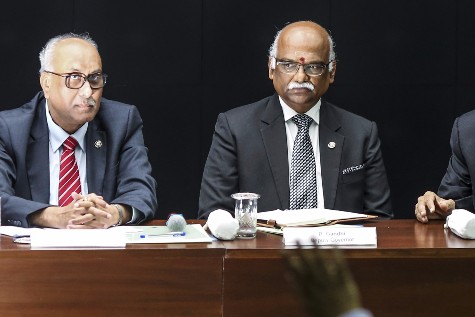
Virtual currencies like Bitcoin may be in fashion but they could pose potential financial, customer protection and security related risks, said Reserve Bank of India (RBI) deputy governor R Gandhi at a FinTech conference in Mumbai.
Gandhi's comments come at a time when virtual currencies are once again in the limelight. Bitcoin, the most widely cited virtual currency, hit a record high in terms of its trading value on February 23. Analysts cited uncertainty around global economic policies as a reason for the increase in the value of Bitcoin, suggesting that it was very seen as an alternative asset class.
In India, too, demonetisation drew attention to the potential benefit of virtual currencies as an alternative.
Gandhi, in his speech, cautioned against this.
Blockchain, the foundation for Bitcoins like innovations, is touted to be the death knell of currency. I believe its potential is being overstated. We can see that in these types of solutions for Virtual Currency (VC), there is no central bank or monetary authority. They pose potential financial, operational, legal, customer protection and security related risks. VCs being in digital form are stored in digital / electronic media; are prone to losses arising out of hacking, loss of password, compromise of access credentials, malware attack, etc.R Gandhi, Deputy Governor, Reserve Bank of India
Most monetary authorities globally have taken a cautious approach towards virtual currencies but have not clamped down on them.
In India, the RBI has issued atleast two cautionary notices. The most recent one came on February 1 when the RBI said that “Any user, holder, investor or trader dealing with virtual currencies is doing it at their own risk.”
In his speech on Wednesday, Gandhi said that a ‘currency' should be able to ensure confidence and anonymity.
“The ‘confidence' in Bitcoins or for that matter any virtual currency based on blockchain or any other technology is also limited to its initial rounds and circles only,” said Gandhi, adding that the initial proponents of these currencies are usually “adventurists and risk seekers”. He believes that once more people, who are risk averse, start purchasing the currency, the currency will require a greater degree of confidence, which can only come if it is issued by an authority.
Innovate But With Care
Gandhi's comments on virtual currencies were made in the wider context of innovation in financial technologies, popularly known as FinTech.
FinTech innovations need to be studied carefully for potential risks before they are accepted, said Gandhi.
“Innovation can sometimes be bad per se, and even good innovation can be misused,” said Gandhi during his keynote address at a summit organised to discuss financial technology. “A careful analysis of the pros and cons, a thoughtful ring-fencing of the risks, closer study on pilot basis before scaling up, and fine-tuning based on feedback are required,” he added.
Apart from virtual currencies, Gandhi cited marketplace lending as an area where caution needs to be exercised.
Marketplace lending, or peer-to-peer lending, is usually conducted through a portal which connects many potential lenders to potential borrowers. Usually, multiple lenders lend to one borrower, thereby dissipating the risk each one has to undertake. The borrower repays the loan along with an interest payment.
Studies cited by the RBI have pegged the size of the peer-to-peer lending market globally at 4.4 billion pound sterling in 2015. The size of the market is estimated to have doubled in just three years. In India, however, this market is still nascent and is as yet unregulated.
The RBI, in a consultation paper released in April last year, proposed that peer-to-peer lending be brought under its ambit. Formal regulations for these entities are yet to be announced.
Marketplace financing eliminates the need for financial intermediaries and all the costs associated with it. But, who guarantees the good behavior of the fundraisers and fund providers? Who will enforce their contractual obligations? When each of them is faceless to one another, and at a great distance, even beyond borders, the issue gets complicated.R Gandhi, Deputy Governor, RBI
An organised and regulated entity is necessary to ensure consumer protection, he added.

-
Indians Are Travelling, But Not Every Journey Is A Holiday | The Week In Whys

Pilgrims, patients and working women are the real travellers, and the system hasn't quite caught up with them.
-
Getting To Work Costs Women More | The Reason Why
It is not just about women paying more than men. It is about women paying much more in cities than in villages.
-
AI Bias In Investing Cannot Be Eliminated, But It Can Be Governed
Framing is a particularly important example as identical financial information presented in terms of gains rather than losses can lead an LLM to reach a different assessment.
-
Joining The Dots | Dark Skies, Steady Diya: Why Hope Holds This Diwali
With war, a weak rupee and foreign outflows weighing on sentiment, policymakers at the NDTV World Summit and market veterans at NDTV Profit Ignite: Diwali Edition offered the same advice: stay invested and filter out the noise.
-
The Curious Case of Equitas Small Finance Bank And A CEO Who Quit For Stock
PN Vasudevan believes persistent investor concerns over a perceived conflict of interest had become a governance overhang on Equitas Small Finance Bank's stock, even as the lender improved profitability and asset quality.
-
Talking Points This Week: AI Cash Burn, A Tiger Comeback And An India That Still Finds Its Own Path
India is not immune to higher oil or tighter global liquidity, yet its earnings base is broader, its domestic policy levers are still available.
-
Foreign Investors Own Half Of HDFC Bank and ICICI Bank. An LTCG Cut Could Matter Most Here
Foreign portfolio investors have US$115 billion parked in HDFC Bank, ICICI Bank. If the government cuts long-term capital gains tax, Jefferies says returning foreign money could land here first.
-
'Never Seen This Level Of Negativity': Sandeep Tandon Says The Next Rally May Be Closer Than You Think
Veteran investor Sandeep Tandon says foreign selling is easing, large-caps are due a comeback and mid-caps are crowded, while he turns positive on gold, power and pharma this Diwali.
-
Indians Stay With Family, Not In Hotels | The Reason Why
India still lacks enough clean, reliable and affordable hotels for budget-conscious travellers.
-
The Economic Imperative: Analysing The Material Driving Force Behind India-Canada Strategic Reset
This economic complementarity is further reinforced by deep institutional investment ties and talent mobility, which form the bedrock of the bilateral framework.










