Global Investors Search for Signs of End to Stock Market Correction
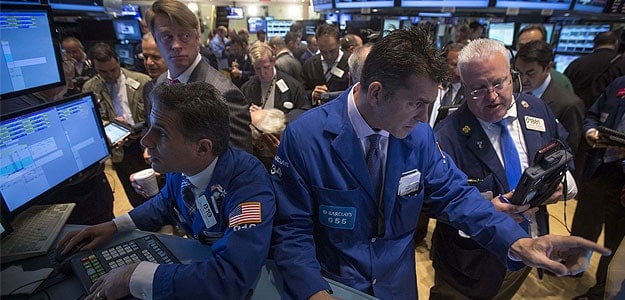
Measuring the point at which investors have exhausted their selling in a market downturn is an inexact science at best, and at its worst akin to sticking a finger in the air to judge shifting winds.
By some measures, the near 10 per cent decline in the Standard & Poor's 500 stock index from a record high last month may already have flushed out much of the speculative money that helped propel a bull market in stocks beyond the average length.
Investors look for a number of signs to determine whether a correction has run its course. The reduction in big bets on the dollar and equities, the rebound of small-cap stocks, the rise in volatility and heavy activity in futures trading as the S&P plunged Wednesday all stand as potential signs that the selling is reaching a crescendo.
For months, worries about European economy and the conflicts in the Middle East and between Russia and Ukraine didn't shake the bullish conviction as the S&P 500 surged to a record closing high of 2,011.36 on September 18. But with the US Federal Reserve looking more serious about reducing stimulus and uncertainty surrounding the Ebola outbreak, the market finally succumbed to a bout of panic.
"One possibility is we're seeing risk reduction not for economic or any kind of structural reasons, but maybe fear of Ebola," said Jack Ablin, chief investment officer at BMO Private Bank in Chicago. "If that's the case and things are transitory, headlines improve over time, perhaps we get back on track."
According to Whitefish, Montana-based InvesTech, since 1932 there has been on average a 10 per cent correction every 25.7 months. It has now been about three years since the last correction occurred in 2011. The S&P 500 has lost 7.4 per cent since its Sept. 18 high.
"We are not surprised we are in a correction phase. ... Typically, crisis events have a short-term impact and a month later the market starts to return to the position it was headed in prior to the downturn," said Sandra Stoutenburg, senior market analyst at InvesTech Research.
One sign that stocks could be rebuilding a base is the turnaround in small-cap names. The recent outperformance of the Russell 2000, an index more closely associated with US-based companies, would suggest investors haven't lost faith in the US economy, despite lousy overseas growth and concerns about weak inflation trends.
After falling 12.9 per cent from its March high, the Russell 2000 is up 3.1 per cent this week, compared with a 2.3 per cent decline in the S&P 500.
In addition, the high number of new 52-week lows seen in the broader market may indicate a turning point. The number of new 52-week lows on the NYSE hit 605 on Thursday, the most in three years, while just 21 issues hit new 52-week highs. That spread is comparable to the 600-to-21 difference seen on June 24, 2013, at the nadir of a 7.5 per cent pullback in the S&P.
"You only get these levels of washed-out-ness at extremes," said Bruce Zaro, chief technical strategist at Bolton Global Asset Management in Boston.
The 14-day relative strength index on the S&P 500, a measure of internal momentum, was below the 30 level that indicates the index is oversold for a second session running on Thursday.
The last time it closed under 30 for two straight days was on Nov. 15, 2012, when the index bottomed after a near 8 per cent slide.
WORRYING ABOUT VOLATILITY
The selloff has caused investors to start paying for protection against further declines. The CBOE Volatility index on Wednesday registered its highest closing level since June 2012.
Notably, the VIX is still at a higher level than VIX futures contracts expiring between October and December, a sign that investors remain more worried about the next 30 days than the period after that.
Much of the fuel for the downturn has come from hedge funds cutting bait on popular long bets that are losing money. Long/short equity funds, which have the freedom to mix bets on stocks rising or falling, have been reducing their long bets in the last month, with net long exposure down to 41 percent from around 55 per cent, according to Credit Suisse research.
While that shows hedge funds have sold out of losing positions, the ratio remains well above the 23 per cent net long position the funds held when the market had a near 10 per cent washout in June 2012.
This could mean there's another round of selling to come. "Hedge fund net exposures appear to be out of step with the October's risk-off move," Credit Suisse said in a note.
In contrast, the sharp rally in bonds, the slump in the price of oil and rise in cross-asset correlations more clearly signals risk-off panic hitting a peak. Jeffrey Kleintop, chief global investment strategist at Charles Schwab in Boston, said he is looking for signs of stability in commodities as a precursor to a recovery in equities.
Commodities, he said, led the stock market, but "they really led the concern about deflation that now seems to be at the root of the concerns that are pushing stocks lower - this lingering and deepening weakness in the euro zone and the concern that it is spreading elsewhere."
Crude oil prices have tumbled nearly 26 per cent from a recent peak in June. Corn is off 32 per cent since May and gold has lost 7.4 per cent in the last four months.
In other markets, big long positions in the dollar and bets on a selloff in the bond market have been reversed. Coming into the week, the value of dollar long positions was $40.91 billion, the biggest since May 2013. As those positions are liquidated and volatility declines, selling across markets could abate.
Investors have maintained a steady level of buying stocks on margin, according to New York Stock Exchange data. August data, the latest available, showed borrowing of $463 billion, slightly more than the $460 billion in July and just off the record $465.7 billion set in February.
InvesTech's Stoutenburg said a decisive drawdown in margin debt would suggest the market could be poised for a downturn. Overall, recent figures, including Thursday's data on industrial production and jobless claims, still point to relatively solid US growth - suggesting investors need to be wary of extreme sentiment.
"Margin debt ticked up in August, but if it turns down in a substantial way that is a real warning flag. History shows us that," Stoutenburg said. "The economics in the U.S. are firm. We are not seeing signs of recession here."
Copyright: Thomson Reuters 2014

-
Extracting Value From Battery Scrap Could Be Challenging For India | The Reason Why

A discarded lithium-ion battery still contains valuable materials such as lithium, nickel and cobalt. These can be recovered and reused. When such batteries are crushed and shredded, they produce a dark powder called black mass.
-
One El Nino, India Can Handle. Two Could Break The Granary
India's grain stocks can absorb one bad year, but a second El Nino could drain the buffer in two to three years, economists say.
-
India's Troika Of Good Luck | Joining The Dots
As Jensen Huang's exit drags Nvidia down, a cooling AI trade and resilient earnings have revived investor interest in India. A likely RBI rate hike looms.
-
Talking Points This Week: Leadership Shock At Nvidia, Earnings Strength, And The Fog Over Hormuz
The Anthropic IPO pricing and first trading day, Nvidia's upcoming earnings, and any fresh signals from Iran will set the tone for the following week.
-
Signature Play: The Classic Cocktail Is Dead. Or Is It?
Classic cocktails are disappearing from India's cocktail menus. But they're still being ordered, taught to bartenders and borrowed from. So, who's really having the last drink?
-
A New Samvat Wishlist: Inclusive Prosperity And Human Development
India has strengthened its economic foundations through infrastructure, digital access and enterprise. Its next growth chapter must deepen productivity, create better livelihoods and widen participation in prosperity.
-
Love, Sex Aur Dhokha: The Audacious Plot To Spy On Jensen Huang
A Taipei dinner, a Singapore chip buyer and a suspected Chinese asset: inside the alleged spy operation that got close to NVIDIA's Jensen Huang.
-
Ten Things I Learnt This Samvat
Patience can be a trap. Cheap stocks can stay cheap. Leverage can wipe you out. What did Samvat 2082 teach us? Niraj Shah writes on 10 lessons from the year gone by.
-
Talking Points This Week: Tech Nerves, FII Buying, And A Faraway Banking Shock
The global markets are not shining this Diwali. The exception in the large markets is, India.
-
Midterm Rally Lasted A Day. The Hard Reality Of A Divided US May Last Two Years | Opinion
Between a contested AI boom, a debt ceiling that arrives in 2027 and a president with every incentive to act alone, the next two years may prove more volatile than the first day's rally suggests.









