Global Funds Look To India As Financial Market Jitters Pick Up
India is shaping up to be a destination for investors seeking a relative shelter from financial volatility linked to the US election.
A steady influx of foreign capital has positioned the nation's bonds among top performers in developing markets this year, while the country's stock market hit a record high last month, buoyed by robust domestic liquidity. India's appeal is driven by a blend of structural factors: stable political ties with both the US and Russia, capital controls that curb hot money flows, and a currency that's less impacted by big dollar moves than emerging market peers.
India's divergence from global markets was evident last week when its sovereign bonds remained relatively steady despite a global selloff in US Treasuries. The nation has become a key emerging market bet for abrdn plc., particularly ahead of the US presidential election on Nov. 5, as hedge funds brace for a pickup in global volatility.
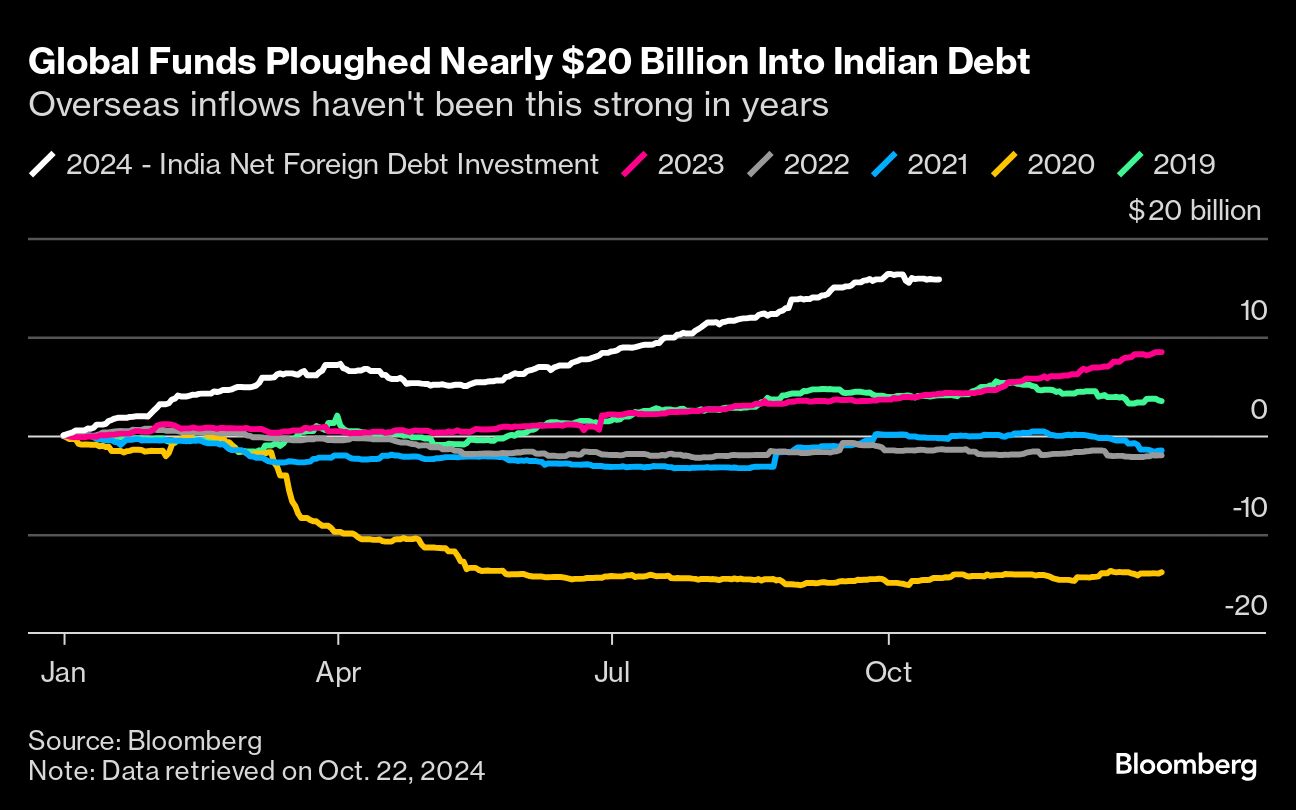
“India's local bond market is relatively insulated from the volatility of global markets, remaining peaceful amidst the storm,” said Edward Ng, a bond fund manager at Nikko Asset Management Co. “Given the market's low volatility, we remain comfortable staying invested in Indian bonds,” which may outperform in a strong-dollar environment, he said.
A key pillar of India's resilience is its currency — once one of Asia's most volatile. For much of 2024, the rupee has been stuck between 82.8 and 84.1 per dollar due to Reserve Bank of India's interventions.
Data compiled by Bloomberg show that the currency has only shaved 1 percentage point off the returns on Indian bonds this year, less than half the rate of currency-related losses on emerging market local-currency bonds overall.
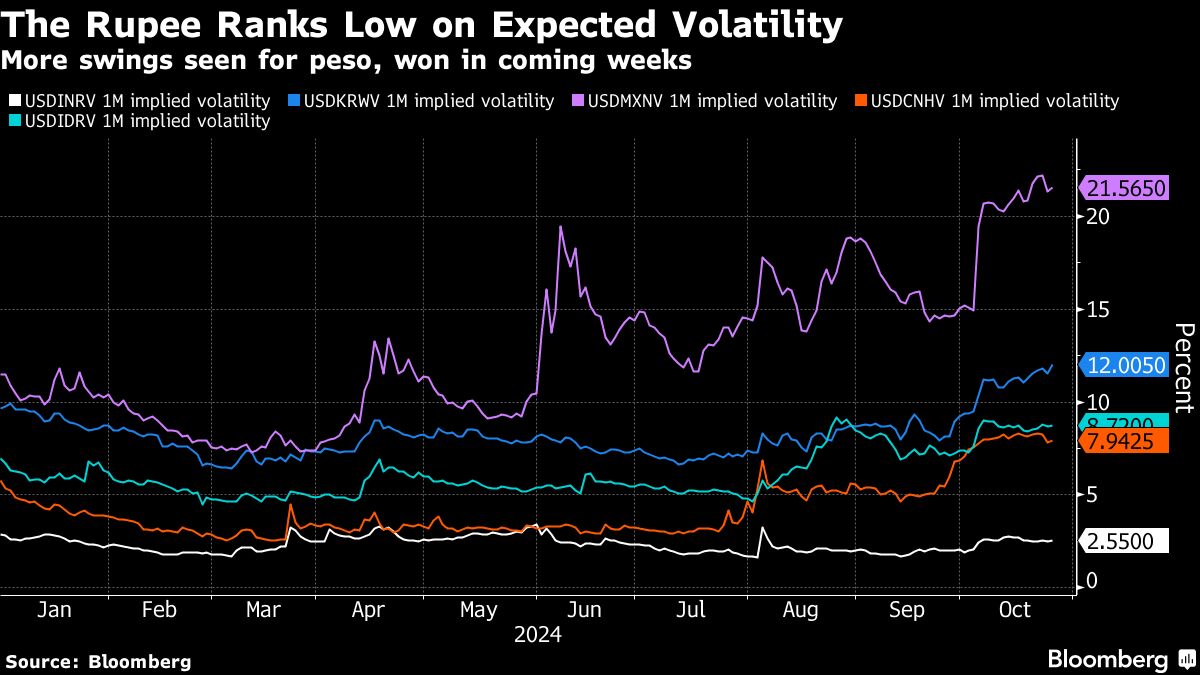
The rupee offers “minimal” volatility, Edwin Gutierrez, head of EM sovereign debt at abrdn, said in an interview. “In this world of uncertainty it ain't a bad place to be.”
To be sure, India isn't a hotspot for global equity investors right now. Signs of a slowdown in the country's robust economic growth and a rebound in Chinese stocks have led to outflows of $8.8 billion from local shares in October, set for a record. While domestic investors' purchases have evened out foreign outflows, the stock market is still on track for its worst month since March 2020.
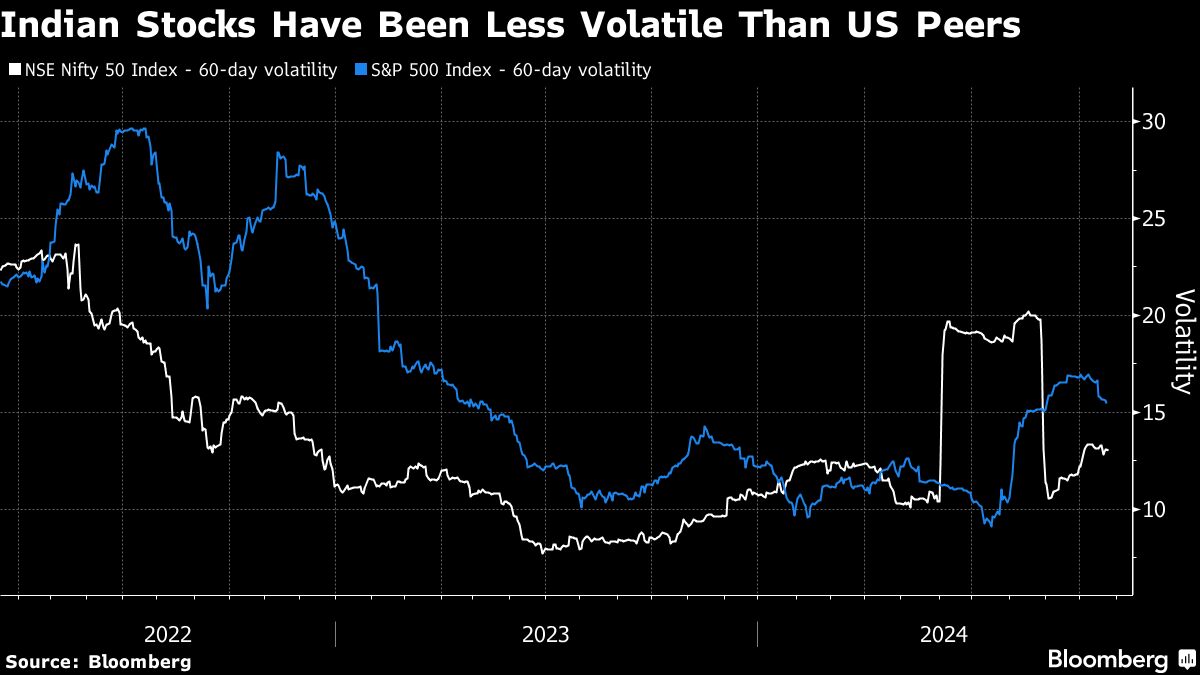
The selloff hasn't led to dramatic swings in the market. The 60-day historical volatility for the benchmark NSE Nifty 50 Index stands at 13.2% — 1.95 percentage points lower than the S&P 500 Index, indicating relative stability in comparison.
UBS Global Wealth Management suggests the selloff is a buying opportunity as the soft patch in India's growth and earnings appears transitory. The view followed Goldman Sachs Group Inc. tactically lowering local shares to neutral from overweight last week.
India isn't the only emerging economy offering a low correlation to global sentiment. Amundi SA and William Blair & Company, LLC have said they favor frontier markets such as Nigeria and Kazakhstan, as potential buffers against US election-driven turmoil.
Yet these alternatives lack the liquidity and depth of India's $1.3 trillion sovereign debt market and $5 trillion of stocks. The country is also expected to lure more offshore funds as part of its inclusion in JPMorgan's bond index — BlackRock Inc. and Amundi SA have launched ETFs to ride that wave.
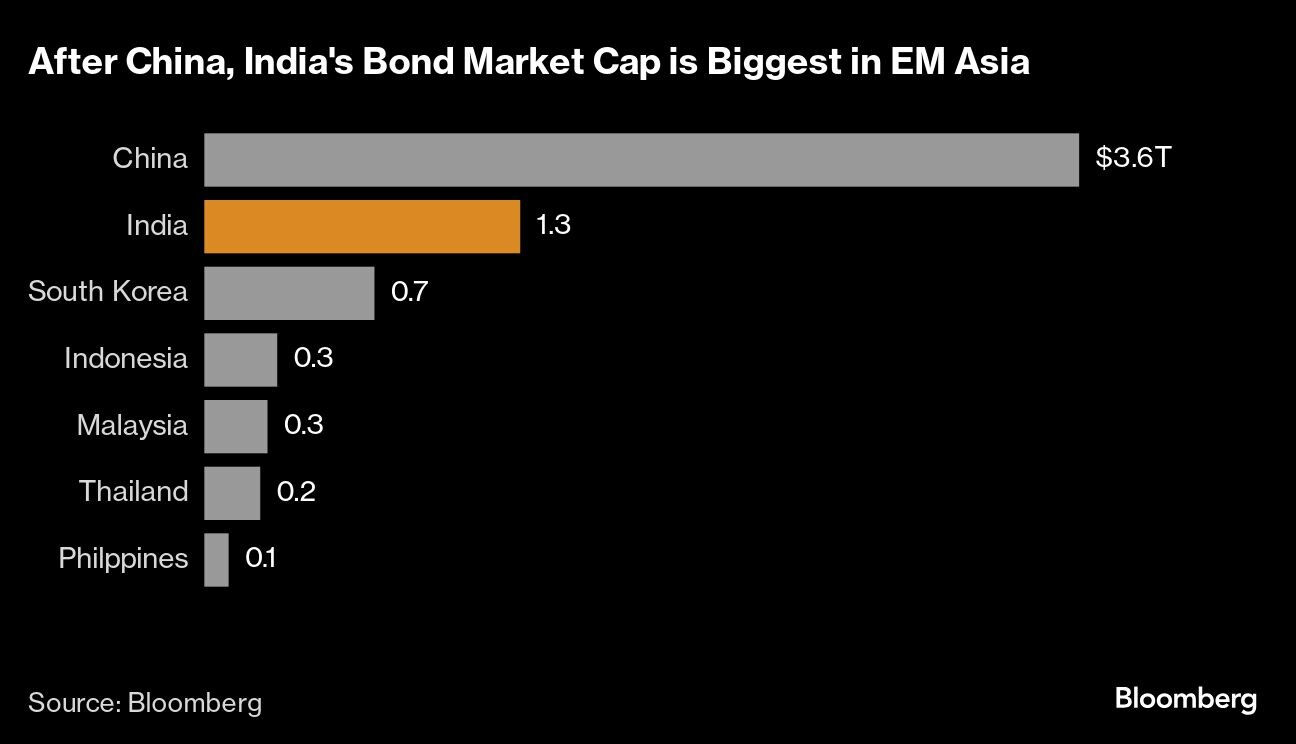
India is due to join Bloomberg's EM gauges from January.
“India local still screens fairly attractively to us,” compared with other assets globally like dollar-denominated debt, said Leonard Kwan, portfolio manager of T. Rowe Price Group Inc.'s dynamic EM bond strategy. “We're overweight rather than in line with the benchmark” on India.
Bloomberg LP is the parent company of Bloomberg Index Services Ltd., which administers indexes that compete with indexes from other providers.

-
Signature Play: The Classic Cocktail Is Dead. Or Is It?

Classic cocktails are disappearing from India's cocktail menus. But they're still being ordered, taught to bartenders and borrowed from. So, who's really having the last drink?
-
A New Samvat Wishlist: Inclusive Prosperity And Human Development
India has strengthened its economic foundations through infrastructure, digital access and enterprise. Its next growth chapter must deepen productivity, create better livelihoods and widen participation in prosperity.
-
Love, Sex Aur Dhokha: The Audacious Plot To Spy On Jensen Huang
A Taipei dinner, a Singapore chip buyer and a suspected Chinese asset: inside the alleged spy operation that got close to NVIDIA's Jensen Huang.
-
Ten Things I Learnt This Samvat
Patience can be a trap. Cheap stocks can stay cheap. Leverage can wipe you out. What did Samvat 2082 teach us? Niraj Shah writes on 10 lessons from the year gone by.
-
Talking Points This Week: Tech Nerves, FII Buying, And A Faraway Banking Shock
The global markets are not shining this Diwali. The exception in the large markets is, India.
-
Midterm Rally Lasted A Day. The Hard Reality Of A Divided US May Last Two Years | Opinion
Between a contested AI boom, a debt ceiling that arrives in 2027 and a president with every incentive to act alone, the next two years may prove more volatile than the first day's rally suggests.
-
Blue Wave Will Derail the AI Trade but Won't Dismantle the AI Era | Unhedged Position
The Democrats' sweep of the US Congress will see politics collide with economic forces both over the long and short term.
-
It's Time To Take The GST Council's Bet On Trust Global
Payment records can prove India's services exports, and clear, proportionate rules can bring foreign digital sellers into the tax net.
-
Opinion | India at 38: From Innovation Overperformer to Innovation Powerhouse
India now has 453 VC-backed deep science startups, 18 of them late-stage, after 117 percent growth since 2020. Laurus Labs, at USD 9.3 billion, is the most valuable deep science company in any middle-income economy outside China.









