Gehlot Government, Protesting Doctors Reach "Compromise" Over Right To Health Bill
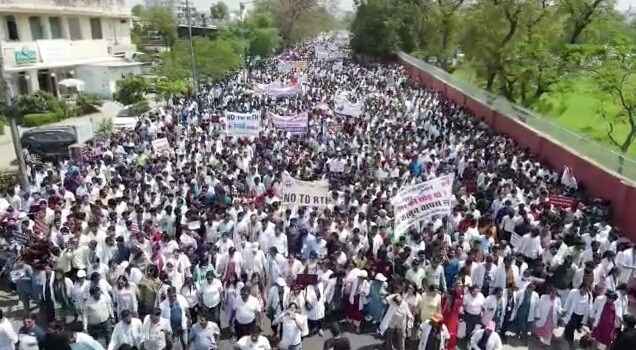
Nearly fifteen days after doctors and hospital owners in Rajasthan launched massive protests against the State government's Right to Health bill that gives people of the State “the right to free consultation, drugs, diagnostics and emergency care at all public hospitals," the state government on Tuesday reached a "consensus" of sorts with the doctors that is likely to get the doctors to resume their work.
Rajasthan Chief Minister Ashok Gehlot tweeted saying that they have reached a consensus with the protesting doctors over the bill. He added that Rajasthan will now become the first state to implement the Right To Health Act. The bill cleared by the state assembly is yet to get the governor's nod.
"I hope that the doctor-patient relationship will remain the same in future as well," the CM said.
Doctors in Rajashan said a decision on the protests will be taken after a meeting in the evening, however IMA officials said there was no sense in agitating any more as most private hospitals have been exempted from the law.
Private doctors in Rajasthan had been demanding the withdrawal of the Bill passed in the state assembly on March 28. According to the bill, every resident of the state will have the right to emergency treatment and care "without prepayment" in any "public health institution, health care establishment and designated health care centres."
The agitating doctors had said there was no clarity on the remuneration, and the burden on private hospitals will increase, with a possibility that non-emergency cases will be cited as emergency cases now. The doctors had also flagged the enormous powers the bill gives to health authorities, and had said this will increase bureaucratic hassles, making the process of filing complaints more complicated. The protests were becoming a challenge for the Gehlot Government in poll-bound Rajasthan that will see assembly elections at the end of the year.
The consensus however came after government officials chaired a meeting with doctors who were protesting against the Bill. A delegation of the Indian Medical Association (IMA) Rajasthan, Private Hospital and Nursing Home Society (PHNHS), and United Private Clinics and Hospitals of Rajasthan (UPCHAR) reached an eight-point agreement with the state government.
The understanding read that the health minister has excluded less than 50 bedded private multi-specialty hospitals from the law, and also all private hospitals that have not taken any facilities from the government in form of land and building at a subsidised rate. The government has clarified that only private medical college hospitals, hospitals established on PPP mode, hospitals established after taking land from the government free of cost or on subsidised rates, and those run by trusts will be covered by the proposed act.
It has also said that police cases and other cases registered during agitation shall be withdrawn, and a single window system for licenses and other approvals for hospitals will be set up, apart from promising that any consultation with two representatives of IMA will be done for further changes in rules.
The bill after being sent to the select committee was passed in the assembly despite protests by the opposition BJP. During the debate on the Bill in the assembly, the BJP had demanded that in case of private facilities, only multispecialty hospitals with 50 beds be included and that there should be a single forum for complaints.

-
The Economic Imperative: Analysing The Material Driving Force Behind India-Canada Strategic Reset

This economic complementarity is further reinforced by deep institutional investment ties and talent mobility, which form the bedrock of the bilateral framework.
-
Medicine Pricing: Where Must Profit Stop?
India must confront excessive margins, hidden incentives and regulatory gaps that threaten the integrity of medicine.
-
Why Amazon And Flipkart Are Struggling To Beat Meesho In India's Smaller Cities
With 274 million users and lowest-cost logistics, Meesho is defending its value commerce crown against giants like Amazon and Flipkart.
-
High US Salaries, No Green Card Certainty: The Financial Calculation Facing Indian H-1B Families
The suspension of PERM processing at eight technology employers does not cancel existing H-1B visas. What it does is force a question many Indian families have been avoiding: is the US salary worth tying your career and family plans to one employer?
-
Swiggy vs Eternal: Food Delivery's Two Rivals Are No Longer In The Same Race
Eternal is building a private AI assistant, dark.ai. Swiggy is still working out how to make Instamart pay, with an operating loss of Rs 895 crore in the July-September quarter while Blinkit stayed profitable.
-
Where You Live Shapes How You Get To Work | The Reason Why
Two-wheelers are the most popular way to get to work in India, accounting for nearly 43% of workplace commutes.
-
Unhedged Position: Can India See An Indonesia-Style Time Correction?
The Nifty is trading below levels it first clocked in 2024. Is there, then, as I have suggested in the headline, potential that the current time correction drags on painfully for the next three-five, even ten years?
-
Navigating Friction And Energy Realities: An Analysis Of Marco Rubio's October Visit To India
Occurring at a critical juncture marked by stalled trade negotiations and escalating geopolitical pressures over global energy supplies, the visit offers a profound window into modern US-India relations.
-
India Exports Capital. Why Not Export Trusteeship?
The big question, then, is whether India can build an institution that global borrowers, investors, banks, and lawyers can trust, even without an Indian connection.
-
France's Economy & Politics Are In Crisis | The Reason Why
Let's look at how the French economy and politics evolved under Nicolas Sarkozy, Franois Hollande and Emmanuel Macron.










