As Economy Slows, Indian States Face Crunch Time For Their Finances
India's sharp slowdown is endangering the fiscal deficit targets of its states, threatening to unravel progress made over the past few years and driving borrowing costs higher for some of them.
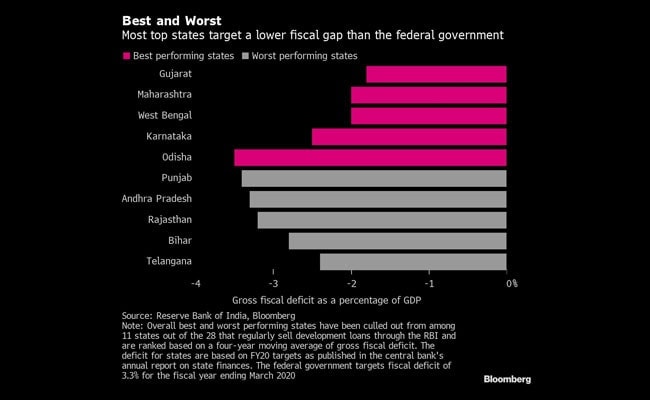
The states have budgeted a consolidated fiscal deficit target of 2.6 per cent of gross domestic product in the financial year ending March, a recent study by the Reserve Bank of India shows. While the deficit ratio has remained within the mandated threshold of 3 per cent of GDP in the previous two years, doubts are growing about their ability to meet the latest goal.
Any slippage could see India's overall public finances come under pressure and raise the risk of a downgrade by rating companies. Only last month, Moody's Investors Service cut the nation's credit rating outlook to negative, citing a litany of problems from a worsening shadow banking crunch and a prolonged slowdown in the economy to rising public debt.
Outstanding debt of states has risen over the last five years to 25 per cent of GDP, posing medium-term challenges to its sustainability, according to the RBI study. India's gross general government debt -- including central and states' borrowings -- stood at 69 per cent of GDP, higher than China's 55.6 per cent, according to the International Monetary Fund.
That spells bad news for states' borrowing costs. The yield on 10-year bonds sold by West Bengal, which has one of the lowest deficit ratios among India's 28 states, rose to 7.29 per cent in December from 7.06 per cent in July, data compiled by Bloomberg News show. That's still lower than the 8.21 per cent at the beginning of the year, as yields tracked the RBI's aggressive interest rate cuts.
Despite attractive yields on states' debt that carry an implicit sovereign guarantee, there's little interest from global funds -- which have used only 2.2 per cent of the Rs 61,200-crore ($8.6 billion) investment limit available to them in such notes. Part of the reason, according to fund managers, is a lack of price differentiation between the better-run and poorer states.
West Bengal is joined by states such as Gujarat and Maharashtra that have managed to keep their fiscal deficits at less than 3 per cent of GDP. But they all pay a coupon similar to that of, or greater than some of their financially weaker peers. Take Rajasthan: the state had an average gross fiscal deficit of 5.4 per cent between financial years 2016 and 2019, but sold 10-year bonds this month at a yield of 7.18 per cent.
States haven't had a problem attracting local investors with yields that are typically higher than those on notes issued by the central government.
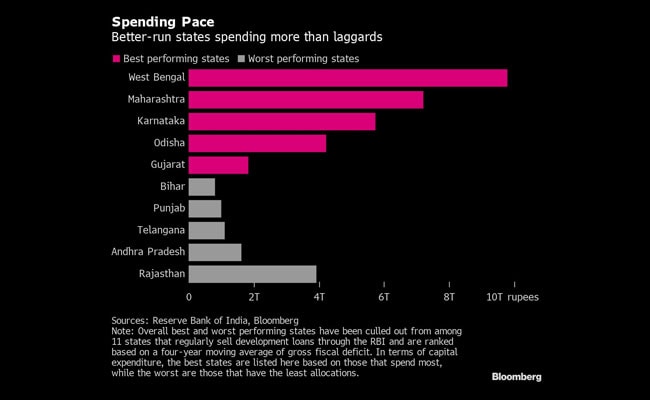
Increasing debt obligations are limiting the scope for greater capital spending by some of the states.
"With the center's finances already under acute stress, we may see cut backs in pace of spending of both the center and states," said Garima Kapoor, an economist at Elara Securities India Pvt. in Mumbai. "This could have ramifications for growth and domestic liquidity conditions."
A Moody's analysis of state budgets shows that capital expenditure by states will likely grow only slightly to Rs 5.5 lakh crore in the current fiscal year from Rs 5.4 lakh crore the previous year.
Social sector spending, which recovered in the year ended March 2019, is expected to hold up in the current year, broadly in line with Prime Minister Narendra Modi's vision of greater welfare reaching the poorer sections of society.
"A shift is projected from expenditure on education, health and family welfare to sectors like housing and urban development and expenditure on social security and welfare," Care Ratings Ltd. wrote in a report, adding that recent initiatives like a health program for all may impact social sector expenditures.
The growth slowdown also means weaker revenue for states, especially collections from the goods and services tax.
It will "constrain states' ability to service their rising debt burdens and address spending needs, especially for states with debt burdens above 200 per cent and debt service over 30 per cent of operating revenue, such as Haryana, Punjab, Kerala and West Bengal," Moody's said in a report.

-
AI Bias In Investing Cannot Be Eliminated, But It Can Be Governed

Framing is a particularly important example as identical financial information presented in terms of gains rather than losses can lead an LLM to reach a different assessment.
-
Joining The Dots | Dark Skies, Steady Diya: Why Hope Holds This Diwali
With war, a weak rupee and foreign outflows weighing on sentiment, policymakers at the NDTV World Summit and market veterans at NDTV Profit Ignite: Diwali Edition offered the same advice: stay invested and filter out the noise.
-
The Curious Case of Equitas Small Finance Bank And A CEO Who Quit For Stock
PN Vasudevan believes persistent investor concerns over a perceived conflict of interest had become a governance overhang on Equitas Small Finance Bank's stock, even as the lender improved profitability and asset quality.
-
Talking Points This Week: AI Cash Burn, A Tiger Comeback And An India That Still Finds Its Own Path
India is not immune to higher oil or tighter global liquidity, yet its earnings base is broader, its domestic policy levers are still available.
-
Foreign Investors Own Half Of HDFC Bank and ICICI Bank. An LTCG Cut Could Matter Most Here
Foreign portfolio investors have US$115 billion parked in HDFC Bank, ICICI Bank. If the government cuts long-term capital gains tax, Jefferies says returning foreign money could land here first.
-
'Never Seen This Level Of Negativity': Sandeep Tandon Says The Next Rally May Be Closer Than You Think
Veteran investor Sandeep Tandon says foreign selling is easing, large-caps are due a comeback and mid-caps are crowded, while he turns positive on gold, power and pharma this Diwali.
-
Indians Stay With Family, Not In Hotels | The Reason Why
India still lacks enough clean, reliable and affordable hotels for budget-conscious travellers.
-
The Economic Imperative: Analysing The Material Driving Force Behind India-Canada Strategic Reset
This economic complementarity is further reinforced by deep institutional investment ties and talent mobility, which form the bedrock of the bilateral framework.
-
Medicine Pricing: Where Must Profit Stop?
India must confront excessive margins, hidden incentives and regulatory gaps that threaten the integrity of medicine.
-
Why Amazon And Flipkart Are Struggling To Beat Meesho In India's Smaller Cities
With 274 million users and lowest-cost logistics, Meesho is defending its value commerce crown against giants like Amazon and Flipkart.










