At -23.9%, GDP Contracts At Its Steepest Pace On Record
- Monday's data marks the likely onset of India's deepest recession on record, which is widely expected to run through the second half of the fiscal year, as the rapid spread of the pandemic continues to weigh on demand, hindering a pickup in economic activity. Typically, recession is defined as two consecutive quarters of decreasing GDP.
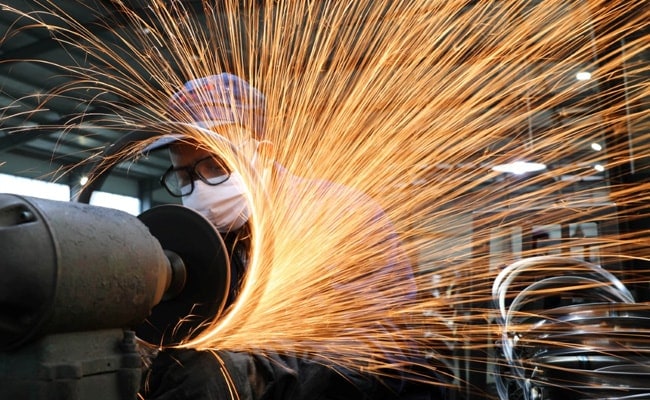
- Financial services - the biggest component of the country's services sector, shrank 5.3 per cent compared to the corresponding period a year ago. Manufacturing and construction shrank 39.3 per cent and 50.3 per cent respectively. Agriculture bucked the trend, with an expansion of 3.4 per cent.
- Though the coronavirus-related restrictions have been gradually lifted, there has been an impact on the economic activities as well as on the data collection mechanisms, the government's statistics office said. Challenges related to other underlying macroeconomic indicators such as industrial production and consumer inflation will also have implications on these estimates, it said, mentioning likely revisions "in due course".
- The data comes as the government is strategically removing restrictions imposed in March to curb COVID-19 infections, which have caused thousands of job losses and forced the majority of workforce to stay indoors, leading to a big blow to an already-slowing economy.
- Chief Economic Adviser Krishnamurthy Subramanian said, "India was in a lockdown all through April to June quarter with majority of economic activities being restricted. So this trend is along expected lines... Core sector output is clearly showing a V-shaped recovery."
- COVID-19 is spreading faster in India than anywhere else in the world, as daily tallies have exceeded those of the US and Brazil for almost two weeks. India currently has more than 3.54 million cases, and 63,498 deaths.
- Economists say the rapid increase in COVID-19 cases amid stretched public finances and soaring inflation means a recovery may not take place soon. Some say the economy could see a contraction of nearly 10 per cent in the year through March 2021.
- In May, PM Narendra Modi announced a stimulus package equivalent to 10 per cent of GDP - including credit guarantees on bank loans and free food grains to the poor - but consumer demand and manufacturing have yet to recover. Many economists have said that much of that support was already budgeted for by the government and very little included new spending.
- Just before the pandemic, the government was aiming at transforming the economy, from an estimated $2.8 trillion, to $5 trillion by 2024, despite slowing growth and low demand.
- The Reserve Bank of India has reduced the key interest rates by 115 basis points (1.15 percentage point) since March to revive the economy, but is watchful of worsening inflationary pressures. It has already shifted gears to focus on economic health for the time being, instead of inflation.

-
Getting To Work Costs Women More | The Reason Why

It is not just about women paying more than men. It is about women paying much more in cities than in villages.
-
AI Bias In Investing Cannot Be Eliminated, But It Can Be Governed
Framing is a particularly important example as identical financial information presented in terms of gains rather than losses can lead an LLM to reach a different assessment.
-
Joining The Dots | Dark Skies, Steady Diya: Why Hope Holds This Diwali
With war, a weak rupee and foreign outflows weighing on sentiment, policymakers at the NDTV World Summit and market veterans at NDTV Profit Ignite: Diwali Edition offered the same advice: stay invested and filter out the noise.
-
The Curious Case of Equitas Small Finance Bank And A CEO Who Quit For Stock
PN Vasudevan believes persistent investor concerns over a perceived conflict of interest had become a governance overhang on Equitas Small Finance Bank's stock, even as the lender improved profitability and asset quality.
-
Talking Points This Week: AI Cash Burn, A Tiger Comeback And An India That Still Finds Its Own Path
India is not immune to higher oil or tighter global liquidity, yet its earnings base is broader, its domestic policy levers are still available.
-
Foreign Investors Own Half Of HDFC Bank and ICICI Bank. An LTCG Cut Could Matter Most Here
Foreign portfolio investors have US$115 billion parked in HDFC Bank, ICICI Bank. If the government cuts long-term capital gains tax, Jefferies says returning foreign money could land here first.
-
'Never Seen This Level Of Negativity': Sandeep Tandon Says The Next Rally May Be Closer Than You Think
Veteran investor Sandeep Tandon says foreign selling is easing, large-caps are due a comeback and mid-caps are crowded, while he turns positive on gold, power and pharma this Diwali.
-
Indians Stay With Family, Not In Hotels | The Reason Why
India still lacks enough clean, reliable and affordable hotels for budget-conscious travellers.
-
The Economic Imperative: Analysing The Material Driving Force Behind India-Canada Strategic Reset
This economic complementarity is further reinforced by deep institutional investment ties and talent mobility, which form the bedrock of the bilateral framework.
-
Medicine Pricing: Where Must Profit Stop?
India must confront excessive margins, hidden incentives and regulatory gaps that threaten the integrity of medicine.










