Gautam Adani-Led Group India's Most Valued Conglomerate, Overtakes Tatas
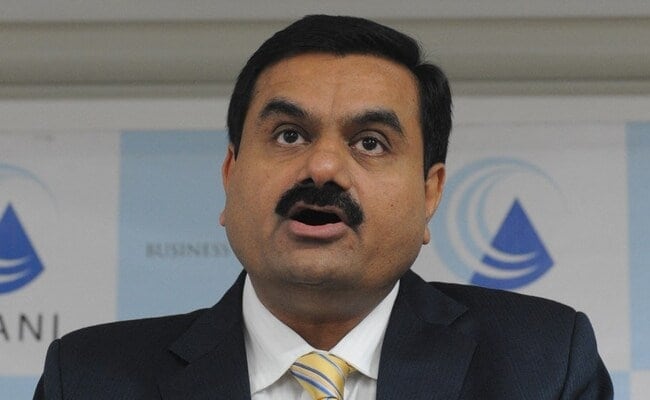
The Adani group of firms' overall market capitalisation on the BSE at over Rs 22 lakh crore makes it the most valued in India, overtaking the Tata-led conglomerate.
Based on Friday's close, the market valuation of all BSE listed stocks of Adani Group, totalling nine firms, including the recently acquired Ambuja cement and ACC LTD, stood at over Rs 22 lakh crore, surpassing 27 of Tata Group of firms listed with a market capitalisation (market cap) of more than Rs 20 lakh crore.
Mukesh Ambani's group of nine companies stood third on the list with a market capitalisation of more than Rs 17 lakh crore.
That reflects a broader run-up in Adani stock, which pushed Gautam Adani to become the third richest in the world on the Forbes list of billionaires, overtaking Amazon founder Jeff Bezos, and behind Elon Musk and Louis Vitton's Bernard Arnault.
While Mr Adani, with a net valuation of $154.7 billion currently, briefly surpassed Louis Vitton's Bernard Arnault, a bloodbath in domestic stocks on Friday pushed him back to No. 3 on the Real-Time Billionaires List compiled by Forbes.
That is largely driven by the wealth erosion of American billionaires from the recent market crash on expectations for a very aggressive Federal Reserve after a red-hot inflation reading.
Still, Elon Musk remains the richest person, with a net worth of $273.5 billion.
Gautam Adani's rise in wealth is also more a measure of a jump in the valuation of stocks rather than the result of a rise in fundamentals, such as earnings and growth, with many of the entities' shares controlled by him rising sharply.
Still, Gautam Adani's ascent, by about any measure, has been nothing short of remarkable.
First, he became the richest person in Asia. Then his net worth surpassed those of Warren Buffett and Bill Gates. Now he's fast approaching a level of wealth only rivalled by Louis Vitton's Bernard Arnault and Elon Musk.
The market valuation of the Adani Group of firms is more spread across entities, while one or two large entities form the majority of Tatas and Reliance's market cap.
The Adani Group, which consists of seven publicly listed companies in the infrastructure, mining, energy, and other industries, is led by Mr Adani, a first-generation entrepreneur.
A rapid diversification spree has pushed his vast, largely fossil-fuel driven conglomerate into a raft of new sectors in and outside of India, and Mr Adani is seeking to reinvent himself for the global stage.
Adani Enterprises has made significant investments in emerging industries over the past five years, including airports, cement, copper refining, data centres, green hydrogen, petrochemical refining, roadways, and solar cell production.
Adani group became the second-largest cement maker in the country after completing its acquisition of Ambuja Cements and ACC on Friday. The group had no cement-making operations previously but had said the firms were a good fit given its ports and logistics, energy and real estate businesses.
Adani Group has big intentions to expand its green hydrogen and airport operations and enter the telecom industry. It has also pledged to invest $70 billion in infrastructure for renewable energy.
A separate report showed Adani Wilmar is scouting for local and overseas acquisition targets as Asia's richest man doubles down on boosting his empire's food operations.

-
We May Need Another Tukaram Mundhe To Fight Air Pollution | The Reason Why

Developers may install basic measures such as sprinklers and green nets, resume work, and continue violating rules when this equipment stops working.
-
Extracting Value From Battery Scrap Could Be Challenging For India | The Reason Why
A discarded lithium-ion battery still contains valuable materials such as lithium, nickel and cobalt. These can be recovered and reused. When such batteries are crushed and shredded, they produce a dark powder called black mass.
-
One El Nino, India Can Handle. Two Could Break The Granary
India's grain stocks can absorb one bad year, but a second El Nino could drain the buffer in two to three years, economists say.
-
India's Troika Of Good Luck | Joining The Dots
As Jensen Huang's exit drags Nvidia down, a cooling AI trade and resilient earnings have revived investor interest in India. A likely RBI rate hike looms.
-
Talking Points This Week: Leadership Shock At Nvidia, Earnings Strength, And The Fog Over Hormuz
The Anthropic IPO pricing and first trading day, Nvidia's upcoming earnings, and any fresh signals from Iran will set the tone for the following week.
-
Signature Play: The Classic Cocktail Is Dead. Or Is It?
Classic cocktails are disappearing from India's cocktail menus. But they're still being ordered, taught to bartenders and borrowed from. So, who's really having the last drink?
-
A New Samvat Wishlist: Inclusive Prosperity And Human Development
India has strengthened its economic foundations through infrastructure, digital access and enterprise. Its next growth chapter must deepen productivity, create better livelihoods and widen participation in prosperity.
-
Love, Sex Aur Dhokha: The Audacious Plot To Spy On Jensen Huang
A Taipei dinner, a Singapore chip buyer and a suspected Chinese asset: inside the alleged spy operation that got close to NVIDIA's Jensen Huang.
-
Ten Things I Learnt This Samvat
Patience can be a trap. Cheap stocks can stay cheap. Leverage can wipe you out. What did Samvat 2082 teach us? Niraj Shah writes on 10 lessons from the year gone by.
-
Talking Points This Week: Tech Nerves, FII Buying, And A Faraway Banking Shock
The global markets are not shining this Diwali. The exception in the large markets is, India.









