G20 Says Nearing Growth Goal, but More Needed From Europe
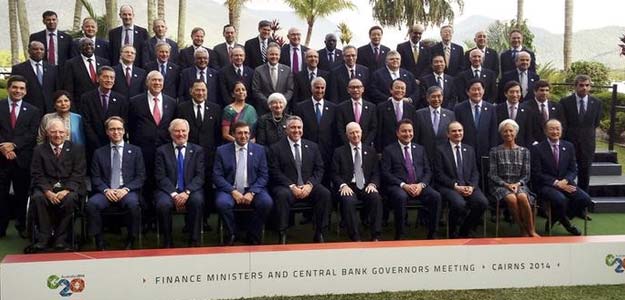
Cairns, Australia: The Group of 20 nations says they are tantalisingly close to adding an extra $2 trillion to the global economy and creating millions of new jobs, but Europe's extended stagnation remains a major stumbling block.
The finance ministers and central bank chiefs gathered in the Australian city of Cairns claimed progress on fireproofing the world's financial system and on closing tax loopholes exploited by giant multinationals.
They also dealt with the thorny problem of whether to invite Russian President Vladimir Putin to the G20 leaders' summit in November given events in Ukraine, with the consensus being to maintain diplomatic pressure but leave the door open for his attendance.
"We are determined to lift growth, and countries are willing to use all our macroeconomic levers - monetary, fiscal and structural policies - to meet this challenge," said Australian Treasurer Joe Hockey, who hosted the event.
Almost 1,000 measures had been proposed that would boost global growth by 1.8 per cent by 2018, nearing the ambitious goal of 2 percentage points adopted back in February.
A common concern was the risk of Europe's economic malaise pulling others down. US Treasury Secretary Jack Lew cited "philosophical" differences with some of his counterparts in Europe, especially on the need for near-term stimulus.
"The concern that I have is that if the efforts to boost demand are deferred for too long, there's a risk that the headwinds get stronger and what Europe needs is some more tailwinds in the economy," Mr Lew said.
That was not an argument that found favour with German Finance Minister Wolfgang Schaeuble who emphasised the need for structural reforms and strict budget controls.
The proposals to lift global growth will now go for formal approval at the summit of G20 leaders in Brisbane in November.
Chief among them was a global initiative aimed at increasing private investment in infrastructure, a particular hobby horse of the Australians who head the G20 this year.
China gets a pass
While Europe's failings were front and centre, there was surprisingly little said about China's slowdown, at least publicly. That struck some as odd given the Asian giant was just behind the United States in the size of its economy.
"Our basic point on the aspirational growth target is that with China slowing down in a structural sense... it will be exceedingly difficult to hit that (2 percent) number, given China's massive arithmetic impact," said Huw McKay, a senior international economist at Westpac.
China's finance chief, Lou Jiwei, noted that stimulus measures also brought problems such as excess capacity, environmental pollution and growing local government debt, just the latest sign that any policy easing there would be limited.
The risks that super-loose monetary policy could inflate asset bubbles was also much discussed by the G20, along with the need for the Federal Reserve to avoid spooking markets as it winds down its quantitative easing campaign.
The US central bank is widely expected to end its asset-buying program in October and to start raising interest rates next year, a marked contrast to the European Central Bank and the Bank of Japan where even more easing might be needed.
Bank buffers
Regulators are looking at increasing the size of the capital buffer that the world's top banks need to hold to reduce the risk of a repeat of the global financial crisis.
European Central Bank Governing Council member Christian Noyer said a buffer of about 16 per cent of risk-weighted assets was realistic but had not been finalised. A figure would be announced at the leaders' summit, he said.
Also on the drawing board were plans to stem the loss of revenue from multinationals shifting their profits to low-tax countries, potentially reclaiming billions of dollars.
Taxation arrangements of global companies such as Google Inc, Apple Inc and Amazon.com Inc have become a hot political topic following media and parliamentary investigations into how many companies reduce their bills.
"We have endorsed far-reaching initiatives to identify and catch tax cheats through the automatic exchange of information using a Common Reporting Standard," Australia's Mr Hockey said.
"We encourage others to match this commitment so that there are no places to hide."
Copyright @ Thomson Reuters 2014

-
The Curious Case of Equitas Small Finance Bank And A CEO Who Quit For Stock

PN Vasudevan believes persistent investor concerns over a perceived conflict of interest had become a governance overhang on Equitas Small Finance Bank's stock, even as the lender improved profitability and asset quality.
-
Talking Points This Week: AI Cash Burn, A Tiger Comeback And An India That Still Finds Its Own Path
India is not immune to higher oil or tighter global liquidity, yet its earnings base is broader, its domestic policy levers are still available.
-
Foreign Investors Own Half Of HDFC Bank and ICICI Bank. An LTCG Cut Could Matter Most Here
Foreign portfolio investors have US$115 billion parked in HDFC Bank, ICICI Bank. If the government cuts long-term capital gains tax, Jefferies says returning foreign money could land here first.
-
'Never Seen This Level Of Negativity': Sandeep Tandon Says The Next Rally May Be Closer Than You Think
Veteran investor Sandeep Tandon says foreign selling is easing, large-caps are due a comeback and mid-caps are crowded, while he turns positive on gold, power and pharma this Diwali.
-
Indians Stay With Family, Not In Hotels | The Reason Why
India still lacks enough clean, reliable and affordable hotels for budget-conscious travellers.
-
The Economic Imperative: Analysing The Material Driving Force Behind India-Canada Strategic Reset
This economic complementarity is further reinforced by deep institutional investment ties and talent mobility, which form the bedrock of the bilateral framework.
-
Medicine Pricing: Where Must Profit Stop?
India must confront excessive margins, hidden incentives and regulatory gaps that threaten the integrity of medicine.
-
Why Amazon And Flipkart Are Struggling To Beat Meesho In India's Smaller Cities
With 274 million users and lowest-cost logistics, Meesho is defending its value commerce crown against giants like Amazon and Flipkart.
-
High US Salaries, No Green Card Certainty: The Financial Calculation Facing Indian H-1B Families
The suspension of PERM processing at eight technology employers does not cancel existing H-1B visas. What it does is force a question many Indian families have been avoiding: is the US salary worth tying your career and family plans to one employer?
-
Swiggy vs Eternal: Food Delivery's Two Rivals Are No Longer In The Same Race
Eternal is building a private AI assistant, dark.ai. Swiggy is still working out how to make Instamart pay, with an operating loss of Rs 895 crore in the July-September quarter while Blinkit stayed profitable.










