Fuel-Tax Hikes Putting Brakes On Recovery Of Virus-Hit Economy: Analysts
Dilip Lamba, who owns a transport company in Jodhpur in, has had more than three-quarters of his fleet of 50 trucks idling for months. Dharampal Nambardar, a farmer who grows wheat and mustard seed in Haryana state, is worried he might not make any profit this year.
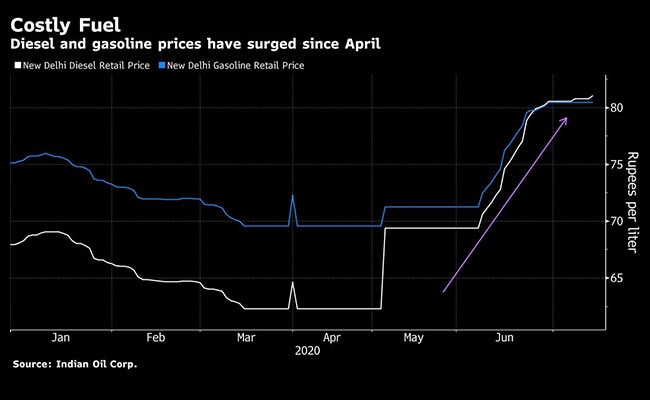
The main source of their anxiety is not Covid-19, however, but rather a surge in fuel prices. The central government has hiked import and excise taxes twice this year even as it imposed the world's biggest coronavirus lockdown. Retail prices for diesel -- the lifeblood of economy -- in New Delhi have jumped 30 per cent since the end of April, while petrol has risen 16 per cent.
"Diesel makes up almost 70 per cent of our operating costs," said Lamba, whose company carries everything from cotton to cement to leather goods all over India. "Higher diesel prices means higher freight charges. But customers aren't ready for it and we can't absorb the costs."
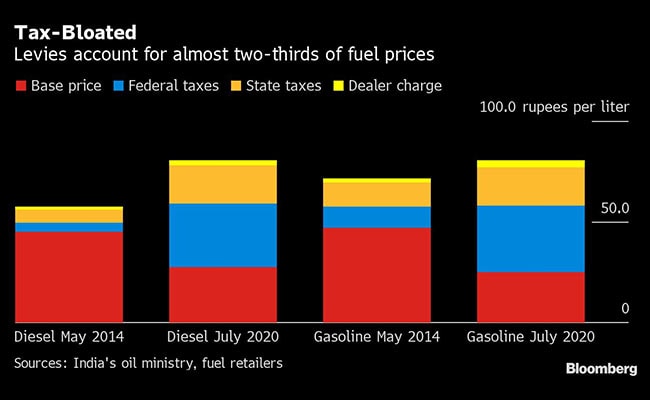
The central government raised levies on diesel and petrol in March and then again in early May as the coronavirus battered the economy. There's been a staggering fivefold increase in taxes on diesel since 2014 when Prime Minister Narendra Modi came to power, while those on petrol have more than doubled. State governments also impose fuel levies, which in Delhi account for around a quarter of the retail prices.
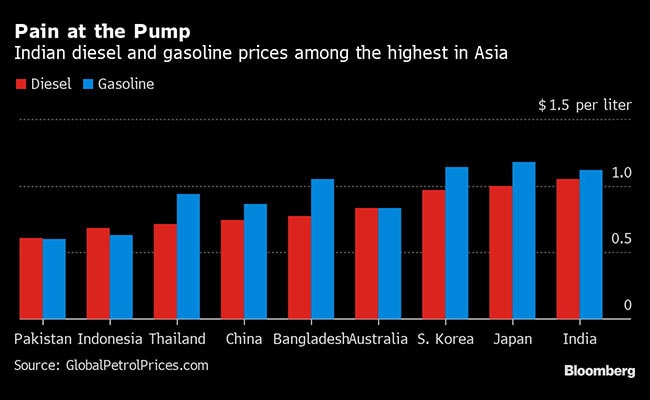
Taxes on the two fuels now account for almost two-third's of what Indians pay at the pump, making Indian retail prices among the highest in Asia and almost double that in neighboring Pakistan. The recovery in global crude prices, meanwhile, has boosted Indian fuel costs even further in the last few months.
The high prices are adding another headwind to an economy facing the biggest contraction in four decades. Diesel powers India's trucking fleet, which carries two-third of the country's freight, and is also essential for construction and agriculture. Gasoline, meanwhile, fills the tanks of millions of motorbikes ridden by lower-income Indians.
"While pump prices across the world have mostly followed the drop in oil prices since last year, India is an exception," said Senthil Kumaran, a senior oil analyst at industry consultant FGE. "It's unusual to see such a steep increase in the taxes on diesel, as the fuel is deemed to be a driver of economic growth, especially in rural areas."
There appears to be little chance that Prime Minister Modi will take steps to curb the rising diesel and petrol prices even as global crude prices recover. This year's fuel levy increases are expected to generate about $30 billion a year in revenue for the government, according to Bloomberg Intelligence, at a time when coffers are being squeezed by less income and sales tax and higher spending on welfare programs.
"The tax hike in early May is turning into a wider cost-push supply shock, reinforced by a rebound in global crude oil prices," Abhishek Gupta, India economist at Bloomberg Economics, said in a note. That's likely to push up inflation over the next few months, he said.
With industrial production still fragile as Covid-19 continues to spread in India, Oil Minister Dharmendra Pradhan's prediction last month that fuel demand will be back to pre-virus levels by September is looking tough to achieve.
There's already evidence that the high prices are curbing demand. Provisional fuel sales in June show that while India's overall consumption of petroleum products was 8 per cent lower than a year earlier, diesel and gasoline consumption were down 15 per cent% and 14 per cent, respectively.
"The cost of operations has increased exorbitantly and small truck operators are unable to pass it on to the consumers because demand is low," said Kultaran Singh Atwal, chairman of the All India Motor Transport Congress, the largest such grouping in the country. Almost half of India's truck fleet is still idle, he said.

-
Gold Is Rs 22,000 Cheaper Than A Month Ago. Should You Buy Amid The Wedding Season?

Gold's potential slide to $3,500 could save around Rs 4,700 per 10 grams, but a soft inflation print could just as easily push prices back up. One way to split the risk is to buy in parts, some now and the rest after the Fed's Dec. 9 decision.
-
AI Agents Are Gaining Power. Who Governs Them?
Artificial intelligence agents promise to transform productivity by moving machines from assisting decisions to executing them. But as organisations delegate greater authority to these AI-agents, they must first establish who controls that authority and who remains accountable when things go wrong.
-
Why Swapping Your Old Gold Can Trigger A Rs 5 Lakh Tax Bill, And How You Can Avoid It Legally
Swapping old gold for new is taxed as a sale and a fresh purchase. Getting your own gold remade can cut most of that bill, though it has its own costs.
-
The AI Trade is Done. The Real Opportunity for Investors Starts in 2027 | Unhedged Position
As pureplay AI stocks plunge and circular, capex-led financing unwinds, 2027 is set to be a year of reckoning for AI companies. Yet the bust clears the way for a better opportunity for investors in 2027 -- shifting the spotlight from AI builders to the companies using AI.
-
Leadership As Mission: Why The Age Of AI Demands More Human Leadership
Debjani Ghosh examines how AI is changing leadership, arguing that its success must be measured by its impact on people and the accountability of those guiding its use.
-
We May Need Another Tukaram Mundhe To Fight Air Pollution | The Reason Why
Developers may install basic measures such as sprinklers and green nets, resume work, and continue violating rules when this equipment stops working.
-
Extracting Value From Battery Scrap Could Be Challenging For India | The Reason Why
A discarded lithium-ion battery still contains valuable materials such as lithium, nickel and cobalt. These can be recovered and reused. When such batteries are crushed and shredded, they produce a dark powder called black mass.
-
One El Nino, India Can Handle. Two Could Break The Granary
India's grain stocks can absorb one bad year, but a second El Nino could drain the buffer in two to three years, economists say.
-
India's Troika Of Good Luck | Joining The Dots
As Jensen Huang's exit drags Nvidia down, a cooling AI trade and resilient earnings have revived investor interest in India. A likely RBI rate hike looms.
-
Talking Points This Week: Leadership Shock At Nvidia, Earnings Strength, And The Fog Over Hormuz
The Anthropic IPO pricing and first trading day, Nvidia's upcoming earnings, and any fresh signals from Iran will set the tone for the following week.









