FSR: RBI Says Bank NPAs May Fall To 10.3% In March 2019
.jpg?downsize=1010:568 "FSR: RBI Says Bank NPAs May Fall To 10.3% In March 2019")
The Reserve Bank of India expects bad loans in the system to fall by March, suggesting that the stress Indian lenders have been facing will start to ease after three years.
The gross non-performing ratio of Indian banking system will drop to 10.3 percent by March, according to the central bank's latest Financial Stability Report. That compares with 10.8 percent in September.
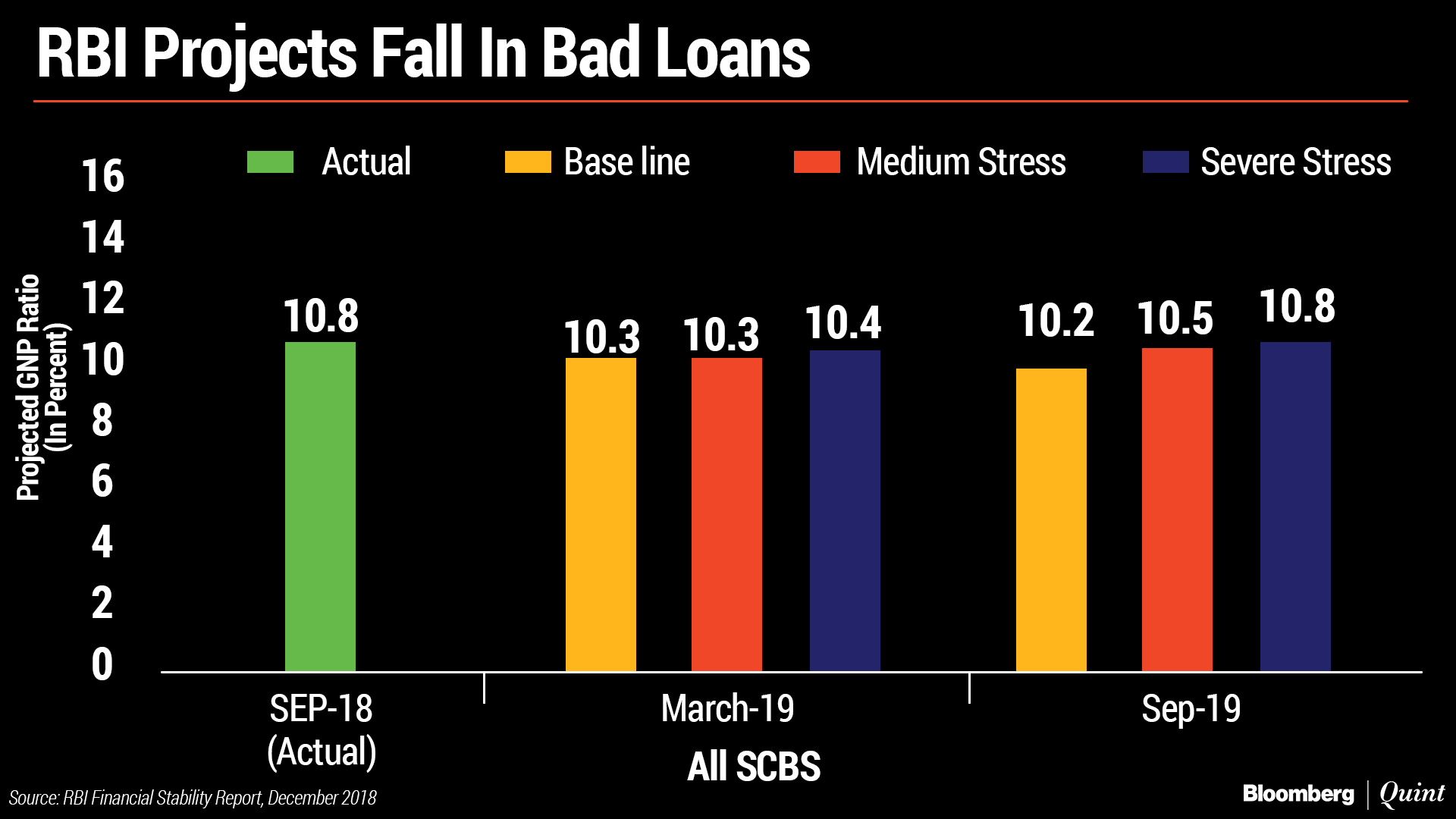
The estimate is based on a baseline scenario which assumes that the current economic situation will continue. To be sure, the RBI in its last installment of the report in July had estimated the gross bad loans to rise to 12.9 percent by March.
Industry-wide bad loans have more than doubled to over Rs 10 lakh crore since the RBI started its asset quality review in October 2015, leading to a slowdown in credit growth as banks faced severe capital crunch. Public sector banks were the worst-hit, forcing the Narendra Modi government to infuse around Rs 3 lakh crore since 2015.
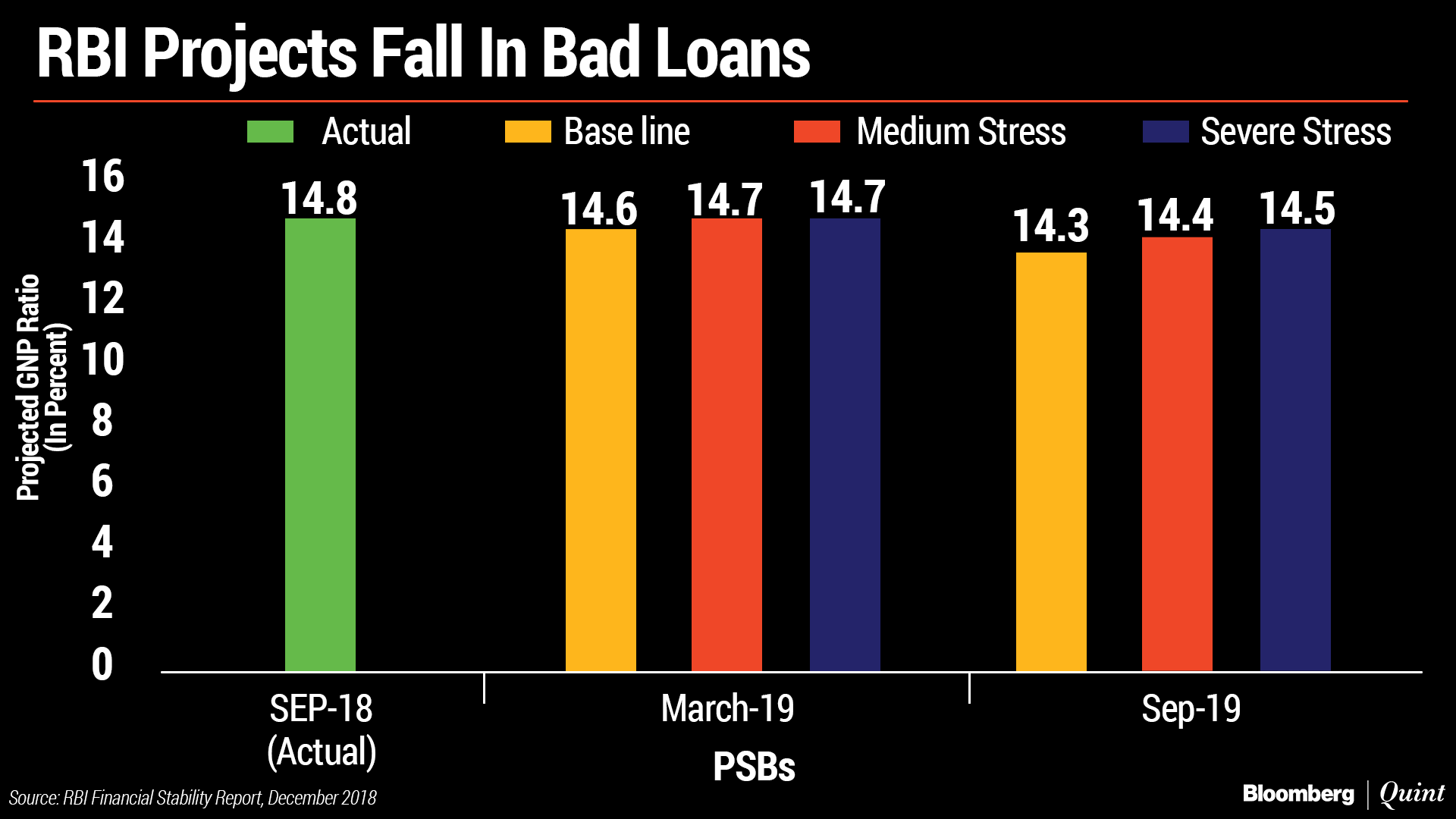
The RBI, in the baseline case, expects the gross NPA (non-performing asset) ratio for state-owned banks to fall to 14.6 percent by March 2019 from 14.8 percent in September. The reading was at 15.6 percent in March 2018. Private banks' gross bad loans could decline to 3.3 percent by the end of this financial year compared with 3.8 percent in September, it said.
The RBI noted that the overall performance of the banking sector on the asset quality front had shown improvement.
“After a prolonged period of stress, the banking sector appears to be on course to recovery as the load of impaired assets recedes; the first half-yearly decline in gross NPA ratio since September 2015 and improving provision coverage ratio, being positive signals. Stress test results suggest further improvement in NPA ratio, though its current level still remains high for comfort,” RBI Governor Shaktikanta Das noted in his comments at the beginning of the report.
Among the broad sectors, the asset quality of industry sector improved in September 2018 as compared with March 2018 whereas that of agriculture and retail sectors deteriorated, the RBI said in its report.
While the NPA situation is likely to improve in the coming months, the central bank estimates that the capital position of public sector banks under the prompt corrective action framework—which places restriction on weak banks—may deteriorate.
System-level capital adequacy is projected to come down to 12.9 percent in March, assuming the baseline macro situation, the RBI said. Further deterioration is projected in case of a severe stress.
As many as eight public sector banks under prompt corrective action framework may have capital adequacy ratio below the minimum regulatory level of 9 percent by March 2019, without taking into account any further planned recapitalisation by the government. Along with a private lender, a total of nine banks may have CRAR below the mandatory 9 percent under the baseline scenario.
If macroeconomic conditions deteriorate, 10 out of 11 state-run banks under PCA may record capital adequacy ratio below 9 percent, the RBI said. In all, 13 banks may have the capital adequacy ratio below the regulatory requirement.
The government has decided to pump in an additional Rs 41,000 crore worth capital into public sector banks this financial year, over and above what it had decided last year.

-
Extracting Value From Battery Scrap Could Be Challenging For India | The Reason Why

A discarded lithium-ion battery still contains valuable materials such as lithium, nickel and cobalt. These can be recovered and reused. When such batteries are crushed and shredded, they produce a dark powder called black mass.
-
One El Nino, India Can Handle. Two Could Break The Granary
India's grain stocks can absorb one bad year, but a second El Nino could drain the buffer in two to three years, economists say.
-
India's Troika Of Good Luck | Joining The Dots
As Jensen Huang's exit drags Nvidia down, a cooling AI trade and resilient earnings have revived investor interest in India. A likely RBI rate hike looms.
-
Talking Points This Week: Leadership Shock At Nvidia, Earnings Strength, And The Fog Over Hormuz
The Anthropic IPO pricing and first trading day, Nvidia's upcoming earnings, and any fresh signals from Iran will set the tone for the following week.
-
Signature Play: The Classic Cocktail Is Dead. Or Is It?
Classic cocktails are disappearing from India's cocktail menus. But they're still being ordered, taught to bartenders and borrowed from. So, who's really having the last drink?
-
A New Samvat Wishlist: Inclusive Prosperity And Human Development
India has strengthened its economic foundations through infrastructure, digital access and enterprise. Its next growth chapter must deepen productivity, create better livelihoods and widen participation in prosperity.
-
Love, Sex Aur Dhokha: The Audacious Plot To Spy On Jensen Huang
A Taipei dinner, a Singapore chip buyer and a suspected Chinese asset: inside the alleged spy operation that got close to NVIDIA's Jensen Huang.
-
Ten Things I Learnt This Samvat
Patience can be a trap. Cheap stocks can stay cheap. Leverage can wipe you out. What did Samvat 2082 teach us? Niraj Shah writes on 10 lessons from the year gone by.
-
Talking Points This Week: Tech Nerves, FII Buying, And A Faraway Banking Shock
The global markets are not shining this Diwali. The exception in the large markets is, India.
-
Midterm Rally Lasted A Day. The Hard Reality Of A Divided US May Last Two Years | Opinion
Between a contested AI boom, a debt ceiling that arrives in 2027 and a president with every incentive to act alone, the next two years may prove more volatile than the first day's rally suggests.