Ford Shuffles Executive Ranks In Its Race To Take On Silicon Valley
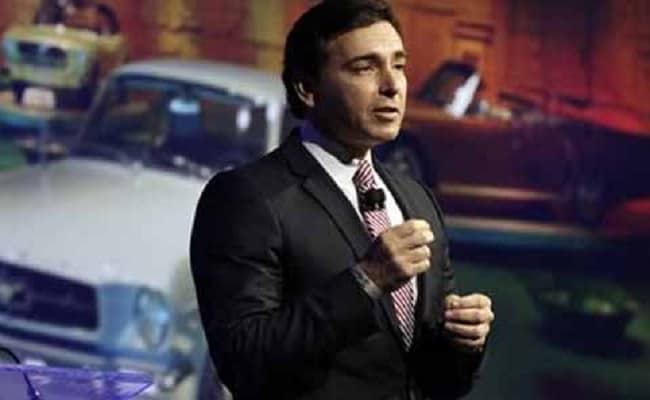
Ford Motor Company on Monday replaced its chief executive as the 114-year-old auto giant gears up to compete with Silicon Valley upstarts like Tesla in the coming revolution in smart driving.
Mark Fields retired after 28 years at the company. He was replaced by former Steelcase chief Jim Hackett, a longtime furniture executive who had almost zero experience in automobiles until he joined the company last year to head its "smart mobility" transportation initiative.
"We need speed [in] decision making," Ford Chairman Bill Ford Jr., said in a Wall Street Journal interview. Ford, the great-grandson of company founder Henry Ford, said he expects the 62-year-old Hackett to be in the job "for a good, long time."
Ford earned more than $25 billion in profit in the past four years, helped largely by the surging U.S. auto and truck market. But the auto icon is reeling from several challenges, including a stock price that has plummeted more than 30 percent since Fields took over three years ago from Alan Mulally, a former Boeing executive known as an approachable executive who encouraged candor among his direct reports.
"The main issue is the underperformance of the stock price," said Ivan Feinseth, chief investment officer at Tigress Financial Partners. "I didn't think that Mark Fields was a bad CEO. But the net result is that the stock is down in an up market. The stock is down in a period of up auto sales. There is nothing that will limit CEO longevity more than a stock price that is down in an up market."
Traditional auto companies have seen their share prices lag in recent years because investors believe the boom cycle - driven by historically low interest rates that bolstered auto sales - may be exhausted and that fast-changing technology presents an uncertain future. Ford may be down more than its counterparts, but some analysts think the change has more to do with the company's founding family.
"Ford has one, very big shareholder," said Matthew Stover, an analyst with Susquehanna Financial Group, referring to the extended Ford family. "The board and the Ford family thought, 'We have ideas and we aren't acting fast enough and we're not getting enough credit.' I don't think it's much more complicated than that."
Despite its 14.6 percent share of the U.S. car and truck market in 2016, Ford's market value of $44 billion has been surpassed by electric-car upstart Tesla at $50 billion. The U.S. auto market is expected to slow this year.
Hackett's job will be to reinvent Ford into a new transportation company capable of prospering in a highly competitive and fast-changing business.
Ford is facing competiton not only from traditional competitors such as General Motors, Toyota. The icon is also battling a new cadre of would-be transportation players who have Detroit on edge.
In addition to Tesla, ride-sharing companies like Uber Technologies, and tech juggernauts such as Alphabet and others are venturing into the transportation domain with smart-car ambitions and revolutionary ideas around fuel.
Karl Brauer, executive publisher for Autotrader and Kelley Blue Book, credited Fields with turning in profits and investing in technology.
"But over this same period Mary Barra and GM have produced even more impressive financial results by focusing on where GM can be profitable while removing business units showing little short- or long-term promise," Brauer said. "Add in the rise of Tesla . . . and the impressive results Fields delivered simply weren't enough to satisfy Ford's stockholders."
Palo Alto-based Tesla, founded by billionaire Elon Musk, lost hundreds of millions of dollars last year, has yet to turn a profit and last year produced just 84,000 cars. But its rise has put a scare into the legacy automakers such as Ford and General Motors.
Ford is betting that Hackett is up to the job. The former center for the University of Michigan football team is a personal friend of Bill Ford, whose family controls the auto giant through its ownership of voting shares. Unlike most auto executives, Hackett does not have a long history in the industry.
When Hackett joined Ford Smart Mobility, he had been on the Ford Motor board of directors for three years.
"Hackett, together with Bill Ford, will focus on three priorities: Sharpening operational execution, modernizing Ford's present business and transforming the company to meet tomorrow's challenges," according to a company news release.
Ford is known for making some unusual CEO choices. Bill Ford in 2006 hired Mulally from Boeing. Mulally privatedly borrowed nearly $30 billion to rebuild Ford without government assistance. His overhaul of the automaker included forging new agreements with auto unions that saved costs. Mulally retired after putting the company on a solid footing.
Hackett is known as a customer-minded turnaround artist who thinks outside the box. Like Mulally, Hackett's style is reported to be more relaxed and direct than the hard-charging Fields, who came up through the Ford ranks.
The company seems conscious enough about those comparisons that in a news conference Monday morning, chairman Bill Ford said "I promised myself I wouldn't compare [Hackett] to Alan this morning because it's not right - they're very different leaders for very different times." But, he said, "I'll break this rule just this once," saying both Mulally and Hackett were the types of leaders able to "capture the hearts and minds of employees" and make them feel that "not only could we win but we were going to win and they were going to have fun on the journey."
Ford could also be hoping an outsider will strike gold again, bringing a fresh set of eyes to a car company that could use a jump-start.
"It certainly breaks with a long, in-bred tradition," says Noel Tichy, a professor at the University of Michigan's Ross School of Business who has studied CEO succession. Traditionally when it comes to succession, "these guys live in a little cocoon in the greater Detroit area," making Mulally and Hackett more unusual picks.
As the chief executive of Steelcase, where he served for almost two decades, Hackett transformed the business culture of the office furniture company and advocated a more open-office physical space. He stepped down in 2014.
His nontraditional background includes 16 months at the interim athletic director at the University of Michigan, where he is best known for hiring Jim Harbaugh as its head football coach.
Tichy, who said he has worked with Hackett helping with leadership development and consulting for more than two decades, called Hackett a "transformational leader" who's good at team-building and is known for having a reputation for integrity, Tichy said.
The former Steelcase CEO voluntarily recalled wall panels of cubicles at the Pentagon that weren't up to higher fire standards; later reviews said the updated walls kept the fires from spreading on the morning of the Sept. 11, 2001, terrorist attacks, Tichy said of a story that has also been recounted in management guides.
Chris DeRose, a consultant in Ann Arbor, Mich. who has worked with Tichy and with Steelcase, said of Hackett taking the helm: "The analogous thing is he would talk about taking Steelcase out of commodity hell. When you think about where the auto industry is, I think there's a pretty clear message that here's a guy who knows how to differentiate in a low-margin, commodity based business."
(c) 2017
(This story has not been edited by NDTV staff and is auto-generated from a syndicated feed.)

-
Indians Are Travelling, But Not Every Journey Is A Holiday | The Week In Whys

Pilgrims, patients and working women are the real travellers, and the system hasn't quite caught up with them.
-
Getting To Work Costs Women More | The Reason Why
It is not just about women paying more than men. It is about women paying much more in cities than in villages.
-
AI Bias In Investing Cannot Be Eliminated, But It Can Be Governed
Framing is a particularly important example as identical financial information presented in terms of gains rather than losses can lead an LLM to reach a different assessment.
-
Joining The Dots | Dark Skies, Steady Diya: Why Hope Holds This Diwali
With war, a weak rupee and foreign outflows weighing on sentiment, policymakers at the NDTV World Summit and market veterans at NDTV Profit Ignite: Diwali Edition offered the same advice: stay invested and filter out the noise.
-
The Curious Case of Equitas Small Finance Bank And A CEO Who Quit For Stock
PN Vasudevan believes persistent investor concerns over a perceived conflict of interest had become a governance overhang on Equitas Small Finance Bank's stock, even as the lender improved profitability and asset quality.
-
Talking Points This Week: AI Cash Burn, A Tiger Comeback And An India That Still Finds Its Own Path
India is not immune to higher oil or tighter global liquidity, yet its earnings base is broader, its domestic policy levers are still available.
-
Foreign Investors Own Half Of HDFC Bank and ICICI Bank. An LTCG Cut Could Matter Most Here
Foreign portfolio investors have US$115 billion parked in HDFC Bank, ICICI Bank. If the government cuts long-term capital gains tax, Jefferies says returning foreign money could land here first.
-
'Never Seen This Level Of Negativity': Sandeep Tandon Says The Next Rally May Be Closer Than You Think
Veteran investor Sandeep Tandon says foreign selling is easing, large-caps are due a comeback and mid-caps are crowded, while he turns positive on gold, power and pharma this Diwali.
-
Indians Stay With Family, Not In Hotels | The Reason Why
India still lacks enough clean, reliable and affordable hotels for budget-conscious travellers.
-
The Economic Imperative: Analysing The Material Driving Force Behind India-Canada Strategic Reset
This economic complementarity is further reinforced by deep institutional investment ties and talent mobility, which form the bedrock of the bilateral framework.










