India’s Neo-Banks: What’s So ‘Neo’ About Them?
First it was payments, then online lending and asset management platforms, and now its ‘neo-banks' that are grabbing the attention of fintech investors and entrepreneurs.
In the past year, ventures pitching themselves as ‘neo-banks' have raised a little over $90 million from venture capital investors, who are eager to tap into the next big opportunity in fintech. With the payments segment crowded and lending platforms up against the realities of India's tight credit markets, the buzz and the money has shifted towards ‘neo-banks'.
Globally, ‘neo-banks' are essentially 100 percent digital banks, which offer services ranging from accounts, credits and payments without the burden of a physical network. They are considered to be a more nimble version of old-fashioned banking, which appeals to the younger, digitally savvy customers.
In India, however, regulations do not permit 100 percent digital banks. Payments banks, which was the closest such model, have had little success. As such, entities pitching themselves as ‘neo-banks' are now offering services built atop a traditional bank's offerings.
At least eight such ‘neo-banks' exist and have raised $90.5 million in the past year, according to data from Tracxn, a platform that provides research on the venture capital industry. A majority has been raised by two such platforms—Niyo Solutions and Open.
These firms have attracted capital from a range of heavyweight global investors, like Tencent Holdings Ltd., Tiger Global Management LLC and Sequoia Capital, along with domestic institutional investors.
According to Anil Joshi, founder and managing partner of Unicorn India Ventures, the opportunity for ‘neo-banks' is “huge” as they are targeting specific customer segments with digital services over and above what banks provide.
“It is a digital layer of services that the banks cannot provide due to their limitations, whether it is in terms of banking regulations or technology infrastructure,” Joshi said while explaining the investment thesis for such entities. Banks, who want to target specific segments, may find it easier to partner with these ‘neo-banks' rather than build additional technology and front-end infrastructure aimed at just one specific segment, Joshi said.
“Banks are partnering with ‘neo-banks' as they can build a differentiated or targeted business proposition for certain segments, and get some incremental business and revenue, by merely sharing the revenues,” said Gautam Chhugani, director (India financials and emerging fintech) at Sanford C Bernstein. The interesting thing is that banks are willing to share a part of their revenue with fintechs in order to grow incrementally, he said.
What's So ‘Neo' About Them?
Beyond the investment pitch, what exactly are these platforms offering?
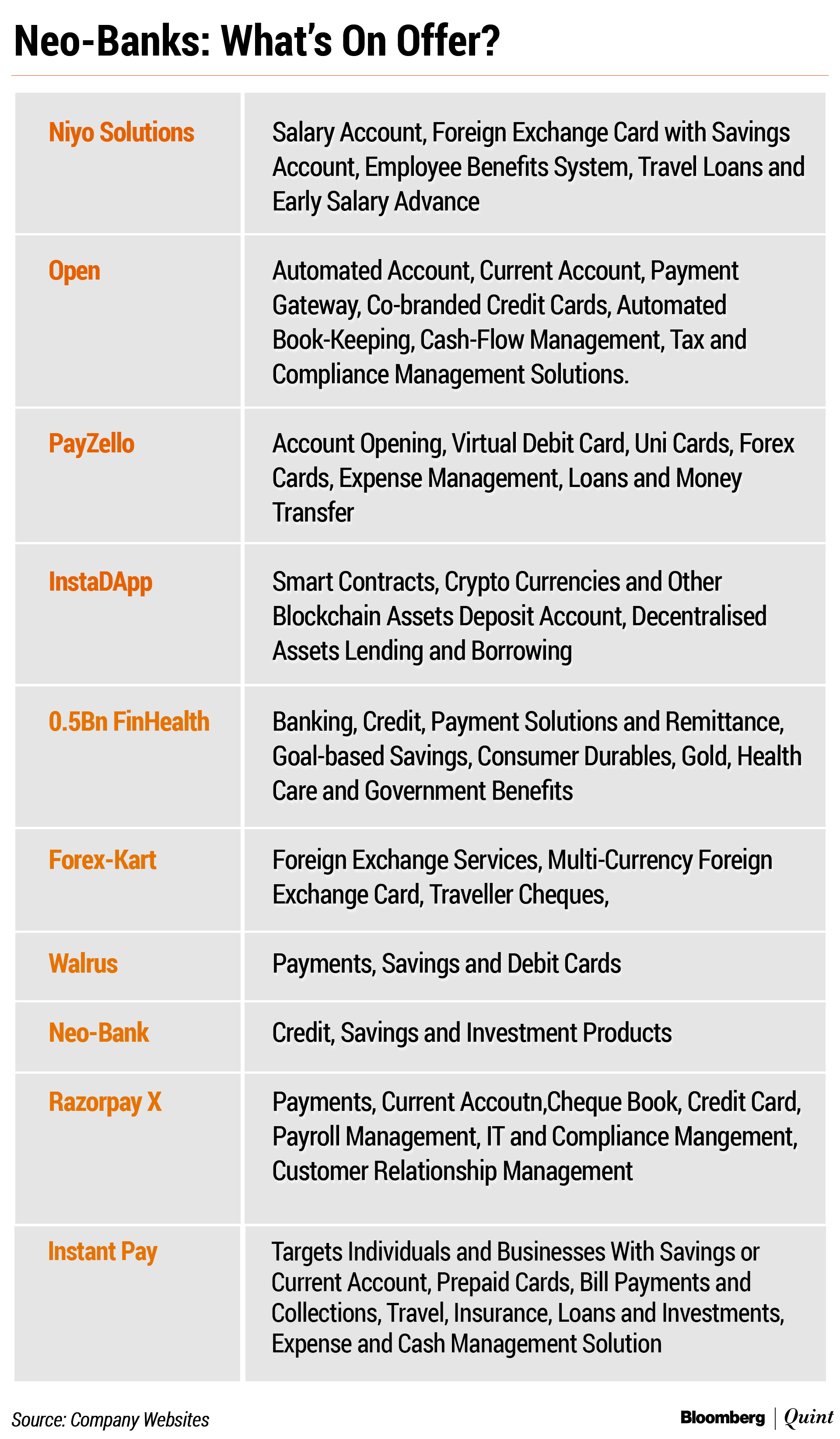
Niyo Solutions, which has raised the largest amount of funding, offers a ‘Niyo Global Card'. The card claims to offer the “best forex rates”. But in order to get the card, a customer has to open a current account with Niyo's partner bank, which is currently DCB Bank.
Vinay Bagri, chief executive officer and co-founder of Niyo, explained that essentially the company acts as a business correspondent for DCB Bank in the account-opening leg of the transaction. The KYC for this, according to Bagri, is eventually cleared by the bank. In this account, a customer deposits a certain amount of money, which using the ‘Niyo Global Card' can be used to withdraw foreign exchange.
“Most large banks charge a 3-5 percent forex mark-up when foreign exchange transactions are made on an international debit card. Through partnerships with banks, we eliminate that mark-up,” Bagri said. To be sure, since the customer would be parking funds in a current account, she or he would lose interest that may have been earned on those funds.
Another such platform, Open, pitches itself as a “business banking service that combines everything from banking to invoicing and automated bookkeeping in one place”.
Here, too, the underlying current account belongs to a bank—in this case ICICI Bank Ltd., which has partnered with Open. Over and above that bank account, Open allows its customers to connect all of their accounts across over 60 banks and provides a prepaid business card, powered by Visa Inc., for small businesses to manage their employees' expenses.
“Given that the SME market is extremely underserved both banks and platforms like us feel that there is a large opportunity for growth going forward,” said Deena Jacob, chief financial officer and co-founder, Open. Jacob said that for banks the advantage of the neo-bank model is that they can acquire a new set of customers, without the cost of acquisition and on-boarding. At the same time, they can provide customised services depending on the end users' business needs.
Recently, Razorpay, a leading payment gateway, also launched a neo-bank platform called Razorpay X. It offers startups and small and medium enterprises with current accounts, credit cards, payment and tax compliance services. The company is also rolling out corporate credit cards in association with RBL Bank Ltd. and recently acquired payroll management firm Opfin, as part of the neo-bank service.
“Through Razorpay X, you can open a current account for your business and manage all your expenses and payments at scale on the platform. We have built many tools on the platform so a small business can automate a lot of work just on their mobile phones,” said Harshil Mathur, co-founder and chief executive officer, Razorpay. “We have also launched a corporate credit card recently for startups and small merchants, who otherwise find it very hard to get,” he said.
‘Bank' Or A Bank's Sales Agent
While these entities may be calling themselves ‘neo-banks', they are not allowed to offer any of the key services that a bank provides such as deposits, interest on deposits or loans. They are also not regulated by the Reserve Bank of India.
“Neo banks largely do sourcing and front-end management while all the transactions are processed by the banks and decisions would be driven by customer consent. Like in other industries we are seeing the value chain of banking fragmenting between the product ownership and distribution,” said Vivek Belgavi, partner and India fintech leader, PwC India. Ultimately, the onus for regulatory compliance lies with the sponsor bank, he said.
Belgavi, however, said that there is room to experiment and finding the right product-market fit, as long as the core promise of the underlying banking product is not being broken.
Regulatory Grey Area?
These entities also operate in what appears to be a regulatory grey area.
For one, the use of the term “bank” is restricted by The Banking Regulation Act, 1949. “No firm, individual or group of individuals shall, for the purpose of carrying on any business, use as part of its or his name any of the words ‘bank', ‘banking' or ‘banking company',” the Act states.
Many of these firms do. For instance, Niyo's website claims to offer “banking for global citizens”. Open's website address is bankopen.co and Razorpay X, liberally uses the term neo-bank and describes it as a kind of digital bank, although it specifies that it does not have a bank licence.
Also, these entities may or not be complying with the code of conduct laid down for ‘Direct Sales Agents' of banks or those applicable in the case of outsourcing of financial services.
“Right now the issue is of a lack of standardisation of the user experience for such partnerships because, for example, if a prepaid instrument player begins neo-banking services, the link with the banks' core banking system will not be the same,” said Nikhil Kumar, who has worked on projects such as India's Unified Payments Interface and now runs a startup called Setu, a technology firm that works with banks on building scalable infrastructure for digital financial services.
“Since these platforms directly face the customers like direct sales agents or business correspondents, they would either need to fit into the current regulatory framework or under a new framework to ensure there is some legal liability and responsible practices,” he said.
Topendra Bhattacharjee, head of digital banking at RBL Bank, which has tied up with some of these platforms, disagreed.
“Since all the banking business is conducted by the neo-bank on the banks' balance-sheet, lenders are ensuring that the same regulations they follow are followed by their neo-bank partners so there is no differentiated regulations on KYC account opening or lending,” said Bhattacharjee. He explained that the bank is the main custodian of all customer information. All transactions are authenticated by the bank and flow through the bank's fraud monitoring processes, even though they are getting initiated by a third party.
PwC's Belgavi also pointed to the issue of data analytics and customer consent.
“These platforms are generating a lot of new data from their users, which helps the neo-bank and the sponsor bank deliver credit and other services in a targeted manner to their customer segment. But there needs to be some guidelines on how they can use this data and how they can package products based on this data,” he said.

-
The Economic Imperative: Analysing The Material Driving Force Behind India-Canada Strategic Reset

This economic complementarity is further reinforced by deep institutional investment ties and talent mobility, which form the bedrock of the bilateral framework.
-
Medicine Pricing: Where Must Profit Stop?
India must confront excessive margins, hidden incentives and regulatory gaps that threaten the integrity of medicine.
-
Why Amazon And Flipkart Are Struggling To Beat Meesho In India's Smaller Cities
With 274 million users and lowest-cost logistics, Meesho is defending its value commerce crown against giants like Amazon and Flipkart.
-
High US Salaries, No Green Card Certainty: The Financial Calculation Facing Indian H-1B Families
The suspension of PERM processing at eight technology employers does not cancel existing H-1B visas. What it does is force a question many Indian families have been avoiding: is the US salary worth tying your career and family plans to one employer?
-
Swiggy vs Eternal: Food Delivery's Two Rivals Are No Longer In The Same Race
Eternal is building a private AI assistant, dark.ai. Swiggy is still working out how to make Instamart pay, with an operating loss of Rs 895 crore in the July-September quarter while Blinkit stayed profitable.
-
Where You Live Shapes How You Get To Work | The Reason Why
Two-wheelers are the most popular way to get to work in India, accounting for nearly 43% of workplace commutes.
-
Unhedged Position: Can India See An Indonesia-Style Time Correction?
The Nifty is trading below levels it first clocked in 2024. Is there, then, as I have suggested in the headline, potential that the current time correction drags on painfully for the next three-five, even ten years?
-
Navigating Friction And Energy Realities: An Analysis Of Marco Rubio's October Visit To India
Occurring at a critical juncture marked by stalled trade negotiations and escalating geopolitical pressures over global energy supplies, the visit offers a profound window into modern US-India relations.
-
India Exports Capital. Why Not Export Trusteeship?
The big question, then, is whether India can build an institution that global borrowers, investors, banks, and lawyers can trust, even without an Indian connection.
-
France's Economy & Politics Are In Crisis | The Reason Why
Let's look at how the French economy and politics evolved under Nicolas Sarkozy, Franois Hollande and Emmanuel Macron.










