Financial Stability Report: RBI Sees Bank NPAs Fall To 9% By March 2020
The Reserve Bank of India expects bad loans to continue to fall in the current financial year, as an early turnaround in asset quality picks up pace.
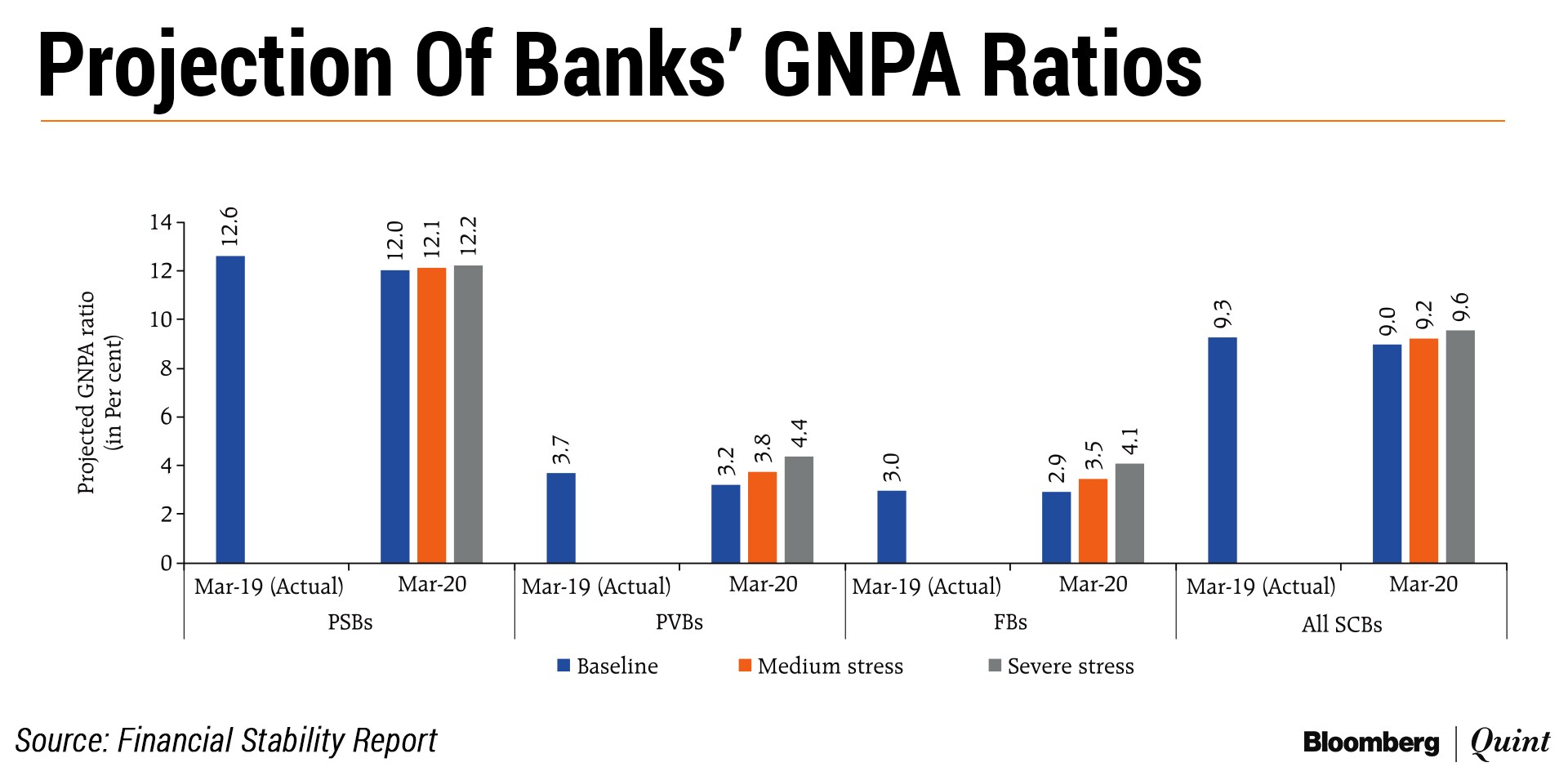
Gross non-performing assets of scheduled commercial banks are expected to decline to 9 percent by March 2020 from 9.3 percent in March 2019, under the baseline scenario, the RBI said in its Financial Stability Report published on Thursday.
Gross NPAs may be slightly higher at 9.2 percent under a scenario where the economy is under “medium”stress” and at 9.6 percent under a “severe stress” scenario.
For public banks, gross NPA ratio may decline to 12.0 percent by March 2020 under the baseline scenario. The decline in bad loans to 12.6 percent, was the sharpest for public sector banks in March 2019, from over 15 percent a year ago.
Private banks are expected to see Gross NPA ratio fall to 3.2 percent by March 2020 from 3.7 percent under the same scenario.
A break-up of bad loans for industry showed a decline, as did stressed assets across most individual sectors.
- Across all industrial loans, gross NPAs stood at 17.5 percent
- Bad loans in the basic metals segment stood at 28.5 percent
- In the mining sector, bad loans were at 26.7 percent
- For the infrastructure sector, bad loans stood at 17.8 percent
Improved Capital And Provision Coverage
Banks are also looking healthier now in terms of the amount of provisions and capital they hold on their balancesheet.
The Provision Coverage Ratio of all banks rose sharply to 60.6 percent as of March 2019 from 52.4 percent in September 2018 and 48.3 percent in March 2018, increasing the resilience of the banking sector, the report said.
Capital adequacy of the banking system has also improved due to the capital provided by the government to public sector banks. Still, some lenders will need additional capital, the RBI's stress tests showed.
As many as five SCBs may have capital adequacy ratio below the minimum regulatory level of 9 percent by March 2020 without taking into account any further planned recapitalisation by the government. However, if macroeconomic conditions deteriorate,nine SCBs may record capital adequacy below 9 percent under a severe macro-stress scenario.
Pick Up In Credit Growth
Aggregate credit growth on a year-on-year basis improved marginally to 13.2 percent in March 2019 from 13.1 percent in September 2018, said RBI. Public sector banks registered near double-digit growth of 9.6 percent in March 2019 while private bank growth remained strong at 21 percent.
Related Coverage:

-
Leadership As Mission: Why The Age Of AI Demands More Human Leadership

Debjani Ghosh examines how AI is changing leadership, arguing that its success must be measured by its impact on people and the accountability of those guiding its use.
-
We May Need Another Tukaram Mundhe To Fight Air Pollution | The Reason Why
Developers may install basic measures such as sprinklers and green nets, resume work, and continue violating rules when this equipment stops working.
-
Extracting Value From Battery Scrap Could Be Challenging For India | The Reason Why
A discarded lithium-ion battery still contains valuable materials such as lithium, nickel and cobalt. These can be recovered and reused. When such batteries are crushed and shredded, they produce a dark powder called black mass.
-
One El Nino, India Can Handle. Two Could Break The Granary
India's grain stocks can absorb one bad year, but a second El Nino could drain the buffer in two to three years, economists say.
-
India's Troika Of Good Luck | Joining The Dots
As Jensen Huang's exit drags Nvidia down, a cooling AI trade and resilient earnings have revived investor interest in India. A likely RBI rate hike looms.
-
Talking Points This Week: Leadership Shock At Nvidia, Earnings Strength, And The Fog Over Hormuz
The Anthropic IPO pricing and first trading day, Nvidia's upcoming earnings, and any fresh signals from Iran will set the tone for the following week.
-
Signature Play: The Classic Cocktail Is Dead. Or Is It?
Classic cocktails are disappearing from India's cocktail menus. But they're still being ordered, taught to bartenders and borrowed from. So, who's really having the last drink?
-
A New Samvat Wishlist: Inclusive Prosperity And Human Development
India has strengthened its economic foundations through infrastructure, digital access and enterprise. Its next growth chapter must deepen productivity, create better livelihoods and widen participation in prosperity.
-
Love, Sex Aur Dhokha: The Audacious Plot To Spy On Jensen Huang
A Taipei dinner, a Singapore chip buyer and a suspected Chinese asset: inside the alleged spy operation that got close to NVIDIA's Jensen Huang.
-
Ten Things I Learnt This Samvat
Patience can be a trap. Cheap stocks can stay cheap. Leverage can wipe you out. What did Samvat 2082 teach us? Niraj Shah writes on 10 lessons from the year gone by.









