Fifteenth Finance Commission On Devolution, Fiscal Roadmap, And Livable Cities
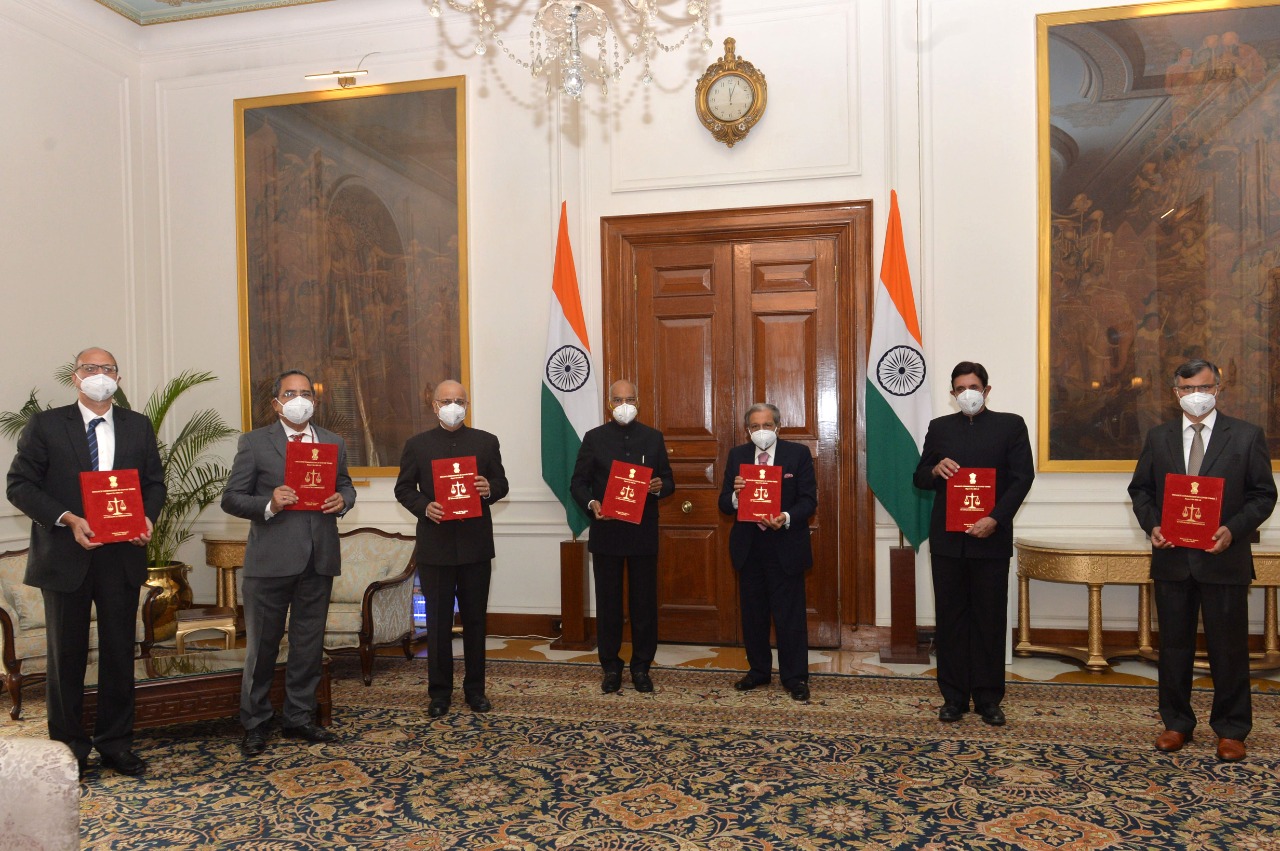
The Fifteenth Finance Commission chose to leave the division of the shareable pool of taxes between the central and state government unchanged, while recommending a glide path to 4% for the central fiscal deficit by 2025-26. While the central government accepted the former recommendation, it has chosen to let the fiscal deficit settle at a higher 4.5%.
Devolution Formula
To maintain predictability and stability in the face of the pandemic, vertical devolution — the division of the net proceeds of taxes collected by the union government between the centre and states remains at 41%. The adjustment of 1% compared to 42% share allocated to states by the previous commission is due to the changed status of Jammu and Kashmir into the two union territories.
For horizontal devolution of taxes, the commission continued to recommend a weight of 12.5% to the criterion of 'demographic performance'.
The commission said the 2011 census data better represents the present need of states and fairly rewards those who have done better on the demographic front.
Fiscal Targets
To account for uncertainty and risk, the commission preferred to work with three scenarios, and accordingly gave a range for both debt and headline deficit, instead of fixed numbers.
The commission expects trend real GDP growth to return to 7% for the period under review.
The central government fiscal deficit is recommended at 4% by FY26 if the assessment of growth holds. In a weaker-than-expected economy, the fiscal deficit can settle at 4.5% by FY26, while in a stronger-than-expected economy it can settle at 3.5%. The central government, in its budget, said it was targeting a fiscal deficit of 4.5% by FY26.
General government debt in the period 2020-26 is expected to reduce from 89.8% of the GDP to 85.7%.
Recognising the need for a major restructuring of the FRBM Act, the commission had recommended the constitution of a high-powered inter-governmental group for a new fiscal consolidation framework.
Fiscal Consolidation By States
The normal limit for net borrowing may be fixed at 4% of GSDP in 2021-22, 3.5% in 2022-23 and be maintained at 3% of GSDP from 2023-24 to 2025-26 .
Greater borrowing flexibility is being provided via three windows. For the first two years, to compensate for the loss of tax revenues, an additional borrowing of 0.5% of GSDP will be permitted if states meet the criteria for power sector reforms.
States will also be allowed to utilise any unutilised borrowing space in the subsequent years within our award period, the commission said.
State governments may explore formation of independent public debt management cells which will chart their borrowing programme efficiently.
States should have more avenues for short-term borrowings to help temporary mismatches, other than the ways and means advances or overdraft facility provided by the RBI, since they have monetary policy implications.
An Effective State Finance Commission
The Constitution requires state finance commissions to be appointed at the expiration of every fifth year in a bid to govern all state government transfers to local governments. In practice, finance commissions have not got the benefit of recommendations of SFCs, as most state governments did not constitute them in time or give them due importance.
Now, the finance commission recommends that all states which have not set up SFCs should do so. They should then act upon their recommendations and lay the explanatory memorandum as to the action taken, before the state legislature on or before March 2024.
Failing this, no grants should be released to states that fail to comply.
Mind The (GST) Gap
The pandemic has given further rise to the need to mobilise sizeable resources even amid a crunch in revenue.
To continue to ramp-up goods and services tax collections, for instance, the commission recommends simplifying the inverted duty structure. It also suggests overcoming technical impediments such as difference in accounting codes. “This, in our view, will improve the efficiency of the entire GST structure, ensure better compliance, check evasion and enable early settlement of income tax credit and other adjustment claims,” the report stated.
The measure of efficiency of GST stands below 50% as of now, and can be pushed up to 60%, which is around advanced country benchmarks, the report said.
Push For Livable Cities
The finance commission recommends total grants for local governments at Rs. 4.36 lakh crore for the period 2021-26.
Rs 2.4 lakh crore is recommended for rural local bodies, and Rs 1. 2 lakh crore is recommended for grants for urban local bodies. Another Rs 70,051 crore is earmarked for the improvement of health services.
In allocation of grants to urban local bodies, the commission adopted a differentiated approach. Fifty ‘million-plus' cities are provided with a challenge fund of Rs 38,196 crore over the five-year award period given the importance of metropolitan areas. Almost one-third of this fund is for achieving ambient air quality based on identified parameters, while the remaining two-thirds is for meeting benchmarks on drinking water supply, rainwater harvesting and water recycling, solid waste management and sanitation.
For cities with a population of less than a million, Rs 82,859 crore is recommended, prioritizing drinking water, rainwater harvesting, solid waste management and sanitation.
Separately, the commission has recommended Rs 8,000 crore to states as grants for incubation of new cities and Rs 450 crore for facilitating shared municipal services.
Health To Remain In Focus
The union budget saw an increase in outlay to health. The finance commission recommends that the government continue to ramp up this spending by the centre and the states.
Health spending by states should be increased to more than 8% of their budget by 2022.
Primary health care should be the ‘number one fundamental commitment' of each state and that primary health expenditure should be increased to two-thirds of the total health expenditure by 2022.
Public health expenditure of union and states together should be increased in a progressive manner to reach 2.5% of GDP by 2025.
Other Recommendations
The finance commission recommends that the union government may constitute a dedicated non-lapsable modernisation fund for defence and internal security, to bridge the gap between projected budgetary requirements and budget allocation for defence and internal security.
The commission said it “re-calibrated the relative shares of union and states in gross revenue receipts” by reducing the grants component by 1%. This will allow the centre to set aside resources for the fund.
The total indicative size of the fund has been proposed at Rs 2.38 lakh crore for the 2021-26 period.
The proceeds from the fund will be used for:
Capital investment for modernisation of defence services.
Capital investment for central armed police forces and modernisation of state police forces.
Small component as welfare fund for soldiers and paramilitary personnel.
The fund will receive incremental funding from the central government, divestment proceeds of public-sector defence firms and proceeds from monetisation of surplus defence land. The Ministry of Defence will have exclusive rights over the use of the funds' money. The government can also operate the fund through a high-powered committee, the report said.

-
The Economic Imperative: Analysing The Material Driving Force Behind India-Canada Strategic Reset

This economic complementarity is further reinforced by deep institutional investment ties and talent mobility, which form the bedrock of the bilateral framework.
-
Medicine Pricing: Where Must Profit Stop?
India must confront excessive margins, hidden incentives and regulatory gaps that threaten the integrity of medicine.
-
Why Amazon And Flipkart Are Struggling To Beat Meesho In India's Smaller Cities
With 274 million users and lowest-cost logistics, Meesho is defending its value commerce crown against giants like Amazon and Flipkart.
-
High US Salaries, No Green Card Certainty: The Financial Calculation Facing Indian H-1B Families
The suspension of PERM processing at eight technology employers does not cancel existing H-1B visas. What it does is force a question many Indian families have been avoiding: is the US salary worth tying your career and family plans to one employer?
-
Swiggy vs Eternal: Food Delivery's Two Rivals Are No Longer In The Same Race
Eternal is building a private AI assistant, dark.ai. Swiggy is still working out how to make Instamart pay, with an operating loss of Rs 895 crore in the July-September quarter while Blinkit stayed profitable.
-
Where You Live Shapes How You Get To Work | The Reason Why
Two-wheelers are the most popular way to get to work in India, accounting for nearly 43% of workplace commutes.
-
Unhedged Position: Can India See An Indonesia-Style Time Correction?
The Nifty is trading below levels it first clocked in 2024. Is there, then, as I have suggested in the headline, potential that the current time correction drags on painfully for the next three-five, even ten years?
-
Navigating Friction And Energy Realities: An Analysis Of Marco Rubio's October Visit To India
Occurring at a critical juncture marked by stalled trade negotiations and escalating geopolitical pressures over global energy supplies, the visit offers a profound window into modern US-India relations.
-
India Exports Capital. Why Not Export Trusteeship?
The big question, then, is whether India can build an institution that global borrowers, investors, banks, and lawyers can trust, even without an Indian connection.
-
France's Economy & Politics Are In Crisis | The Reason Why
Let's look at how the French economy and politics evolved under Nicolas Sarkozy, Franois Hollande and Emmanuel Macron.










