Ferrari Quietly—Very Quietly—Tests Electric Car
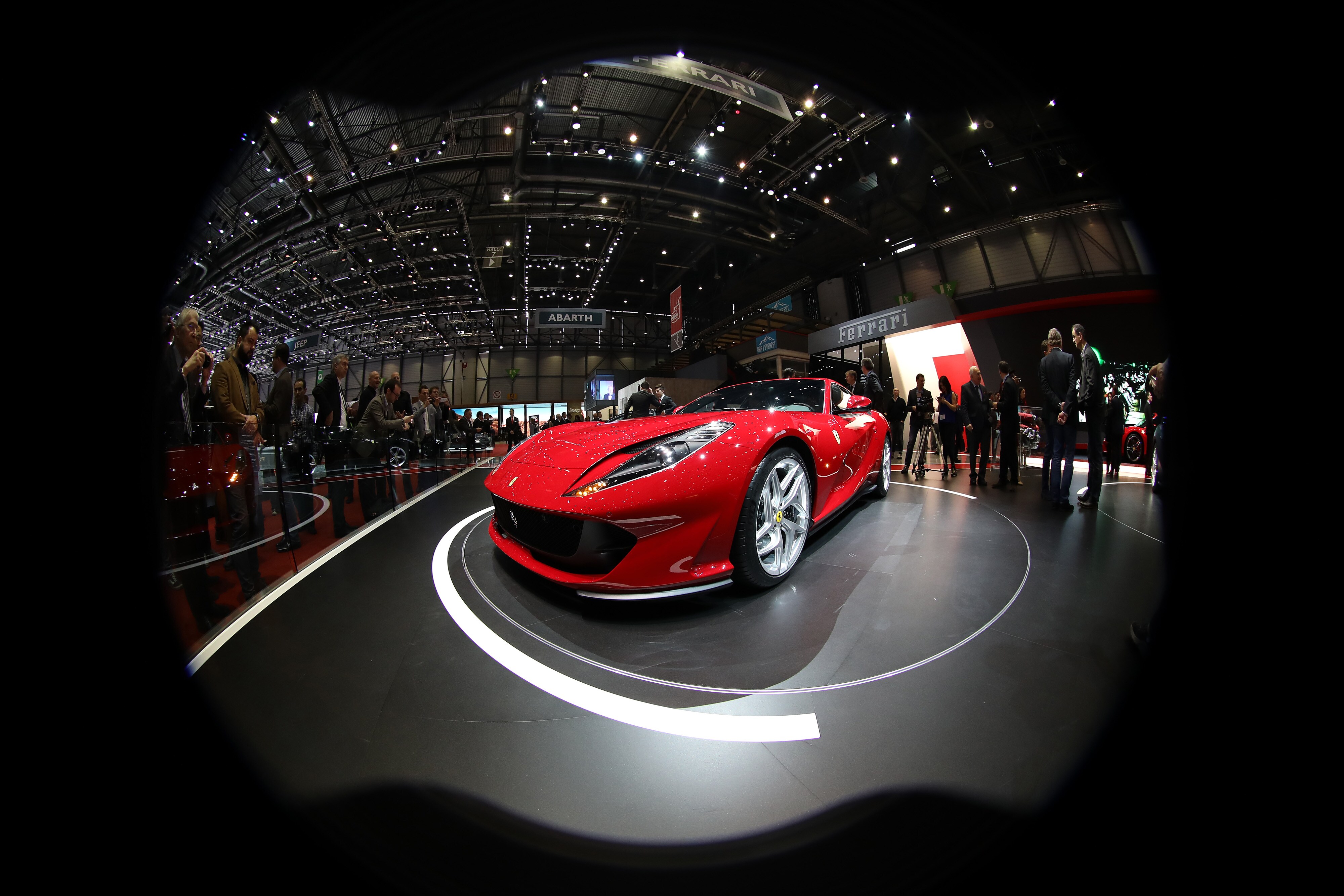
(Bloomberg)--Two years ago, Sergio Marchionne dubbed the notion of a Ferrari that can run without the aggressive growl of its 12-cylinder engines “obscene.” Today, it's a reality.
Marchionne, Ferrari's chief executive officer, says the supercar manufacturer has been quietly—very quietly—testing a gasoline-electric hybrid car “you could run silently” at a track near its headquarters in the northern Italian town of Maranello.
A video posted on YouTube last month shows a car at the Ferrari track making no sound as it accelerates from a full stop. While Ferrari has no plans to produce a full-electric car before 2022, the company is developing vehicles that will show “the full power of electrification,” Marchionne told Bloomberg Television.
Next year, Ferrari will start offering the technology in a sports car, its first model that can run entirely on battery power for any significant distance. The hybrid engine will soon be an option on all new models, and from 2020 the carmaker will use it as the sole drivetrain for its first sport-utility vehicle, which Marchionne says will be the fastest SUV on the market.
Marchionne, 65, long a skeptic about electric cars, is embracing hybrid technology as the shift away from combustion engines picks up speed. In his final five-year business plan for the supercar maker before he retires, to be presented in September, Marchionne will set a goal of doubling profits to 2 billion euros by 2022—and new models with unconventional engines will play a big role in reaching that target.
Analysts expect Ferrari to boost annual production to almost 15,000 cars, from 9,000 last year. The expansion will focus on attracting wealthy customers who might not buy a screaming sports car that can top 200 miles per hour but would pay more than $300,000 for a distinctive luxury ride they can take to the office or on a weekend trip to the countryside.
Ferrari's growing interest in electric motors mirrors the strategies of many of its high-performance rivals. Porsche next year plans to introduce its first all-electric sports car, a coupe called the Mission E. Aston Martin will start selling an electric version of the Rapide in 2019. And Bentley in March introduced a hybrid version of its Bentayga SUV and says that by 2025 all its vehicles will offer some sort of electric drivetrain.

Since 2013, Ferrari has built about 700 LaFerraris, a supercar costing as much as $2.1 million that combines a pair of electric motors with a 12-cylinder gasoline engine to boost acceleration (and in a pinch can travel a few hundred meters on batteries alone). The technology, developed for Formula One racing, delivers 963 horsepower—more than any previous Ferrari model—while cutting fuel consumption by as much as 40 percent
Marchionne says the expansion beyond powerful sports cars isn't a departure for Ferrari. The company currently sells the GT4 Lusso, a hatchback with a functional rear seat, and Marchionne says he aims to expand his offerings of cars designed more for comfort than performance. Under founder Enzo Ferrari in the 1950s and '60s, the company produced a series of so-called Grand Touring models like the 1962 Ferrari 250 GTO that fetched more than $38 million at auction in 2014.
“Those are phenomenal cars,” Marchionne said at the Geneva International Motor Show in March. “In the last 15 years we focused a lot more on the performance of sports cars. We need to rekindle our interest in the other side.”
©2018 Bloomberg L.P.

-
Indians Are Travelling, But Not Every Journey Is A Holiday | The Week In Whys

Pilgrims, patients and working women are the real travellers, and the system hasn't quite caught up with them.
-
Getting To Work Costs Women More | The Reason Why
It is not just about women paying more than men. It is about women paying much more in cities than in villages.
-
AI Bias In Investing Cannot Be Eliminated, But It Can Be Governed
Framing is a particularly important example as identical financial information presented in terms of gains rather than losses can lead an LLM to reach a different assessment.
-
Joining The Dots | Dark Skies, Steady Diya: Why Hope Holds This Diwali
With war, a weak rupee and foreign outflows weighing on sentiment, policymakers at the NDTV World Summit and market veterans at NDTV Profit Ignite: Diwali Edition offered the same advice: stay invested and filter out the noise.
-
The Curious Case of Equitas Small Finance Bank And A CEO Who Quit For Stock
PN Vasudevan believes persistent investor concerns over a perceived conflict of interest had become a governance overhang on Equitas Small Finance Bank's stock, even as the lender improved profitability and asset quality.
-
Talking Points This Week: AI Cash Burn, A Tiger Comeback And An India That Still Finds Its Own Path
India is not immune to higher oil or tighter global liquidity, yet its earnings base is broader, its domestic policy levers are still available.
-
Foreign Investors Own Half Of HDFC Bank and ICICI Bank. An LTCG Cut Could Matter Most Here
Foreign portfolio investors have US$115 billion parked in HDFC Bank, ICICI Bank. If the government cuts long-term capital gains tax, Jefferies says returning foreign money could land here first.
-
'Never Seen This Level Of Negativity': Sandeep Tandon Says The Next Rally May Be Closer Than You Think
Veteran investor Sandeep Tandon says foreign selling is easing, large-caps are due a comeback and mid-caps are crowded, while he turns positive on gold, power and pharma this Diwali.
-
Indians Stay With Family, Not In Hotels | The Reason Why
India still lacks enough clean, reliable and affordable hotels for budget-conscious travellers.
-
The Economic Imperative: Analysing The Material Driving Force Behind India-Canada Strategic Reset
This economic complementarity is further reinforced by deep institutional investment ties and talent mobility, which form the bedrock of the bilateral framework.










