Fed Says U.S. Banks Tightened Credit Further In Wake Of Failures
(Bloomberg) -- The Federal Reserve said that banks reported tighter standards and continued weak demand for loans in the second quarter, extending a trend that began before recent stresses in the banking sector emerged.
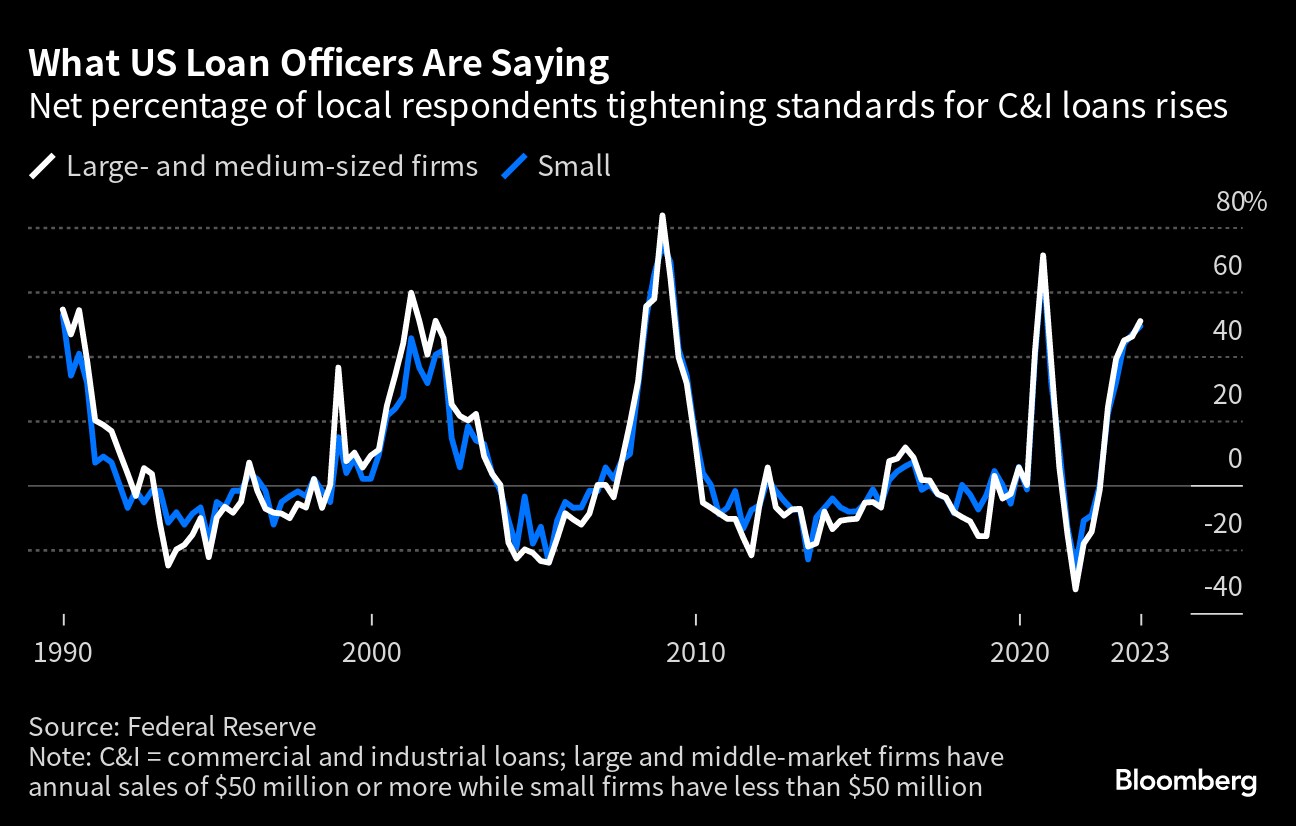
The proportion of US banks tightening terms on commercial and industrial loans for medium and large businesses rose to 50.8%, up from 46% in the first quarter, according to a Fed survey of lending officers released Monday.
The collapse of four US regional banks since March sparked turmoil in the financial sector and increased concerns that lenders would rein in access to credit in a way that could tip the US economy into a recession. Recent data, including last week's report of greater-than-expected growth, have shown the economy has been resilient in the face of the turmoil.
“The tightening in lending standards generally intensified,” JPMorgan Chase & Co. economist Daniel Silver said in a report. The historically tight data “are not a guarantee of a recession to come, but the tightening evident as of late suggests that the economy should slow.”
Credit Demand
The survey also showed low demand for credit persists despite some improvement. The share of banks reporting weaker demand for commercial and industrial loans among large and mid-sized firms fell to 51.6%, from 55.6% in the first quarter.
The figures in the survey are calculated as net percentages, or the shares of banks reporting tighter conditions or stronger demand minus the proportion of banks reporting easier standards or weaker demand.
The poll — known as the Senior Loan Officer Opinion Survey, or Sloos — showed banks expecting to further tighten standards on all types of loans, citing a less favorable or more uncertain economic outlook and expected deterioration in collateral values and the credit quality of loans as reasons.
There was a particular concern by banks over commercial real estate following struggles by office-building owners in the wake of increased remote work due to Covid-19 and higher interest rates.
The net percentage of banks reporting tighter standards on construction and land development loans was 71.7%. It was 68.3% on nonfarm, nonresidential loans, according to the survey.
Overall, the data in the survey are “at least consistent with the tightening in credit that the Fed has been aiming to achieve with raising rates – although credit was still tightening from easy levels so the overall impact on activity is less clear,” said Veronica Clark, an economist at Citigroup Inc.
The US central bank raised interest rates last week for the 11th time since March 2022, bringing the target on its benchmark rate to 5.25% to 5.5%. The Federal Open Market Committee will make decisions on possible future hikes meeting by meeting, Fed Chair Jerome Powell said in a press conference Wednesday.
In a preview of the Fed survey, Powell said “it's broadly consistent with what you would expect. You've got lending conditions tight and getting a little tighter, you've got weak demand, and you know, it gives a picture of a pretty tight credit conditions in the economy.”
“I think it's really hard to tease out whether how much of that is from this source or that source, but I think what matters is the overall picture is of tight and tightening lending conditions,” he said.
(Updates with comment from economist in fourth paragraph.)
More stories like this are available on bloomberg.com
©2023 Bloomberg L.P.

-
Signature Play: The Classic Cocktail Is Dead. Or Is It?

Classic cocktails are disappearing from India's cocktail menus. But they're still being ordered, taught to bartenders and borrowed from. So, who's really having the last drink?
-
A New Samvat Wishlist: Inclusive Prosperity And Human Development
India has strengthened its economic foundations through infrastructure, digital access and enterprise. Its next growth chapter must deepen productivity, create better livelihoods and widen participation in prosperity.
-
Love, Sex Aur Dhokha: The Audacious Plot To Spy On Jensen Huang
A Taipei dinner, a Singapore chip buyer and a suspected Chinese asset: inside the alleged spy operation that got close to NVIDIA's Jensen Huang.
-
Ten Things I Learnt This Samvat
Patience can be a trap. Cheap stocks can stay cheap. Leverage can wipe you out. What did Samvat 2082 teach us? Niraj Shah writes on 10 lessons from the year gone by.
-
Talking Points This Week: Tech Nerves, FII Buying, And A Faraway Banking Shock
The global markets are not shining this Diwali. The exception in the large markets is, India.
-
Midterm Rally Lasted A Day. The Hard Reality Of A Divided US May Last Two Years | Opinion
Between a contested AI boom, a debt ceiling that arrives in 2027 and a president with every incentive to act alone, the next two years may prove more volatile than the first day's rally suggests.
-
Blue Wave Will Derail the AI Trade but Won't Dismantle the AI Era | Unhedged Position
The Democrats' sweep of the US Congress will see politics collide with economic forces both over the long and short term.
-
It's Time To Take The GST Council's Bet On Trust Global
Payment records can prove India's services exports, and clear, proportionate rules can bring foreign digital sellers into the tax net.
-
Opinion | India at 38: From Innovation Overperformer to Innovation Powerhouse
India now has 453 VC-backed deep science startups, 18 of them late-stage, after 117 percent growth since 2020. Laurus Labs, at USD 9.3 billion, is the most valuable deep science company in any middle-income economy outside China.









