In A Big Shift, US Central Bank Rewrites Its Approach To Inflation, Jobs Market
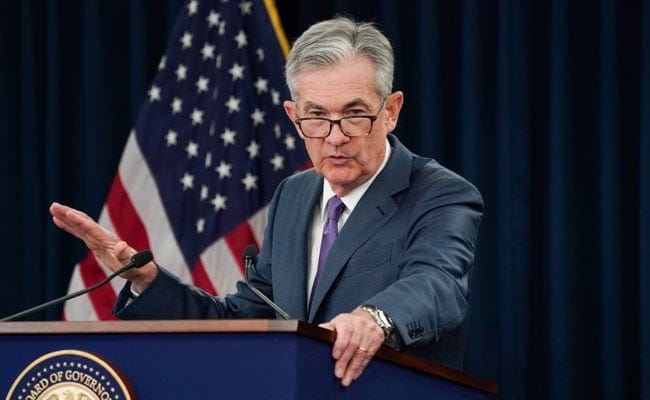
The Federal Reserve on Thursday rolled out a sweeping rewrite of its approach to its dual role of achieving maximum employment and stable prices, putting new weight on bolstering the US labour market and less on worries about too-high inflation. The US central bank's new monetary policy strategy, unveiled at the start of an annual central banking conference, pledges to address "shortfalls" from the "broad-based and inclusive goal" of full employment, a nod to research showing racial income disparities hold back economic growth.
It also promises to aim for 2 per cent inflation on average, so that periods of too-low inflation would likely be followed by an effort to lift inflation "moderately above 2 per cent for some time."
The change suggests the US central bank's key overnight interest rate, already near zero, will stay there for potentially years to come as policymakers woo higher inflation.
"It's no news that (Fed Chair Jerome) Powell doesn't want to raise interest rates," said Vincent Reinhart, chief economist at Mellon. What is news, Mr Reinhart said, is that the Fed has now enshrined a degree of tolerance for inflation in its guiding document.
The policy shift is arguably the biggest for the Fed since Paul Volcker remade the central bank into an inflation-slaying force four decades ago, when prices were spiraling higher.
Mr Powell's new policy blueprint, designed for a world where weak inflation, low interest rates, and slow economic growth appear to be here to stay, puts the labour market front and center.
The changes acknowledge, the Fed said in its description of its new strategy, that "downward risks to employment and inflation have increased", and include a new promise to use the central bank's "full range of tools" to achieve its goals of stable prices and a strong labour market. All 17 Fed policymakers signed on to the new strategy.
"Our revised statement reflects our appreciation for the benefits of a strong labour market, particularly for many in low- and moderate-income communities, and that a robust job market can be sustained without causing an unwelcome increase in inflation," Mr Powell said as he explained the changes at the start of the Kansas City Fed's central banking conference.
The gathering is normally held in Jackson Hole, Wyoming, but was convened this year online because of the coronavirus pandemic.
"It is hard to overstate the benefits of sustaining a strong labour market, a key national goal that will require a range of policies in addition to supportive monetary policy," Mr Powell said.
On Thursday, the US central bank released a library of staff papers and research on the topic, including one arguing that average inflation targeting would help a broad set of Americans benefit from the economy.
Issues such as income distribution have traditionally been considered out of the Fed's domain, but the differing economic outcomes among different groups of people has been a focus of recent research that concluded the economy as a whole can benefit from more inclusive policies.
Fundamental Changes
With tens of millions of people out of work because of the pandemic, the economy in a deep crisis and Americans preparing to vote in a contentious Nov. 3 election, the Fed's new approach is both an acknowledgment of fundamental economic changes that began well before the pandemic, and a map for how the Fed plans to conduct policy going forward.
Still, the map is fairly blurry: the Fed's transformation of the way it manages monetary policy included no explicit promises on how long it may keep rates low, or how high it would allow inflation to go. Indeed, Mr Powell said the Fed's new approach to inflation would not be dictated by an explicit mathematical formula.
For more specific guidance, investors may need to wait until at least September, when the central bank is expected to adopt so-called outcome-based guidance for its key federal funds rate, promising to keep it near zero until inflation reaches a specific threshold, perhaps 2.25 per cent or 2.5 per cent.
Dallas Fed President Robert Kaplan told CNBC on Thursday that he would not be comfortable with leaving rates where they are if inflation stayed at 3 per cent for a year.
Market reaction signaled that, at least for now, investors believe the Fed is serious about its new approach.
Yields on US Treasuries with the longest maturities - the most sensitive to inflation risks - shot to their highest in more than two months. US stocks traded largely higher, with the S&P 500 index on track for a new record closing high. The dollar was flat against a basket of currencies.
After this week's central bankers' event and the mid-September policy meeting, Fed officials will not meet again until the day after the US election.
The Fed's framework review began nearly two years ago through public hearings and research to explore how monetary policy should be adapted for a low interest rate environment. On Thursday, it said it could conduct a new review of policy every five years.
Still, the jury is out as to whether the Fed will be able to hit the mark with its new inflation and labour market goals.
"It is not assured that we will get a return of tight labour markets," Tharman Shanmugaratnam, the head of the Monetary Authority of Singapore, told the annual economic symposium. "We're not going back to a pre-COVID world."

-
We May Need Another Tukaram Mundhe To Fight Air Pollution | The Reason Why

Developers may install basic measures such as sprinklers and green nets, resume work, and continue violating rules when this equipment stops working.
-
Extracting Value From Battery Scrap Could Be Challenging For India | The Reason Why
A discarded lithium-ion battery still contains valuable materials such as lithium, nickel and cobalt. These can be recovered and reused. When such batteries are crushed and shredded, they produce a dark powder called black mass.
-
One El Nino, India Can Handle. Two Could Break The Granary
India's grain stocks can absorb one bad year, but a second El Nino could drain the buffer in two to three years, economists say.
-
India's Troika Of Good Luck | Joining The Dots
As Jensen Huang's exit drags Nvidia down, a cooling AI trade and resilient earnings have revived investor interest in India. A likely RBI rate hike looms.
-
Talking Points This Week: Leadership Shock At Nvidia, Earnings Strength, And The Fog Over Hormuz
The Anthropic IPO pricing and first trading day, Nvidia's upcoming earnings, and any fresh signals from Iran will set the tone for the following week.
-
Signature Play: The Classic Cocktail Is Dead. Or Is It?
Classic cocktails are disappearing from India's cocktail menus. But they're still being ordered, taught to bartenders and borrowed from. So, who's really having the last drink?
-
A New Samvat Wishlist: Inclusive Prosperity And Human Development
India has strengthened its economic foundations through infrastructure, digital access and enterprise. Its next growth chapter must deepen productivity, create better livelihoods and widen participation in prosperity.
-
Love, Sex Aur Dhokha: The Audacious Plot To Spy On Jensen Huang
A Taipei dinner, a Singapore chip buyer and a suspected Chinese asset: inside the alleged spy operation that got close to NVIDIA's Jensen Huang.
-
Ten Things I Learnt This Samvat
Patience can be a trap. Cheap stocks can stay cheap. Leverage can wipe you out. What did Samvat 2082 teach us? Niraj Shah writes on 10 lessons from the year gone by.
-
Talking Points This Week: Tech Nerves, FII Buying, And A Faraway Banking Shock
The global markets are not shining this Diwali. The exception in the large markets is, India.









