FDA Woes Hit Aurobindo Pharma As Unit 4 Gets Nine Observations

Aurobindo Pharma Ltd. received nine observations from the U.S. drug regulator for one of its Hyderabad units. That's worrying for two reasons. One, it's an injectables facility that's required to maintain the highest standards; and two, several drug approvals from it are pending in the U.S., the company's biggest market.
The observations for Unit 4 in Hyderabad relate to equipment and cleanliness, employees training, quality control and computer controls, according to the U.S. Food and Drug Administration's Form 483 reviewed by BloombergQuint. Aurobindo Pharma will now have to respond with corrective measures to get the plant cleared.
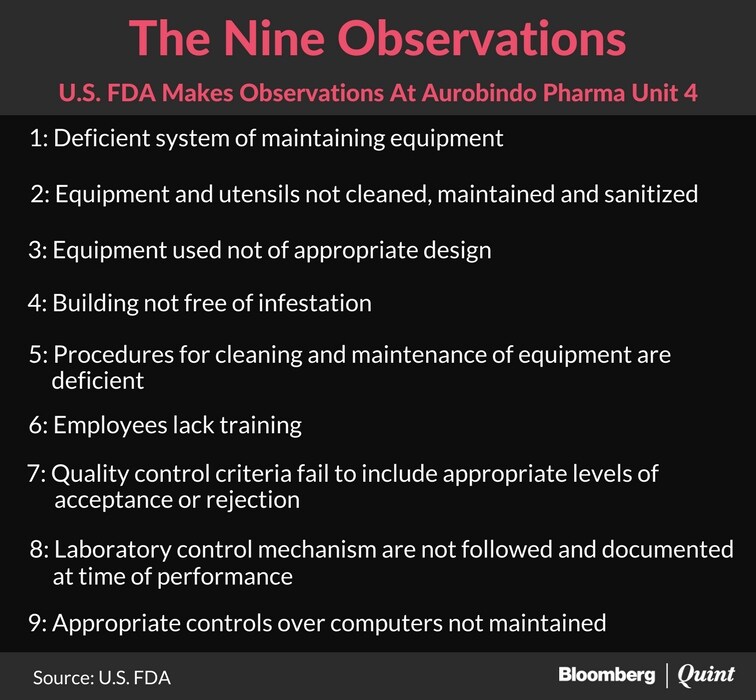
These are not just procedural observations as the company reported earlier, but a strong criticism of its sterile manufacturing unit, especially regarding inadequately designed equipment, untrained staff and maintenance, said Amit Rajan, managing director of quality and regulatory consultant Prosfora Technologies. The company would require robust commitments from the management to move past these observations, he said. The remark on computerised system management are unfortunate given the number of inspections the company has faced from U.S. FDA, he said.
Unit 4 is one of the most important plants for Aurobindo Pharma, contributing 15 percent of the total U.S. sales. More importantly, the next leg of growth will come from this plant as it has several pending approvals. All high-margin injectable products are filed from the Hyderabad facility, the company said in its post-earnings conference call. It's looking at sales of $180-185 million from the unit by the end of the ongoing financial year and increase to about $250 million by the year through March 2020.
Repeated attempts by BloombergQuint to reach the company over the phone and email remain unanswered.
Aurobindo Pharma will now have to respond to the U.S. FDA with corrective measures. If it doesn't respond do that appropriately, then the plant can get a warning letter, Gurudatta GG, chief executive officer and director at consultant Estima Pharma Solutions, said. The regulator doesn't approve filings from a plant that has received a warning letter.
While the observations do not point to any data integrity, the U.S. FDA would be more concerned as the issues relate to an injectables plant, which is expected to maintain the highest level of quality.
“The U.S. FDA will be stringent in terms of future course as observations relate to cleanliness in an injectables plant,” Amey Chalke, analyst at HDFC Securities said, stressing that a depends on on the company's response. “Don't see an immediate warning letter as the company will have time to respond. It may get a warning letter if the responses are not appropriate.”

-
Indians Stay With Family, Not In Hotels | The Reason Why

India still lacks enough clean, reliable and affordable hotels for budget-conscious travellers.
-
The Economic Imperative: Analysing The Material Driving Force Behind India-Canada Strategic Reset
This economic complementarity is further reinforced by deep institutional investment ties and talent mobility, which form the bedrock of the bilateral framework.
-
Medicine Pricing: Where Must Profit Stop?
India must confront excessive margins, hidden incentives and regulatory gaps that threaten the integrity of medicine.
-
Why Amazon And Flipkart Are Struggling To Beat Meesho In India's Smaller Cities
With 274 million users and lowest-cost logistics, Meesho is defending its value commerce crown against giants like Amazon and Flipkart.
-
High US Salaries, No Green Card Certainty: The Financial Calculation Facing Indian H-1B Families
The suspension of PERM processing at eight technology employers does not cancel existing H-1B visas. What it does is force a question many Indian families have been avoiding: is the US salary worth tying your career and family plans to one employer?
-
Swiggy vs Eternal: Food Delivery's Two Rivals Are No Longer In The Same Race
Eternal is building a private AI assistant, dark.ai. Swiggy is still working out how to make Instamart pay, with an operating loss of Rs 895 crore in the July-September quarter while Blinkit stayed profitable.
-
Where You Live Shapes How You Get To Work | The Reason Why
Two-wheelers are the most popular way to get to work in India, accounting for nearly 43% of workplace commutes.
-
Unhedged Position: Can India See An Indonesia-Style Time Correction?
The Nifty is trading below levels it first clocked in 2024. Is there, then, as I have suggested in the headline, potential that the current time correction drags on painfully for the next three-five, even ten years?
-
Navigating Friction And Energy Realities: An Analysis Of Marco Rubio's October Visit To India
Occurring at a critical juncture marked by stalled trade negotiations and escalating geopolitical pressures over global energy supplies, the visit offers a profound window into modern US-India relations.
-
India Exports Capital. Why Not Export Trusteeship?
The big question, then, is whether India can build an institution that global borrowers, investors, banks, and lawyers can trust, even without an Indian connection.










