Farm Credit Growth Hit A Four-Year High In FY21
Growth in credit to the agriculture sector rose to a four-year high in FY21, according to the latest data from the Reserve Bank of India. This, as a strong monsoon helped the farm sector remain relatively immune from the Covid-19 pandemic and the ecosystem around the farm sector continued to develop.
As of February 2021, outstanding credit to agriculture and allied activities grew 10.2% year-on-year to Rs 12.74 lakh crore, almost doubling from the 5.8% year-on-year growth recorded in February 2020, data from the RBI's monetary policy report published on April 1 showed.
The rise in agricultural credit growth, according to Barkat Ali, chief general manager for business development-financial inclusion and micro-market at State Bank of India, was helped by a slew of government measures such as the Emergency Credit Line Guarantee Scheme, interest subvention scheme and loan moratorium that kept the agriculture credit growth buoyant.
“While good harvest was the major reason, government measures introduced during the pandemic also helped ease credit flow to the agriculture sector that largely remained unaffected by the lockdown curbs,” he said.
Disbursement to the agriculture sector grew about 5% to Rs 2.10 lakh crore for the country's largest lender.
Besides, an evenly spread monsoon, record crop sowing and higher reservoir levels led more farmers to avail credit in fiscal 2020-21, said Sunil Kumar Sinha, principal economist and director - public finance at India Ratings and Research.
“In fiscal 2019-20, even though the monsoon was good on an average, it was delayed and unevenly spread,” he said. “This left higher reservoir levels and moisture in the soil, which led to bumper rabi production last year, followed by a good kharif crop due to good monsoon, taking the total output to record high levels.”
Foodgrain production has been pegged at 144.52 million tonnes, as per the first advance estimates of production of major kharif or monsoon-sown crops for 2020-21 by the ministry of agriculture and farmer's welfare. The estimate is 9.83 million tonnes higher than the average food grain production of the previous five years.
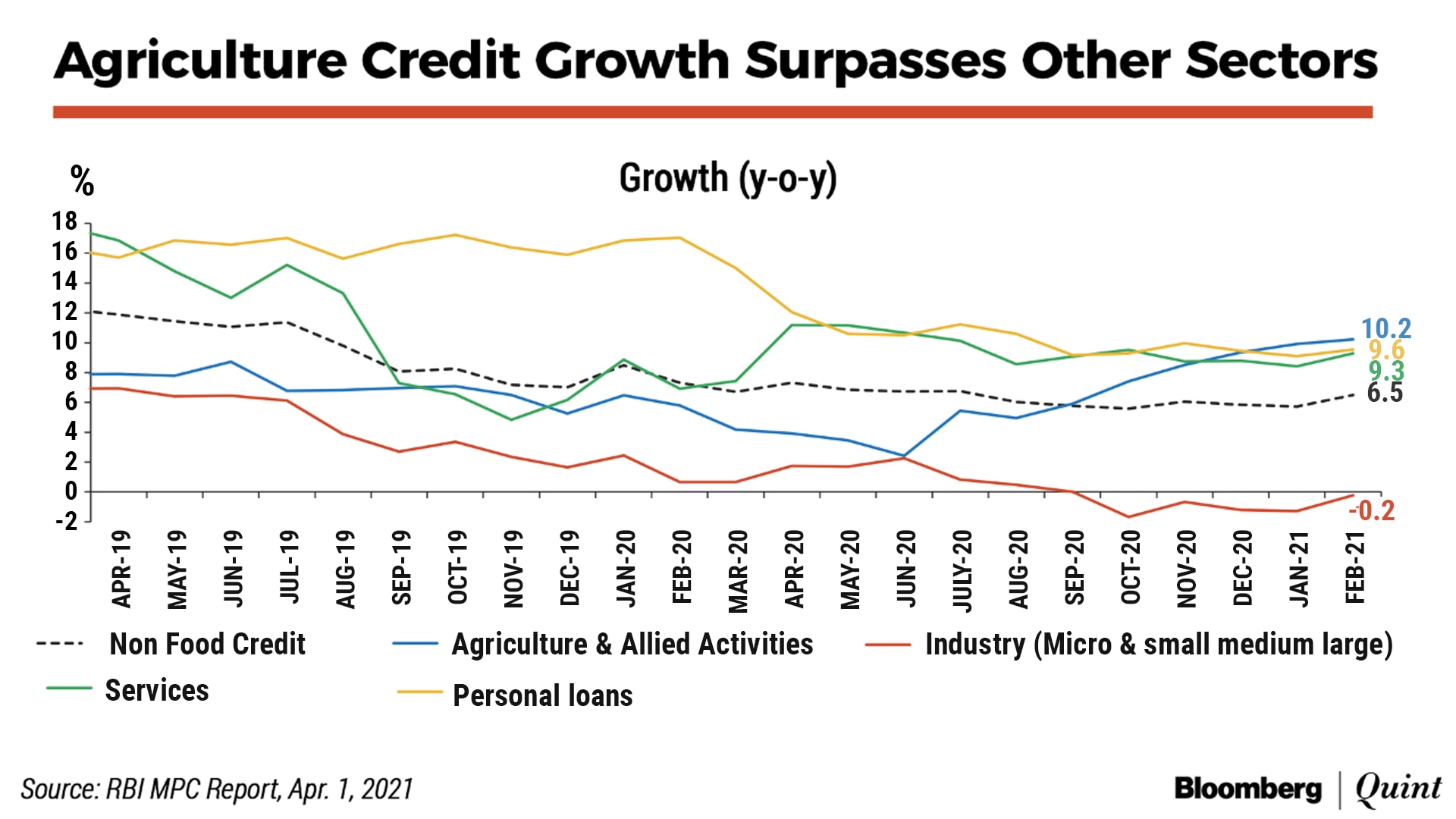
The share of agriculture in incremental non-food credit also doubled to 20.4% as of February, compared to 10.4% in February 2020. This, as the share of personal loans fell to 41.7% from 60.6%, while industry credit share fell to 1.1% from 3.1% during the period. Sinha attributed it mainly to the relatively lower impact of the pandemic on the agriculture sector.
“Unlike industrial and retail-focused sectors that got severely impacted due to Covid-19 and the subsequent lockdown curbs, agriculture remained insulated and functioned rather smoothly, which explains why incremental credit to the sector grew while others contracted,” he said.
Apart from direct credit to farmers, there has also been a significant increase in on-lending to agri-focused financial institutions, said Madan Sabnavis, chief economist at CARE Ratings.
“On-lending to non-banking financial companies and micro-finance institutions has also increased significantly as food processing and agri-focused businesses saw an uptick in their production levels,” he said.
In Budget 2021, the government raised the farm loan target to Rs 16.5 lakh crore for fiscal 2022, compared to the Rs 15-lakh-crore target in the preceding year. Along with higher agriculture credit target, additional taxes on the import of some commodities such as edible oils, pulses, gold, silver and alcohol were introduced to boost agricultural infrastructure and crop production in the country.
GR Chintala, chairman at and National Bank for Agriculture and Rural Development, agreed. “The credit flow to agriculture also improved due to higher farm mechanisation, and strong growth in agriculture infrastructure including warehouses and cold storage units, and allied industries like fisheries, dairy and poultry,” he said.
Nabard, which on-lends to cooperative banks and regional rural banks, gave Rs 1.31 lakh crore towards crop loans and agriculture investments in fiscal 2021, compared to Rs 90,000 crore extended in fiscal 2020. Credit towards agri-allied businesses also rose 18% year-on-year to Rs 92,000 crore in FY21.

-
Getting To Work Costs Women More | The Reason Why

It is not just about women paying more than men. It is about women paying much more in cities than in villages.
-
AI Bias In Investing Cannot Be Eliminated, But It Can Be Governed
Framing is a particularly important example as identical financial information presented in terms of gains rather than losses can lead an LLM to reach a different assessment.
-
Joining The Dots | Dark Skies, Steady Diya: Why Hope Holds This Diwali
With war, a weak rupee and foreign outflows weighing on sentiment, policymakers at the NDTV World Summit and market veterans at NDTV Profit Ignite: Diwali Edition offered the same advice: stay invested and filter out the noise.
-
The Curious Case of Equitas Small Finance Bank And A CEO Who Quit For Stock
PN Vasudevan believes persistent investor concerns over a perceived conflict of interest had become a governance overhang on Equitas Small Finance Bank's stock, even as the lender improved profitability and asset quality.
-
Talking Points This Week: AI Cash Burn, A Tiger Comeback And An India That Still Finds Its Own Path
India is not immune to higher oil or tighter global liquidity, yet its earnings base is broader, its domestic policy levers are still available.
-
Foreign Investors Own Half Of HDFC Bank and ICICI Bank. An LTCG Cut Could Matter Most Here
Foreign portfolio investors have US$115 billion parked in HDFC Bank, ICICI Bank. If the government cuts long-term capital gains tax, Jefferies says returning foreign money could land here first.
-
'Never Seen This Level Of Negativity': Sandeep Tandon Says The Next Rally May Be Closer Than You Think
Veteran investor Sandeep Tandon says foreign selling is easing, large-caps are due a comeback and mid-caps are crowded, while he turns positive on gold, power and pharma this Diwali.
-
Indians Stay With Family, Not In Hotels | The Reason Why
India still lacks enough clean, reliable and affordable hotels for budget-conscious travellers.
-
The Economic Imperative: Analysing The Material Driving Force Behind India-Canada Strategic Reset
This economic complementarity is further reinforced by deep institutional investment ties and talent mobility, which form the bedrock of the bilateral framework.
-
Medicine Pricing: Where Must Profit Stop?
India must confront excessive margins, hidden incentives and regulatory gaps that threaten the integrity of medicine.










