Facebook Shares Log Biggest Daily Gain In Nearly 2 Years After Zuckerberg's Testimony
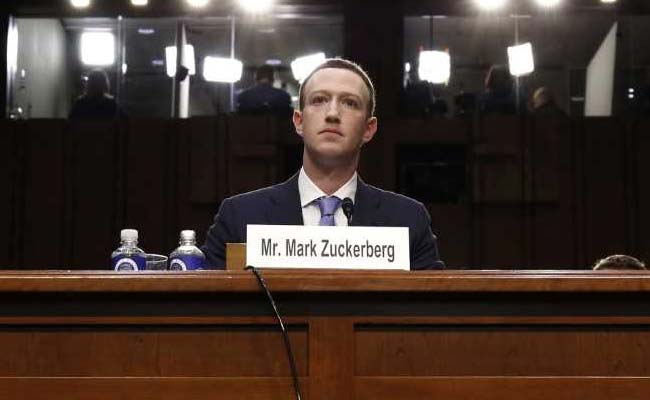
Washington/San Francisco: Facebook Inc Chief Executive Mark Zuckerberg on Tuesday navigated through the first of two U.S. congressional hearings without making any further promises to support new legislation or change how the social network does business. Investors were impressed with his performance. Shares in Facebook posted their biggest daily gain in nearly two years, closing up 4.5 per cent. The shares fell steeply last month after it came to light that millions of users' personal information was harvested from Facebook by Cambridge Analytica, a political consultancy that has counted U.S. President Donald Trump's election campaign among its clients. The latest estimate of affected users is up to 87 million.
That disclosure pitched Facebook into a crisis of confidence among users, advertisers, employees and investors who were already struggling with Facebook's reaction to fake news and its role in the 2016 election.
During nearly five hours of questioning by 44 U.S. senators, Zuckerberg repeated apologies he previously made for a range of problems that have beset Facebook, from a lack of data protection to Russian agents using Facebook to influence U.S. elections.
But the 33-year-old internet mogul managed to deflect any specific promises to support any congressional regulation of the world's largest social media network and other U.S. internet companies.
"I'll have my team follow up with you so that way we can have this discussion across the different categories where I think this discussion needs to happen," Zuckerberg told a joint hearing by the U.S. Senate's Commerce and Judiciary committees, when asked what regulations he thought were necessary.
PACKED HEARING
The crowded Senate hearing was not without theatrics, although most was from the audience, like an activist dressed in costume as a Russian internet "troll." On Twitter, observers seemed obsessed with an extra cushion on Zuckerberg's chair that was dubbed his "booster seat." A photojournalist for Associated Press took a picture of his prepared talking points and the photo was posted on Twitter.
The Senate hearing ended just past 7 p.m. (2300 GMT), and a second session before a House of Representatives committee is scheduled for Wednesday at 10 a.m. (1400 GMT).
Wearing a dark suit and tie instead of his typical T-shirt and jeans, Zuckerberg remained largely unruffled and serious as senators questioned him. But some senators did provoke a reaction. Zuckerberg was asked whether Facebook was a monopoly. "It certainly doesn't feel that way to me," he said, breaking into a smile as the audience laughed.
But the senators who asked sharp questions were often at a disadvantage because each had only five minutes to pin down the billionaire.
Democratic Senator Kamala Harris, from Facebook's home state of California, asked a line of questions about whether Zuckerberg or his senior executives considered notifying Facebook users of the data breach. She was among the lawmakers dissatisfied.
"Mark Zuckerberg's failure to answer several critical questions during his appearance before the Senate today leaves me concerned about how much Facebook values trust and transparency," she wrote on Twitter.
SEEING A CONNECTION
Facebook disclosed in September that Russians under fake names used the social network to try to influence U.S. voters in the months before and after the 2016 election, writing about inflammatory subjects, setting up events and buying ads.
"We believe it is entirely possible that there will be a connection there," Zuckerberg said when asked if there was overlap between Cambridge Analytica's harvested user data and the political propaganda pushed by the Kremlin-linked Internet Research Agency during the 2016 presidential election, which Facebook has said was seen by some 126 million people.
The U.S. Federal Trade Commission is investigating whether Facebook violated an agreement it signed with the agency in 2011 by its actions in the Cambridge Analytica scandal.
In the agreement, which Facebook signed to end an investigation into privacy breaches, the company promised not to misrepresent the extent to which it maintains the privacy or security of personal information, and it said it would obtain users' affirmative consent before sharing personal information with any third party.
Zuckerberg told senators he did not see the Cambridge Analytica episode as a violation. But he acknowledged that Facebook did not notify the FTC in 2015 when it first learned of that company's data-harvesting.
On Friday, Zuckerberg threw his support behind proposed legislation, known as the Honest Ads Act, that would require social media sites to disclose the identities of buyers of online political campaign ads.
On Tuesday, however, Zuckerberg would not agree to speak out further on behalf of the Honest Ads Act.
"Are you going to come back up here and be a strong advocate to see that that law's passed?" asked Democratic Senator Tom Udall.
"Senator, the biggest thing I think we can do is implement it," Zuckerberg responded, saying that Facebook already planned to comply voluntarily.
Udall pressed: "I'd like a yes or no answer."
Zuckerberg again demurred, saying: "I'm going to direct my team to focus on this."

-
Talking Points This Week: Leadership Shock At Nvidia, Earnings Strength, And The Fog Over Hormuz

The Anthropic IPO pricing and first trading day, Nvidia's upcoming earnings, and any fresh signals from Iran will set the tone for the following week.
-
Signature Play: The Classic Cocktail Is Dead. Or Is It?
Classic cocktails are disappearing from India's cocktail menus. But they're still being ordered, taught to bartenders and borrowed from. So, who's really having the last drink?
-
A New Samvat Wishlist: Inclusive Prosperity And Human Development
India has strengthened its economic foundations through infrastructure, digital access and enterprise. Its next growth chapter must deepen productivity, create better livelihoods and widen participation in prosperity.
-
Love, Sex Aur Dhokha: The Audacious Plot To Spy On Jensen Huang
A Taipei dinner, a Singapore chip buyer and a suspected Chinese asset: inside the alleged spy operation that got close to NVIDIA's Jensen Huang.
-
Ten Things I Learnt This Samvat
Patience can be a trap. Cheap stocks can stay cheap. Leverage can wipe you out. What did Samvat 2082 teach us? Niraj Shah writes on 10 lessons from the year gone by.
-
Talking Points This Week: Tech Nerves, FII Buying, And A Faraway Banking Shock
The global markets are not shining this Diwali. The exception in the large markets is, India.
-
Midterm Rally Lasted A Day. The Hard Reality Of A Divided US May Last Two Years | Opinion
Between a contested AI boom, a debt ceiling that arrives in 2027 and a president with every incentive to act alone, the next two years may prove more volatile than the first day's rally suggests.
-
Blue Wave Will Derail the AI Trade but Won't Dismantle the AI Era | Unhedged Position
The Democrats' sweep of the US Congress will see politics collide with economic forces both over the long and short term.
-
It's Time To Take The GST Council's Bet On Trust Global
Payment records can prove India's services exports, and clear, proportionate rules can bring foreign digital sellers into the tax net.
-
Opinion | India at 38: From Innovation Overperformer to Innovation Powerhouse
India now has 453 VC-backed deep science startups, 18 of them late-stage, after 117 percent growth since 2020. Laurus Labs, at USD 9.3 billion, is the most valuable deep science company in any middle-income economy outside China.









