Evergrande Faces Final Chance To Avoid Liquidation By HK Court

(Bloomberg) -- Two years after its default marked a key moment in China's property crisis, the world's most indebted developer has just hours to avoid another bleak milestone: liquidation.
China Evergrande Group faces a Hong Kong court hearing on Monday over a creditor request to wind up the company, a lawsuit that's lingered for about 18 months. The developer must convince the judge that it has a concrete debt restructuring plan. Failure to do so will likely mean liquidation, leading to more chaos in its operations and further denting sentiment in the housing market.
“If Evergrande fails to deliver an improved restructuring plan that meets the demands of the ad hoc group of creditors, the Hong Kong court is very likely to grant a winding-up order against the company,” said Lance Jiang, a partner at law firm Ashurst LLP.
Evergrande is trying to salvage its multi-billion dollar debt overhaul since a slew of setbacks derailed the process in recent months. In the latest twist ahead of the court hearing, a group of offshore creditors is demanding controlling equity stakes in the developer and its two Hong Kong-listed units, people with knowledge of the matter said.
Read more: Evergrande Creditors Demand Controlling Stakes in New Proposal
The so-called ad-hoc group of bondholders, which has said it holds more than $6 billion of the builder's about $19 billion of offshore notes, wants the debt to be swapped for controlling stakes, the people said. Evergrande earlier proposed offering 17.8% of the parent and 30% of each of the subsidiaries — Evergrande Property Services Group and China Evergrande New Energy Vehicle Group Ltd.
It's unclear whether Evergrande has responded to the proposal or whether it will mark a step closer to an agreement.
The tight deadline ahead of Monday's session may prompt the developer to offer more favorable terms to win over bondholders, according to CreditSights analyst Zerlina Zeng.
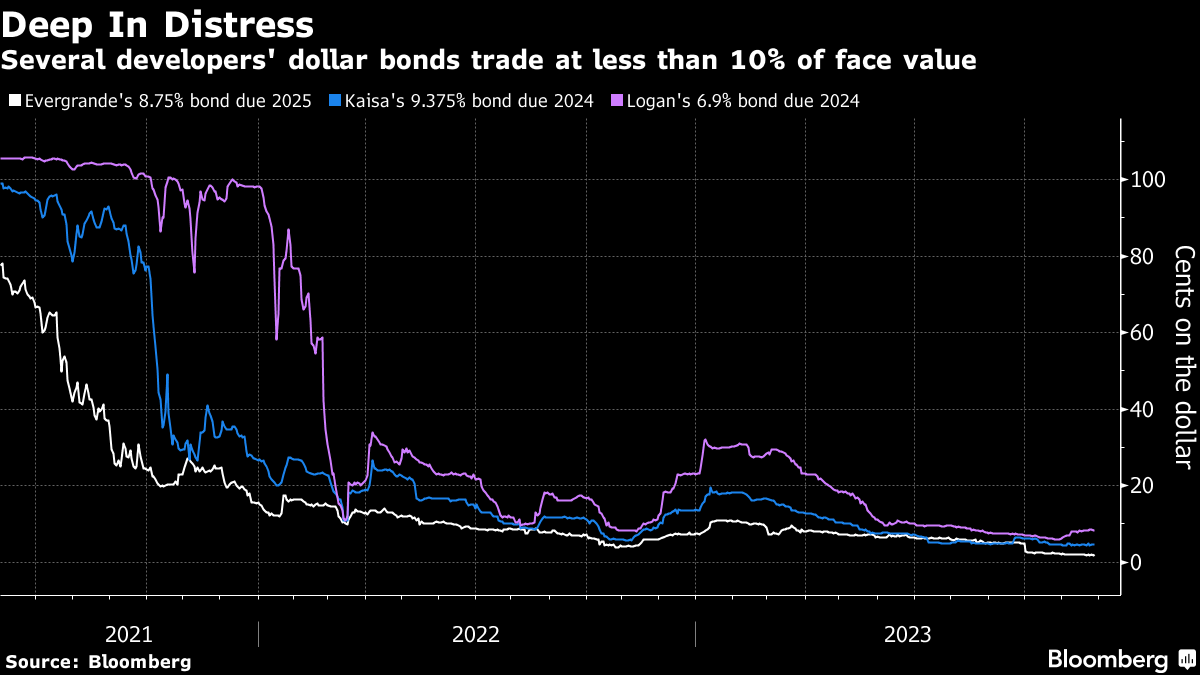
Evergrande, which has liabilities of about $327 billion, has become the poster child of China's real estate debt crisis since it defaulted in December 2021. China has been releasing new measures to shore up the struggling sector, including drafting a list of builders that would be eligible for funding support. But there is little indication that Evergrande has benefited at all.
The developer scrapped creditor meetings at the last minute in late September and said it would reassess its original restructuring proposal. In the same month, its founder and chairman Hui Ka Yan was suspected of committing crimes and placed under police control.
In the most recent court hearing in October, Evergrande's lawyer contended that the company was considering a new plan — one that would offer creditors new shares in its units, after the firm failed to obtain permission from Chinese authorities to issue bonds. That argument won what Judge Linda Chan called “a final adjournment.”
Any order to wind up Evergrande will further complicate the picture for creditors and homebuyers. One big question is whether a liquidation decision by a Hong Kong judge would be acknowledged and carried out in the mainland. Another is what happens to the progress of building presold homes — estimated at 604 billion yuan — that the company has yet to deliver.
“There will be significant interest” in the hearing on Monday, said Jiang. “In part because of the sheer scale of the default, but also because market participants are very interested in finding out if the liquidator appointed in Hong Kong will be recognized in mainland China.”
--With assistance from Shuiyu Jing and Pearl Liu.
More stories like this are available on bloomberg.com
©2023 Bloomberg L.P.

-
Indians Stay With Family, Not In Hotels | The Reason Why

India still lacks enough clean, reliable and affordable hotels for budget-conscious travellers.
-
The Economic Imperative: Analysing The Material Driving Force Behind India-Canada Strategic Reset
This economic complementarity is further reinforced by deep institutional investment ties and talent mobility, which form the bedrock of the bilateral framework.
-
Medicine Pricing: Where Must Profit Stop?
India must confront excessive margins, hidden incentives and regulatory gaps that threaten the integrity of medicine.
-
Why Amazon And Flipkart Are Struggling To Beat Meesho In India's Smaller Cities
With 274 million users and lowest-cost logistics, Meesho is defending its value commerce crown against giants like Amazon and Flipkart.
-
High US Salaries, No Green Card Certainty: The Financial Calculation Facing Indian H-1B Families
The suspension of PERM processing at eight technology employers does not cancel existing H-1B visas. What it does is force a question many Indian families have been avoiding: is the US salary worth tying your career and family plans to one employer?
-
Swiggy vs Eternal: Food Delivery's Two Rivals Are No Longer In The Same Race
Eternal is building a private AI assistant, dark.ai. Swiggy is still working out how to make Instamart pay, with an operating loss of Rs 895 crore in the July-September quarter while Blinkit stayed profitable.
-
Where You Live Shapes How You Get To Work | The Reason Why
Two-wheelers are the most popular way to get to work in India, accounting for nearly 43% of workplace commutes.
-
Unhedged Position: Can India See An Indonesia-Style Time Correction?
The Nifty is trading below levels it first clocked in 2024. Is there, then, as I have suggested in the headline, potential that the current time correction drags on painfully for the next three-five, even ten years?
-
Navigating Friction And Energy Realities: An Analysis Of Marco Rubio's October Visit To India
Occurring at a critical juncture marked by stalled trade negotiations and escalating geopolitical pressures over global energy supplies, the visit offers a profound window into modern US-India relations.
-
India Exports Capital. Why Not Export Trusteeship?
The big question, then, is whether India can build an institution that global borrowers, investors, banks, and lawyers can trust, even without an Indian connection.










