Ekta Kapoor’s Strategy To Grow ALTBalaji Without Taking On Netflix, Amazon
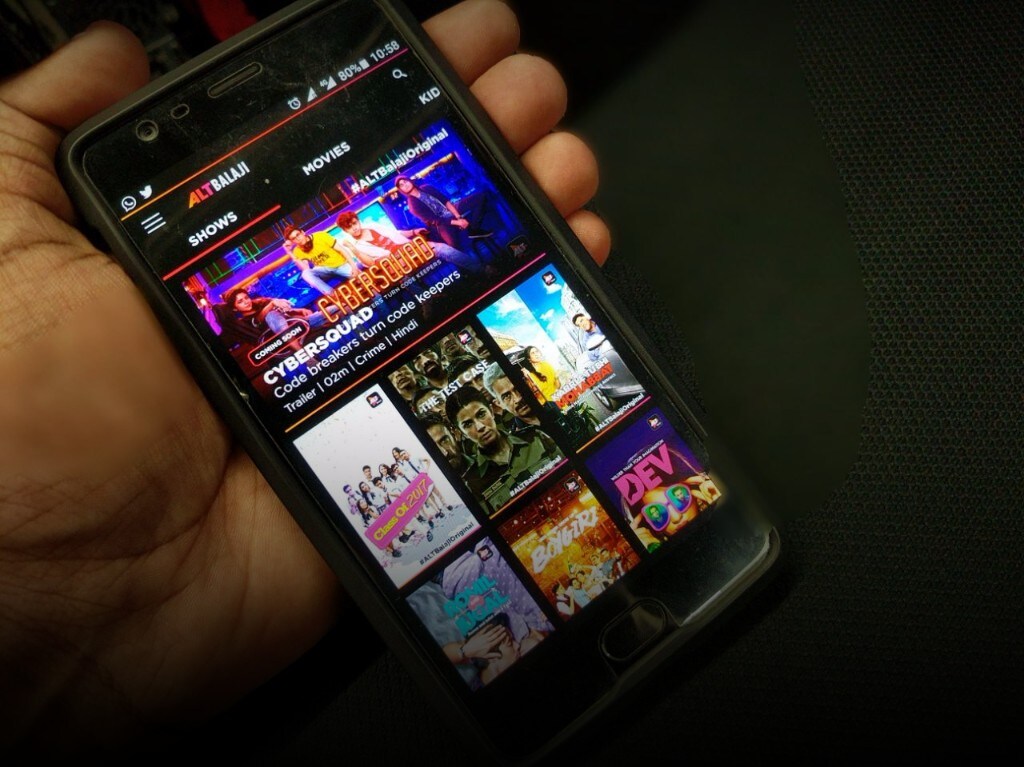
Ekta Kapoor, maker of some of India's most popular television series and blockbuster Bollywood films, says she isn't competing with Amazon Prime or Netflix, the subscription services that got Indians hooked to online content. Her target is the nation's low- and mid-income consumers.
“We don't want to cannibalise and compete with the international apps,” Kapoor told BloombergQuint in an interview via videoconference. “We know the mass market here, and we know the need for individualised content in mass market.”
In recent months online viewership of shows and movies has seen sharp rise in India, a nation with half-a-billion internet users, on cheap data and smartphone penetration. With people confined to homes during the lockdown to contain Covid-19 pandemic, demand for content on over-the-top apps spiked.
Kapoor said the content she puts on television and on ALTBalaji, her Balaji Telefilms Ltd.'s OTT service, is different. Television content consumption is a communal activity where the entire family sits together to watch a show, which means it can't be radical or upsetting for anyone, said the maker of TV series like ‘Kasautii Zindagii Kay', ‘Yeh Hai Mohabbatein' and ‘Naagin'. The same people, however, also have a growing need for individualised content, which is more radical or modern, she said.
While urban shows—big on Netflix and Amazon—did well for Balaji, the return on investment is higher on lower-budget areas of dramas, youth shows, thrillers and even some of the sexual content, she said. Shows on ALTBalaji include series like ‘Baarish' and comedy ‘Who's Your Daddy', aimed at 18+ audiences.
ALTBalaji's one-year subscription costs Rs 300 or Rs 25 a month. This compares with a Rs 129 per month or Rs 999-a year subscription for Amazon Prime, which includes other services such as faster delivery from Amazon's marketplace. Netflix's plans range from Rs 199 to Rs 799 a month.
Still, majority of the Indians view content online free and paid subscription services account for a tiny fraction of demand. The online shift is taking at a fast pace. A report by Boston Consulting Group estimates it to become a $5-billion market by 2023. Covid-19 may have accelerated that growth.
“Price sensitivity will create its own audience and it will be a big part of the content play because you can't create content at a crore or Rs 2 crore per episode, make 50 shows like that and charge Rs 300 a year,” Kapoor said.
While online consumption rose during pandemic, movie releases suffered as the multiplexes remained shut. Kapoor, who has made films like ‘Dirty Picture', ‘Half Girlfriend' and ‘Udta Punjaab', said her Balaji Motion Pictures Ltd. has smaller releases lined up for 2020.
“Eclectic movies” such as these work better on digital platforms since they reach their audiences without the pressure of box-office collections, she said. This way their life is also extended to more than the two weeks, Kapoor said. “This can open up a whole new revenue stream.”
Among the movies Balaji Motion Pictures is scheduled to release this year are ‘Dolly Kitty Aur Woh Chamakte Sitare', ‘KTina' and ‘Pagglait', which will be released on OTT platforms. The company is likely to release four to five of its big-budget movies in 2021 when Kapoor expects viewers to flock back to cinemas.
‘You Aren't Judged For What You Watch'
Kapoor said the outbreak has been good and bad. While shooting came to a standstill for three months, OTT platforms grew at a much faster rate as viewers moved away from the television in search for new shows.
“There was a huge shift due to lack of television content because watching content on apps resulted in what we thought would take a year, year-and-a-half more,” she said. Kapoor, who launched ALTBalaji in 2017, said the pandemic has only accelerated the shift to individualised content.
“You can have your individual playlist, your own phone number and a landline but people like personalised communication,” she said. “We knew that would come into play once we had an OTT platform and you're not being judged for what you watch.”
Watch the full conversation here:

-
The Economic Imperative: Analysing The Material Driving Force Behind India-Canada Strategic Reset

This economic complementarity is further reinforced by deep institutional investment ties and talent mobility, which form the bedrock of the bilateral framework.
-
Medicine Pricing: Where Must Profit Stop?
India must confront excessive margins, hidden incentives and regulatory gaps that threaten the integrity of medicine.
-
Why Amazon And Flipkart Are Struggling To Beat Meesho In India's Smaller Cities
With 274 million users and lowest-cost logistics, Meesho is defending its value commerce crown against giants like Amazon and Flipkart.
-
High US Salaries, No Green Card Certainty: The Financial Calculation Facing Indian H-1B Families
The suspension of PERM processing at eight technology employers does not cancel existing H-1B visas. What it does is force a question many Indian families have been avoiding: is the US salary worth tying your career and family plans to one employer?
-
Swiggy vs Eternal: Food Delivery's Two Rivals Are No Longer In The Same Race
Eternal is building a private AI assistant, dark.ai. Swiggy is still working out how to make Instamart pay, with an operating loss of Rs 895 crore in the July-September quarter while Blinkit stayed profitable.
-
Where You Live Shapes How You Get To Work | The Reason Why
Two-wheelers are the most popular way to get to work in India, accounting for nearly 43% of workplace commutes.
-
Unhedged Position: Can India See An Indonesia-Style Time Correction?
The Nifty is trading below levels it first clocked in 2024. Is there, then, as I have suggested in the headline, potential that the current time correction drags on painfully for the next three-five, even ten years?
-
Navigating Friction And Energy Realities: An Analysis Of Marco Rubio's October Visit To India
Occurring at a critical juncture marked by stalled trade negotiations and escalating geopolitical pressures over global energy supplies, the visit offers a profound window into modern US-India relations.
-
India Exports Capital. Why Not Export Trusteeship?
The big question, then, is whether India can build an institution that global borrowers, investors, banks, and lawyers can trust, even without an Indian connection.
-
France's Economy & Politics Are In Crisis | The Reason Why
Let's look at how the French economy and politics evolved under Nicolas Sarkozy, Franois Hollande and Emmanuel Macron.










