Economists warn of more market 'tantrums' as US Fed tightens
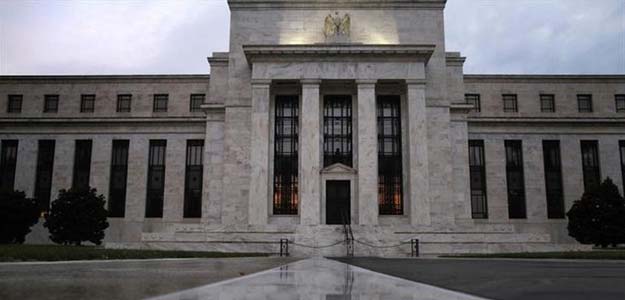
Turbulence on Wall Street will likely return when the Federal Reserve decides to hike interest rates, top US economists said in a paper that warned the Fed's huge stimulus program could have harmful consequences.
The paper, released on Friday, focused on a financial market selloff in mid-2013 after Fed officials said they planned to trim monthly bond-buying.
The authors found mutual fund investors participated heavily in the selloff even though their market bets weren't made with a lot of borrowed money.
This is important because policymakers sometimes weigh the chances of a financial crash by looking at the size of leveraged bets, which can be prone to swift reversals. The research highlights a perhaps under-appreciated risk for the Fed's plans to wind down its easy-money stimulus.
"Whenever the decision to tighten policy is made, then the instability seen in summer of 2013 is likely to reappear," wrote JPMorgan chief US economist Michael Feroli, University of Chicago professor Anil Kashyap and two other well-respected economists.
Several Fed officials were present at the high-profile economics conference where the paper was presented, and two said the paper raised real concerns.
That said, the ideas highlighted by the paper already play into the Fed's current monitoring of financial risks, said Minneapolis Fed President Narayana Kocherlakota.
Kocherlakota, who is a voting member on the Fed's rate-setting policy committee this year, has argued forcefully for monetary stimulus and said the U.S. economy remains so weak that the Fed still has another "two to three years" to mull financial stability risks.
"We don't need this theory to be able to make decisions in March of 2014," Kocherlakota said during a discussion of the paper.
'Not a free lunch'
The Fed in January started winding down five years of ultra-accommodative policies meant to fight the 2007-09 recession and foster a stronger recovery. That means an eventual end to trillions of dollars in bond buying and a policy of keeping overnight interest rates at zero.
The risk that all this easy money may have inflated asset price bubbles has stoked debate within the Fed over whether policymakers should stand ready to raise rates earlier than planned to snuff out those risks.
Fed Chair Janet Yellen, however, has said her inclination is that financial stability risks can be addressed primarily through regulatory tools.
In the paper, also co-authored by professors Hyun Song Shin of Princeton University and Kermit Schoenholtz of New York University, the economists concluded that the current policy stimulus "is not a free lunch" and can bring about disruptions when that accommodation is lifted.
"Perhaps the domestic macroeconomic fallout from exit will be as gentle as was the impact from the 2013 'taper tantrum,'" they wrote. "However, such a benign outcome is not guaranteed."
Fed Governor Jeremy Stein, who also spoke at the conference, agreed that the behavior of asset managers needs careful watching. He flagged the rapid growth fixed-income funds and similar investment funds.
"It would be a mistake to be complacent about this phenomenon simply because such funds are unlevered," Stein said.
Daniel Tarullo, a Fed governor and its top bank regulator, said on Tuesday the central bank should not rule out using monetary policy to combat asset price bubbles that potentially threaten financial stability.
The economists argued in their paper that the Fed's two key stimulus efforts, monthly bond buying and a pledge to keep interest rates low for a long time, "can build future hazards by encouraging certain types of risk-taking that are not easily reversed in a controlled manner."
The paper also underlines a concern that Tarullo and Stein have raised in the past: that regulatory tools may not be enough to stamp out risks in harder-to-detect corners of financial markets.
The usual tools of monitoring banks - bank capital ratios and liquidity requirements, among other regulations - fail to address instabilities that mutual fund investors, for example, can cause when they rush for the exits, the economists wrote.
The 55-page paper examined bond flows from mutual funds, and noted that investors do not want to be the last out of a trade.
It finds that banks need not take action to spark market tantrums, suggesting that too-big-to-fail banks should not be the sole focus of regulators looking to stabilize markets.
The "absence of leverage may not be sufficient to ensure that monetary policy can disregard concerns for financial stability," the paper said.
Copyright: Thomson Reuters 2014

-
Gold Is Rs 22,000 Cheaper Than A Month Ago. Should You Buy Amid The Wedding Season?

Gold's potential slide to $3,500 could save around Rs 4,700 per 10 grams, but a soft inflation print could just as easily push prices back up. One way to split the risk is to buy in parts, some now and the rest after the Fed's Dec. 9 decision.
-
AI Agents Are Gaining Power. Who Governs Them?
Artificial intelligence agents promise to transform productivity by moving machines from assisting decisions to executing them. But as organisations delegate greater authority to these AI-agents, they must first establish who controls that authority and who remains accountable when things go wrong.
-
Why Swapping Your Old Gold Can Trigger A Rs 5 Lakh Tax Bill, And How You Can Avoid It Legally
Swapping old gold for new is taxed as a sale and a fresh purchase. Getting your own gold remade can cut most of that bill, though it has its own costs.
-
The AI Trade is Done. The Real Opportunity for Investors Starts in 2027 | Unhedged Position
As pureplay AI stocks plunge and circular, capex-led financing unwinds, 2027 is set to be a year of reckoning for AI companies. Yet the bust clears the way for a better opportunity for investors in 2027 -- shifting the spotlight from AI builders to the companies using AI.
-
Leadership As Mission: Why The Age Of AI Demands More Human Leadership
Debjani Ghosh examines how AI is changing leadership, arguing that its success must be measured by its impact on people and the accountability of those guiding its use.
-
We May Need Another Tukaram Mundhe To Fight Air Pollution | The Reason Why
Developers may install basic measures such as sprinklers and green nets, resume work, and continue violating rules when this equipment stops working.
-
Extracting Value From Battery Scrap Could Be Challenging For India | The Reason Why
A discarded lithium-ion battery still contains valuable materials such as lithium, nickel and cobalt. These can be recovered and reused. When such batteries are crushed and shredded, they produce a dark powder called black mass.
-
One El Nino, India Can Handle. Two Could Break The Granary
India's grain stocks can absorb one bad year, but a second El Nino could drain the buffer in two to three years, economists say.
-
India's Troika Of Good Luck | Joining The Dots
As Jensen Huang's exit drags Nvidia down, a cooling AI trade and resilient earnings have revived investor interest in India. A likely RBI rate hike looms.
-
Talking Points This Week: Leadership Shock At Nvidia, Earnings Strength, And The Fog Over Hormuz
The Anthropic IPO pricing and first trading day, Nvidia's upcoming earnings, and any fresh signals from Iran will set the tone for the following week.









