Economist Abhijit Sen - An Advocate Of MSP, Public Distribution System
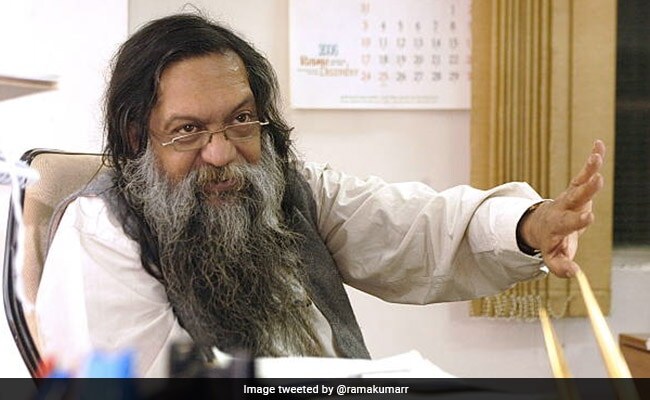
Economist Abhijit Sen, who died on Monday night, was a strong advocate of the public distribution system of foodgrains and a leading expert on rural economy.
He was 72.
A member of the erstwhile Planning Commission, Sen was the author of the landmark report that recommended making the Commission for Agricultural Costs and Prices (CACP) a statutory body and its fixation of minimum support prices - which the government was bound to accept - be based on the cost of production.
Born in Jamshedpur on November 18, 1950, Sen, whose father Samar Sen worked as an economist for the World Bank, was schooled at Sardar Patel Vidyalaya in New Delhi before studying Physics at St Stephen's College in Delhi University.
Switching to economics, Sen earned his PhD from Cambridge University for his thesis, 'The agrarian constraint to economic development: The case of India' under the supervision of Suzy Paine.
He taught economics at Sussex, Oxford, Cambridge and Essex before joining the Centre for Economic Studies and Planning at Jawaharlal Nehru University in 1985.
In 1997, he was appointed chairman of CACP and tasked to recommend support prices for agri commodities.
He authored the report of the High-Level Committee on Long Term Grain Policy in July 2000, that recommended fixation of MSP based on all paid-out cultivation expenses in cash and in kind, plus the imputed value of unpaid family labour and rent/interest forgone on owned land and fixed capital assets.
This formulation was later captured in the 'Swaminathan formula' that recommended that MSPs of crops be at least 50 per cent more than the cost of production.
The Sen panel had also favoured a universal public distribution system with uniform central issue prices for rice and wheat while doing away with 'below poverty line' and 'above poverty line' categories.
This was used by the Congress-led UPA government in the National Food Security Act of 2013, to provide wheat and rice to more than a third of the country's population at a uniform Rs 2 and Rs 3 per kg price.
During the Manmohan Singh government from 2004 to 2014, he was a member of the Planning Commission.
In 2010, he was awarded the Padma Bhushan for public service.
Sen was a strong supporter of the public distribution system (PDS) of wheat and rice and would contend that the cost of food subsidies to the exchequer was frequently overstated and that the nation had enough financial leeway to afford both a universal PDS and a fair price for farmers' produce.
His brother Pronab Sen is also an economist and was the chairman of the National Statistical Commission and Chief Statistician of India.
His wife Jayati Ghosh is a prominent economist and his daughter Jahnavi is a journalist.
Reacting to his death, Kaushik Basu, former chief economist of the World Bank, said: "Shattering news. A brilliant mind and a fine human being."
(This story has not been edited by NDTV staff and is auto-generated from a syndicated feed.)

-
Signature Play: The Classic Cocktail Is Dead. Or Is It?

Classic cocktails are disappearing from India's cocktail menus. But they're still being ordered, taught to bartenders and borrowed from. So, who's really having the last drink?
-
A New Samvat Wishlist: Inclusive Prosperity And Human Development
India has strengthened its economic foundations through infrastructure, digital access and enterprise. Its next growth chapter must deepen productivity, create better livelihoods and widen participation in prosperity.
-
Love, Sex Aur Dhokha: The Audacious Plot To Spy On Jensen Huang
A Taipei dinner, a Singapore chip buyer and a suspected Chinese asset: inside the alleged spy operation that got close to NVIDIA's Jensen Huang.
-
Ten Things I Learnt This Samvat
Patience can be a trap. Cheap stocks can stay cheap. Leverage can wipe you out. What did Samvat 2082 teach us? Niraj Shah writes on 10 lessons from the year gone by.
-
Talking Points This Week: Tech Nerves, FII Buying, And A Faraway Banking Shock
The global markets are not shining this Diwali. The exception in the large markets is, India.
-
Midterm Rally Lasted A Day. The Hard Reality Of A Divided US May Last Two Years | Opinion
Between a contested AI boom, a debt ceiling that arrives in 2027 and a president with every incentive to act alone, the next two years may prove more volatile than the first day's rally suggests.
-
Blue Wave Will Derail the AI Trade but Won't Dismantle the AI Era | Unhedged Position
The Democrats' sweep of the US Congress will see politics collide with economic forces both over the long and short term.
-
It's Time To Take The GST Council's Bet On Trust Global
Payment records can prove India's services exports, and clear, proportionate rules can bring foreign digital sellers into the tax net.
-
Opinion | India at 38: From Innovation Overperformer to Innovation Powerhouse
India now has 453 VC-backed deep science startups, 18 of them late-stage, after 117 percent growth since 2020. Laurus Labs, at USD 9.3 billion, is the most valuable deep science company in any middle-income economy outside China.









