Economic Recovery Still Uneven, Says Raghuram Rajan
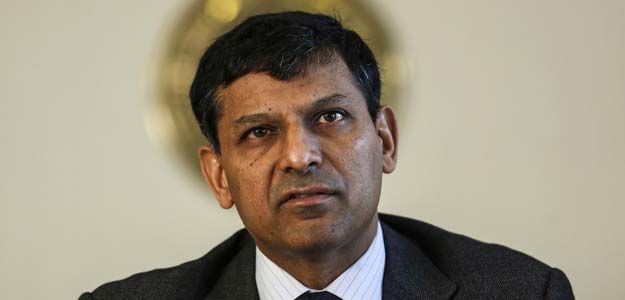
New York: Stating that India's economic recovery is still uneven, Reserve Bank of India Governor Raghuram Rajan has exuded optimism that the country will be "solidly" in the 5 per cent growth bracket during the course of this fiscal year, and accelerate further in 2015-16.
The RBI Governor has also said he is not "overly" worried about any interest rate hike by the Federal Reserve, saying the country has enough foreign exchange reserves.
"It is still an uneven (economic) recovery, so my guess is that this quarter may be a little weaker than the previous quarter but I think over the course of this year, we will be solidly in the five per cent growth range and by next year we should be solidly in the six per cent growth range," he said.
He was speaking at the Institute of International Finance in Washington on Saturday.
He also said there was no need for "grand-sounding announcements" and that India needed to "fix the plumbing" including problems in coal and gas sectors to accelerate improve recovery and get the Indian economy back on track.
On whether the Indian government will be able to deliver on the expectations of economic growth, he said, "Talk is cheap. What we really have to do is deliver. We have to start delivering."
"We are in the process of doing it, but watch the space and see the results. Hopefully that will convince you," he said.
He said that in order to revive economic growth, "execution" is important and the government is engaged in that aspect.
"The inflation path or the glide path that we have proposed has wide acceptance but it is still not enshrined in the law."
"For now I have what I need, which is the glide path which has at this point convinced the financial markets that we mean what we say and we will do what we say," the RBI Governor said.
Mr Rajan said that while India has to do its basic homework, the "good news" is that there are "lots of low-hanging fruit and we got to pluck them".
"Of course the big question is why we did not do it before but I think there is an environment and there is a willingness at this point to do what it takes."
"What it means, I would caution people on, is not at this point grand-sounding announcements because that is not what we really need," the RBI chief said, adding, "We need to fix the plumbing."
"We need to do the basic stuff which will get the economy back on track," he said when asked how India will meet the high expectations that have been set by the Narendra Modi government to revive economic growth.
In a lighter vein, Mr Rajan said the expectations needed to be toned down.
He, however, added that on the real side, focus should be on getting the projects that are stalled going again, fixing problem in coals and gas, "which are not the stuff of headlines but are quite important" as well as getting businesses and government departments to make payments on time.
Mr Rajan also said that beyond 2016, the Indian economy will grow depending on what the country does over these couple of years.
Mr Rajan noted that there is massive push on infrastructure.
"On energy we have to get the pricing of energy right in India. This means gas pricing, coal pricing so as to give people incentive to explore and invest. These are the big issues the government is tackling, what is the appropriate price for gas, what is the appropriate price and flexibility to produce for coal."
"I think in the next few months, these big decisions will be made and that will create a much clear environment for investment in energy which India needs tremendously," Mr Rajan added.
Outlining the key pillars that the government is focused on, he said that apart from clarifying the monetary framework, the other area that India is focuses on is creating a more vibrant banking sector.
"We propose to license a number of different banks," which like small finance banks would have the ability and mandate to lend to individuals and small enterprises.
"There is a whole restructuring of the banking sector that is going to happen."
Mr Rajan also pointed out that another "ongoing process" is deepening the financial markets, including bringing more investors including foreign investors into those markets.
He said the government is also focused on fixing financial distress.
"We have some distress on the banking sector balance sheet. We need to make the banks come together to resolve those problems and move forward. The earlier they resolve it, the better," he said.
Terming financial inclusion as the "last big item we need to fix", Mr Rajan said there is need to bring more Indians into the financial fold and lend to more small enterprises that do not have access to credit.
"This is really our framework for the next few years."
On the possibility of some volatility in emerging markets once the Federal Reserve decides to raise interest rates, Mr Rajan said, "If the Fed starts raising interest rates, as I presume they will, it will be good for the rest of the world."
"The rest of the world will benefit from US growth."
"It could create some volatility for the emerging markets. My hope is that after the initial volatility there will be differentiation, and the financial investors would try to see where there is some macro-stability. And I hope India comes out in (that) group that looks like it has stability."
The RBI Governor also said that he is "not overly worried" about that process given several factors that are in India's favour like the plenty of reserves it has relative to where they were last year.
"We have got inflation coming down in a substantial way. We have got a fiscal deficit which is on a glide path to three per cent in 2016 and we are on the beginning path of much stronger growth," he said.
He further said India is not trying to manage the exchange rate.
"We are not overvalued at this point but reserve build up has not come at the expense of the value of the rupee."

-
Gold Is Rs 22,000 Cheaper Than A Month Ago. Should You Buy Amid The Wedding Season?

Gold's potential slide to $3,500 could save around Rs 4,700 per 10 grams, but a soft inflation print could just as easily push prices back up. One way to split the risk is to buy in parts, some now and the rest after the Fed's Dec. 9 decision.
-
AI Agents Are Gaining Power. Who Governs Them?
Artificial intelligence agents promise to transform productivity by moving machines from assisting decisions to executing them. But as organisations delegate greater authority to these AI-agents, they must first establish who controls that authority and who remains accountable when things go wrong.
-
Why Swapping Your Old Gold Can Trigger A Rs 5 Lakh Tax Bill, And How You Can Avoid It Legally
Swapping old gold for new is taxed as a sale and a fresh purchase. Getting your own gold remade can cut most of that bill, though it has its own costs.
-
The AI Trade is Done. The Real Opportunity for Investors Starts in 2027 | Unhedged Position
As pureplay AI stocks plunge and circular, capex-led financing unwinds, 2027 is set to be a year of reckoning for AI companies. Yet the bust clears the way for a better opportunity for investors in 2027 -- shifting the spotlight from AI builders to the companies using AI.
-
Leadership As Mission: Why The Age Of AI Demands More Human Leadership
Debjani Ghosh examines how AI is changing leadership, arguing that its success must be measured by its impact on people and the accountability of those guiding its use.
-
We May Need Another Tukaram Mundhe To Fight Air Pollution | The Reason Why
Developers may install basic measures such as sprinklers and green nets, resume work, and continue violating rules when this equipment stops working.
-
Extracting Value From Battery Scrap Could Be Challenging For India | The Reason Why
A discarded lithium-ion battery still contains valuable materials such as lithium, nickel and cobalt. These can be recovered and reused. When such batteries are crushed and shredded, they produce a dark powder called black mass.
-
One El Nino, India Can Handle. Two Could Break The Granary
India's grain stocks can absorb one bad year, but a second El Nino could drain the buffer in two to three years, economists say.
-
India's Troika Of Good Luck | Joining The Dots
As Jensen Huang's exit drags Nvidia down, a cooling AI trade and resilient earnings have revived investor interest in India. A likely RBI rate hike looms.
-
Talking Points This Week: Leadership Shock At Nvidia, Earnings Strength, And The Fog Over Hormuz
The Anthropic IPO pricing and first trading day, Nvidia's upcoming earnings, and any fresh signals from Iran will set the tone for the following week.









