Eclipse Draws Thousands to Watch Desert Plunge Into Darkness
(Bloomberg) -- Astronomers and amateur skywatchers were treated to a total solar eclipse in part of Chile's northern desert, an area famed for its clear skies and host to some of the world's largest telescopes.
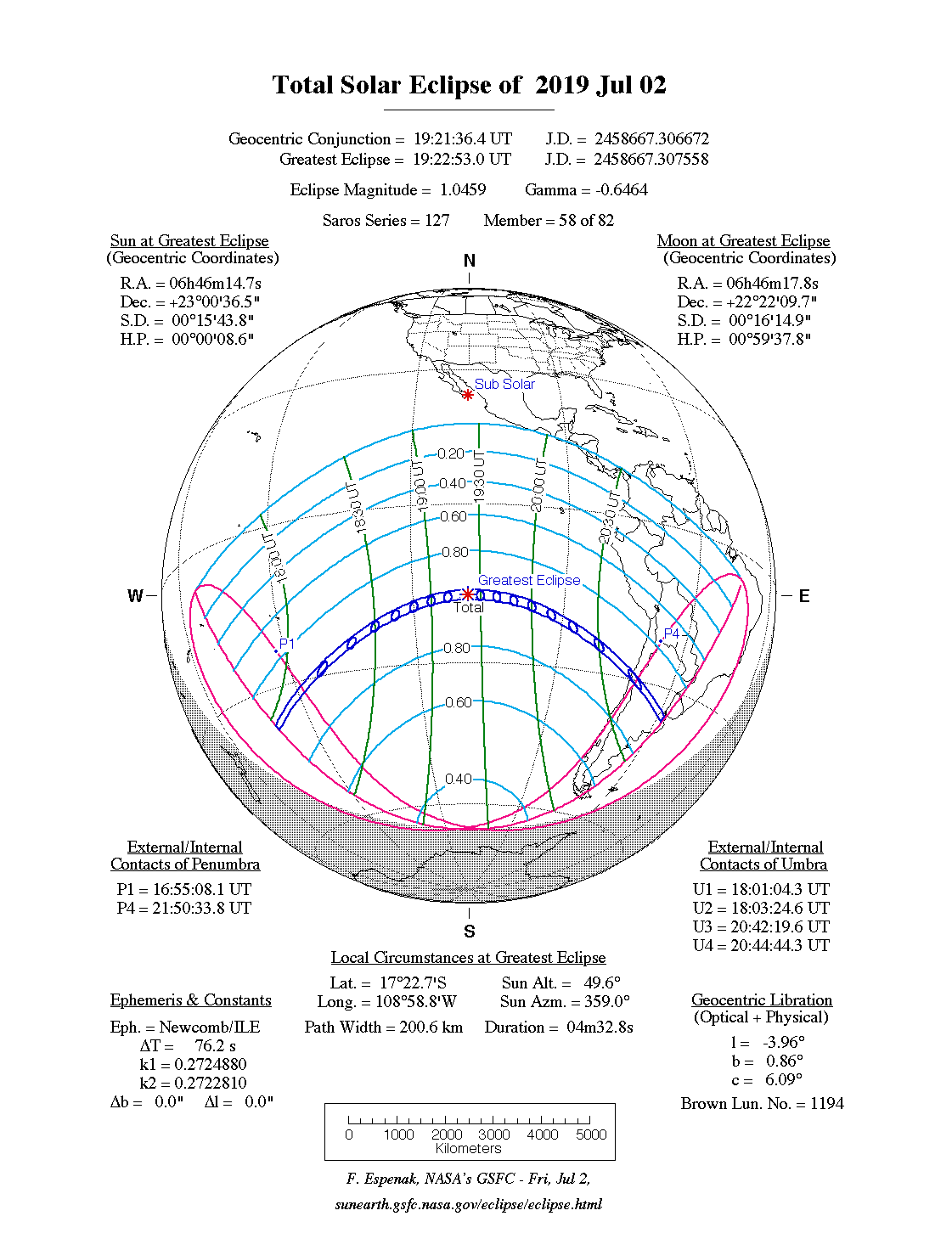
More than 200,000 people flocked to the coastal resort of La Serena and the nearby Elqui Valley to witness the moon's shadow cover the totality of the sun for exactly 2 minutes and 36 seconds at 4:39 p.m. local time Tuesday. Such eclipses happen once every few months, but this year's happened to take place in a region that attracts tens of thousands of amateur astronomers every year.
About half of the world's observation capacity is now installed in Chile and with new mega telescopes under construction, that number is set to rise to 70% by 2020. The country hosts seven of the world's 18 largest optic telescopes, as well as the world's most powerful and modern radio-telescope. High altitude, low humidity, cloudless skies and a lack of light pollution make northern Chile's skies the world's clearest.
Public and private institutions across the globe have invested an estimated $5 billion in 22 observatories in Chile, according to local media. Projects under construction include the $473 million Large Synoptic Survey Telescope, or LSST, and the European Southern Observatory's Extremely Large Telescope or E-ELT, with an estimated investment of 1.17 billion euros ($1.32 billion).
Special glasses
While the eclipse wasn't total further south in the capital Santiago, thousands of Chileans still watched from the city's most emblematic spots, including the Costanera tower, South America's tallest building.
The special glasses required to see the eclipse ran out in many stores earlier in the week. By Tuesday, those who couldn't find them were taking the risk and making their own.
“It has been spectacular to see such a phenomenon in my own country,” said 37-year-old Claudia Castillo, who witnessed the eclipse from San Cristobal hill in Santiago. “Half of the fun are the crowds, there's so many people!”
--With assistance from Daniela Guzman, Maria Jose Campano and Sebastian Boyd.
To contact the reporter on this story: Laura Millan Lombrana in Santiago at lmillan4@bloomberg.net
To contact the editors responsible for this story: James Attwood at jattwood3@bloomberg.net, Philip Sanders
©2019 Bloomberg L.P.

-
Indians Stay With Family, Not In Hotels | The Reason Why

India still lacks enough clean, reliable and affordable hotels for budget-conscious travellers.
-
The Economic Imperative: Analysing The Material Driving Force Behind India-Canada Strategic Reset
This economic complementarity is further reinforced by deep institutional investment ties and talent mobility, which form the bedrock of the bilateral framework.
-
Medicine Pricing: Where Must Profit Stop?
India must confront excessive margins, hidden incentives and regulatory gaps that threaten the integrity of medicine.
-
Why Amazon And Flipkart Are Struggling To Beat Meesho In India's Smaller Cities
With 274 million users and lowest-cost logistics, Meesho is defending its value commerce crown against giants like Amazon and Flipkart.
-
High US Salaries, No Green Card Certainty: The Financial Calculation Facing Indian H-1B Families
The suspension of PERM processing at eight technology employers does not cancel existing H-1B visas. What it does is force a question many Indian families have been avoiding: is the US salary worth tying your career and family plans to one employer?
-
Swiggy vs Eternal: Food Delivery's Two Rivals Are No Longer In The Same Race
Eternal is building a private AI assistant, dark.ai. Swiggy is still working out how to make Instamart pay, with an operating loss of Rs 895 crore in the July-September quarter while Blinkit stayed profitable.
-
Where You Live Shapes How You Get To Work | The Reason Why
Two-wheelers are the most popular way to get to work in India, accounting for nearly 43% of workplace commutes.
-
Unhedged Position: Can India See An Indonesia-Style Time Correction?
The Nifty is trading below levels it first clocked in 2024. Is there, then, as I have suggested in the headline, potential that the current time correction drags on painfully for the next three-five, even ten years?
-
Navigating Friction And Energy Realities: An Analysis Of Marco Rubio's October Visit To India
Occurring at a critical juncture marked by stalled trade negotiations and escalating geopolitical pressures over global energy supplies, the visit offers a profound window into modern US-India relations.
-
India Exports Capital. Why Not Export Trusteeship?
The big question, then, is whether India can build an institution that global borrowers, investors, banks, and lawyers can trust, even without an Indian connection.