Dow breaks 13,000 but can't hold gains
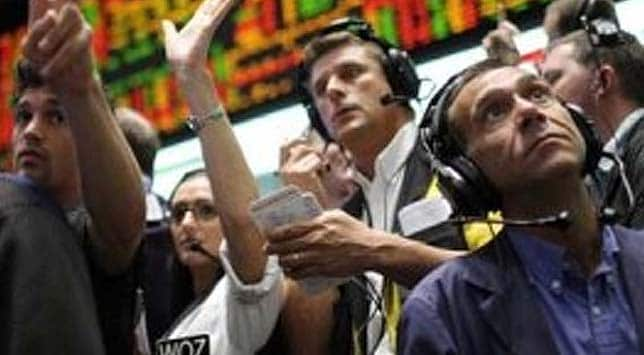
It came and went in a flash, a number on a board for seconds at a time, but its symbolic power couldn't be dismissed.
The Dow Jones industrial average, powered higher all year by optimism that the economic recovery is finally for real, crossed 13,000 on Tuesday for the first time since May 2008.
The last time the Dow occupied such rarefied territory, unemployment was a healthy 5.4 percent, and Lehman Brothers was a solvent investment bank. Financial crises happened in other countries, or the history books.
The milestone Tuesday came about two hours into the trading day. The Dow was above 13,000 for about 30 seconds, and for slightly longer at about noon and 1:30 p.m. (1830 GMT), but couldn't hold its gains. It finished up 15.82 points at 12,965.69.
Still, Wall Street took note of the marker.
It was just last summer that the Dow unburdened itself of 2,000 points in three terrifying weeks. S&P downgraded the United States credit rating, Washington was fighting over the federal borrowing limit, and the European debt crisis was raging.
A second recession in the United States was a real fear. But the economy grew faster every quarter last year, and gains in the job market have been impressive, including 243,000 jobs added in January alone.
"Essentially over the last couple of months you've taken the two biggest fears off the table, that Europe is going to melt down and that we're going to have another recession here," said Scott Brown, chief economist for Raymond James.
The tumult of last summer and fall left the Dow as low as 10,655. Its close Tuesday put it 22 percent above that low. The Dow is 1,199 points from an all-time high, a 9 percent rally from here.
A long-awaited deal to cut the debt of Greece and prevent a potentially catastrophic default, announced before dawn in Europe after 12 hours of talks, helped the Dow clear 13,000.
Under the bailout deal, Greece will get €130 billion, or about $172 billion, from other European nations and the International Monetary Fund. In a separate deal, investors in Greek bonds will forgive €107 billion in debt.
After months in which talks crawled along and vague headlines yanked the market up and down, the conclusion was almost anticlimactic because the markets were already expecting an agreement.
European markets didn't take the news as well. Stocks closed down 3.5 percent in Greece, where stocks have lost 80 percent of their value since 2007. Stocks declined less than 1 percent Tuesday in Germany, France and Britain.
Investors noted that Greece remains in deep recession. Its bond investors will take a 53.5 percent loss on the face value of their bonds, which could discourage future investment.
In the U.S., investors were cheered by earnings from Home Depot, watched closely as a barometer of American spending on homes, and Macy's. Wal-Mart missed Wall Street expectations, and its stock lost 4 percent, worst among the 30 stocks in the Dow.
The Dow has climbed 6 percent this year and has not lost 100 points on any day. The Greek debt crisis may be receding, but high gasoline prices are emerging as a threat to the economic recovery, and thus the stock market.
A gallon of regular gas costs $3.57 on average, the highest on record for this time of year. With tension building over Iran's nuclear ambitions, Iran has halted oil exports to Britain and France and threatened to stop shipping to other European countries.
The price of oil settled at $106.25, up $2.65 for the day and its highest level since last May. The price jumped more than $1 in about 20 minutes after Iran's foreign ministry spokesman told reporters that a U.N. team visiting Iran has no plans to inspect the country's nuclear facilities and will only hold talks with Iranian officials.
"That was the olive branch the market was holding onto," said Phil Flynn, an analyst for the brokerage PFGBest. "If they're not going to discuss the nuclear program, then we're a lot closer to a conflict than further away," he said.
Airline stocks got clobbered. United Continental lost 9 percent, Delta Air Lines 7 percent. The Dow transportation average lost 1.5 percent.
Materials, telecommunications and energy companies led the industries gaining ground. Health care companies, makers of consumer staples and utilities, traditionally stocks to own in more cautious times, were lower.
The Standard & Poor's 500 index surpassed 1,363, its peak from April 2011, but closed at 1,362.21, up 0.98 point. The Nasdaq composite, which is heavy with technology stocks and trading at levels not seen since December 2000, closed down 3.21 points at 2,948.57.
Metals prices jumped because of expectations that demand may improve after the Greek bailout package was approved and China took another step to stimulate economic growth. Silver finished up 3.7 percent, and platinum, copper and palladium all rose 3 percent or more. Gold ended up 1.9 percent.
The Dow industrials last closed above 13,000 on May 19, 2008. The next day, they crossed under 13,000, not to return for almost four years. They fell as low as 6,547 on March 9, 2009. A reading of 13,094 would double that.
Dan McMahon, director of equity trading at Raymond James, called the 13,000 mark "just a big round number" as a matter of market fundamentals. But he added: "Psychologically, it matters."
The milestone could motivate cautious investors to pump more money back into the stock market. The yield on the government's benchmark 10-year Treasury note rose to 2.06 percent from 2.01 percent Friday, a sign that fewer investors wanted the bonds and were instead willing to buy riskier stocks.
"You need notches along the way to measure things," and Dow 13,000 is as good as any, said John Manley, chief equity strategist for Wells Fargo's funds group. "Is 50 older than 49 and a half? Yes, by six months. Do those six months really make a difference? Probably not. But it does give us a fixed point, something we can look at."
The Dow is also an imperfect measure of the economy's health. It is made up of just 30 companies, and it's weighted so that the few with the highest stock prices carry the most heft.
A tiny percentage change in the stock of IBM, which is trading around $193, sways the index much more than a giant change in the stock of Bank of America, which is trading around $8.
Last year, the Dow rose 5.5 percent. But strip out IBM and McDonald's, the two stocks with the highest prices last year, and it rose just 1.8 percent, according to calculations by Birinyi Associates.
Dow Jones, which decides which 30 companies are the best barometer, says the index can accurately represent the economy because the Dow 30 make up 25 to 30 percent of the market value of all U.S. public companies.
Among the big movers:
— Barnes & Noble fell 4 percent after missing expectations. Rising costs offset higher sales of both traditional books and digital books. Investors seemed encouraged that the bookstore chain, a survivor in an era that has felled competitors like Borders and Waldenbooks, plans to introduce a cheaper Nook to compete with Amazon's Kindle Fire.
— J.C. Penney, which is trying to reinvent itself and just brought in an Apple veteran as CEO and changed its logo, fell 3 percent after Fitch Ratings dropped its credit grade to junk status.
— Wal-Mart fell 4 percent after missing analysts' expectations for revenue and per-share earnings.
— High-end department store Saks rose 3 percent after beating analysts' expectations.

-
Getting To Work Costs Women More | The Reason Why

It is not just about women paying more than men. It is about women paying much more in cities than in villages.
-
AI Bias In Investing Cannot Be Eliminated, But It Can Be Governed
Framing is a particularly important example as identical financial information presented in terms of gains rather than losses can lead an LLM to reach a different assessment.
-
Joining The Dots | Dark Skies, Steady Diya: Why Hope Holds This Diwali
With war, a weak rupee and foreign outflows weighing on sentiment, policymakers at the NDTV World Summit and market veterans at NDTV Profit Ignite: Diwali Edition offered the same advice: stay invested and filter out the noise.
-
The Curious Case of Equitas Small Finance Bank And A CEO Who Quit For Stock
PN Vasudevan believes persistent investor concerns over a perceived conflict of interest had become a governance overhang on Equitas Small Finance Bank's stock, even as the lender improved profitability and asset quality.
-
Talking Points This Week: AI Cash Burn, A Tiger Comeback And An India That Still Finds Its Own Path
India is not immune to higher oil or tighter global liquidity, yet its earnings base is broader, its domestic policy levers are still available.
-
Foreign Investors Own Half Of HDFC Bank and ICICI Bank. An LTCG Cut Could Matter Most Here
Foreign portfolio investors have US$115 billion parked in HDFC Bank, ICICI Bank. If the government cuts long-term capital gains tax, Jefferies says returning foreign money could land here first.
-
'Never Seen This Level Of Negativity': Sandeep Tandon Says The Next Rally May Be Closer Than You Think
Veteran investor Sandeep Tandon says foreign selling is easing, large-caps are due a comeback and mid-caps are crowded, while he turns positive on gold, power and pharma this Diwali.
-
Indians Stay With Family, Not In Hotels | The Reason Why
India still lacks enough clean, reliable and affordable hotels for budget-conscious travellers.
-
The Economic Imperative: Analysing The Material Driving Force Behind India-Canada Strategic Reset
This economic complementarity is further reinforced by deep institutional investment ties and talent mobility, which form the bedrock of the bilateral framework.
-
Medicine Pricing: Where Must Profit Stop?
India must confront excessive margins, hidden incentives and regulatory gaps that threaten the integrity of medicine.










