"Don't Want RBI To Become Extension Of Government": Ex CEA Arvind Subramanian
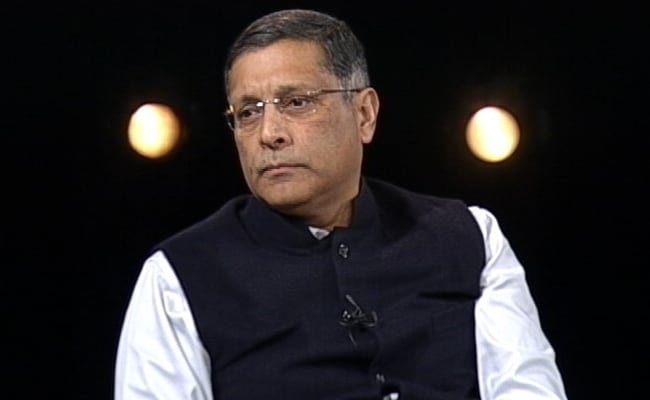
As the Reserve Bank of India (RBI) raised its outlook for inflation to 6.7 per cent for the current fiscal, up from its previous projection of 5.7 per cent, former chief economic adviser Arvind Subramanian said that the central bank has reacted late to rising prices.
In a freewheeling chat with NDTV over a host of issues ranging from global economy, importance of social harmony, India's investment climate as well as on the need for institutional freedom, Mr Subramanian, while reacting to RBI's outlook on inflation, expressed disappointment that though prices have been rising for almost three years, it was late in taking measures to check them, which showed “a certain loss of institutional independence”.
“What has been disappointing is that it is not just that inflation has been high and RBI has been late to react to it, but it smacks of certain loss of institutional independence.” Mr Subramanian said.
The former chief economic adviser said that RBI has been keeping the upper ceiling for inflation at 6 per cent but its target is 4 per cent, therefore “much more action should have been taken. In economic parlance, RBI is like Supreme Court. We don't want conflict among these institutions, but we don't want RBI to become an extension of the Government”.
“When inflation goes up, RBI is meant to raise rates to control it. But it has not done it because Government's interest burden goes up. We call it fiscal dominance, which means that fiscal situation dominates monetary policy. So RBI is trying to do what Government wants it to do, rather than bringing down inflation,” Mr Subramanian explained.
Emphasising on the importance of institutional freedom, he said that “if institutions are not going to be robust as they should be, then it takes a toll on broader investment climate, therefore the question as to why foreign investors are choosing other nations like Vietnam etc (over India), becomes relevant”.
On being asked whether rate hikes – which are impacting EMIs and loans and putting pressure on the common man – are going to continue, Mr Subramanian said that though RBI is mandated to bring inflation down to 4 per cent levels, it has kept the forecast for this fiscal at nearly 7 per cent (6.7 per cent).
“Some global prices may cool off… but RBI has to show that it has the desire and will as well as independence to achieve that (control inflation),” he said, while adding at the same time that rate hikes are likely to continue for some time, depending on external situations.
Quizzed whether India can be an investment destination in the wake of China's economic slowdown, Mr Subramanian said that India's Atmanirbhar policy is proving to be a deterrent in this.
“We have Atmanirbharta policy, so India is not really an attractive place as we have become protectionist and have raised tariffs. So this policy is a problem in attracting investment which can service the global market,” the former chief economic adviser said.
Mr Subramanian also blamed “arbitrariness in investment policy” as another deterrent in India becoming an investment hub.
“To be fair to the Government, it has started negotiating free trade agreements (FTAs)…. But there is tension between such pacts and Atmanirbharta… We will have to abandon this policy as FTAs require doing away with trade barriers,” the economist noted.
He said that there was “too much arbitrariness” in investment policy as some companies are favoured over others, which has turned away foreign investors.
“We need independent institutions, steady rules and social harmony as well as better Centre-State relations, to attract investors. For the moment we are missing that,” Mr Subramanian pointed out.
Underlining the significance of cooperative federalism, which he said was visible when the Centre had framed the Goods and Services Tax (GST) regime in consultation with states, Mr Subramanian said that spirit of consultation was missing while framing the farm laws.
However, he added that Centre alone was not to be blamed, as states too were guilty of indulging in “populism” or rather “imitative populism”.
“Here, the Centre has to take lead and create an atmosphere of trust. These are challenging times and both Centre and states have to come together,” Mr Subramanian emphasised.
Highlighting the significance of social harmony in creating a conducive investment environment, the economist said “when you have social conflict for a long time, then it takes a toll on investment. Many countries have tried to suppress such conflicts but it catches up, as can be seen in Sri Lanka”.
When conflicts become weaponised (like in Ukraine), it is the people who are most vulnerable, he said.
“In such a conflict we forget that if we have so many Indians working abroad who are vulnerable to weaponised interdependence. We have Indians in Gulf countries and overseas governments might get annoyed if social harmony is disturbed in India. These are flammable things and may happen anytime and their repercussions could be massive,” Mr Subramanian cautioned.
“So we need social harmony for ourselves and for maintaining stable relations with other nations in order to attract investment… Therefore social harmony and peace are very important,” he emphasised.
On the global economic scenario and its impact on Indian economy as well as inflation, Mr Subramanian said that currently the spectre of global stagflation is being seen right now.
“World Bank has revised the forecast for global economy and for it, anything less than 2 per cent is considered a recession. We will not only have high international prices of fuel and fertiliser, but also there will be a global slowdown. This will be a double whammy for India, as we are not just net importer of oil but will also face price shocks from global economy. At the same time, exports will fall. So both on growth as well as on inflation side, there are going to be shocks for India,” he summed up.

-
AI Bias In Investing Cannot Be Eliminated, But It Can Be Governed

Framing is a particularly important example as identical financial information presented in terms of gains rather than losses can lead an LLM to reach a different assessment.
-
Joining The Dots | Dark Skies, Steady Diya: Why Hope Holds This Diwali
With war, a weak rupee and foreign outflows weighing on sentiment, policymakers at the NDTV World Summit and market veterans at NDTV Profit Ignite: Diwali Edition offered the same advice: stay invested and filter out the noise.
-
The Curious Case of Equitas Small Finance Bank And A CEO Who Quit For Stock
PN Vasudevan believes persistent investor concerns over a perceived conflict of interest had become a governance overhang on Equitas Small Finance Bank's stock, even as the lender improved profitability and asset quality.
-
Talking Points This Week: AI Cash Burn, A Tiger Comeback And An India That Still Finds Its Own Path
India is not immune to higher oil or tighter global liquidity, yet its earnings base is broader, its domestic policy levers are still available.
-
Foreign Investors Own Half Of HDFC Bank and ICICI Bank. An LTCG Cut Could Matter Most Here
Foreign portfolio investors have US$115 billion parked in HDFC Bank, ICICI Bank. If the government cuts long-term capital gains tax, Jefferies says returning foreign money could land here first.
-
'Never Seen This Level Of Negativity': Sandeep Tandon Says The Next Rally May Be Closer Than You Think
Veteran investor Sandeep Tandon says foreign selling is easing, large-caps are due a comeback and mid-caps are crowded, while he turns positive on gold, power and pharma this Diwali.
-
Indians Stay With Family, Not In Hotels | The Reason Why
India still lacks enough clean, reliable and affordable hotels for budget-conscious travellers.
-
The Economic Imperative: Analysing The Material Driving Force Behind India-Canada Strategic Reset
This economic complementarity is further reinforced by deep institutional investment ties and talent mobility, which form the bedrock of the bilateral framework.
-
Medicine Pricing: Where Must Profit Stop?
India must confront excessive margins, hidden incentives and regulatory gaps that threaten the integrity of medicine.
-
Why Amazon And Flipkart Are Struggling To Beat Meesho In India's Smaller Cities
With 274 million users and lowest-cost logistics, Meesho is defending its value commerce crown against giants like Amazon and Flipkart.










