Dollar Marches to Four-Year High; Euro, Oil Wilt
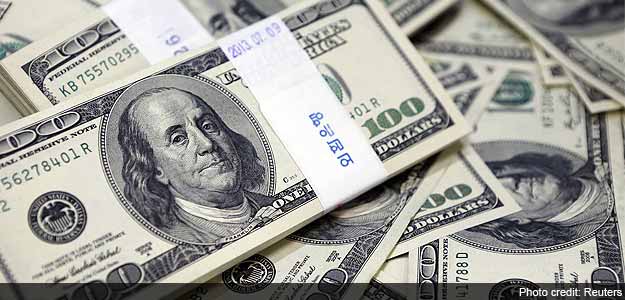
London: The dollar hit a four-year high and oil hovered near a two-year low on Thursday, as investors wagered the United States will be one of the few economies healthy enough to wean itself off of central bank aid in the near future.
Share markets in Europe started with small gains as Britain and France debated joining US-led military action against Islamist militants and as the euro sank to a 22-month low on bets the ECB will need a major stimulus effort.
Its President Mario Draghi reiterated in a newspaper interview again on Thursday there was more the ECB can do if necessary.
His words came as the central bank released its latest batch of lending data that, like it has for months, showed there is little in the way of demand for credit in the euro zone's still-struggling economy.
"ECB President Mario Draghi continues to beat the QE (quantitative easing) drums ... so hardly surprising that euro/dollar is trading at even lower levels this morning," said Esther Reichelt, a currency strategist at Commerzbank.
Britain's FTSE, Germany's DAX and France's CAX rose 0.1-0.3 per cent to put the region in the black after a choppy few days, but it was the currency market where most of action was.
With the ECB data casting a shadow, the euro fell to $1.27305 its lowest since November 2012 while the dollar, which had its own momentum following some strong US housing data on Wednesday, powered up 0.35 per cent to a fresh 4-year high against a basket of currencies.
A key factor was widening yield differentials between US 10-year government bonds and their German counterparts. The difference is the biggest in nearly 15 years and is driving more investors to buy the dollar.
The greenback was also within touching distance of its recent six-year high against the yen and was exerting broad downward pressure on commodities markets which are largely priced in dollars.
Brent crude was stuck below $97 a barrel having hit its lowest in 26 months, with abundant supply also continuing to drag on prices.
Gold extended its recent losses too, reacting to stronger equities and the robust US economic data that curbed its safe-haven appeal.
Russia rebound
Geopolitical uncertainty rumbled in the background as air strikes against Islamic State militants in Syria continued, but there were more positive signs on the tensions with Russia over Ukraine.
Ukraine's President Petro Poroshenko said that for the first time in many months no deaths or wounded had been reported in the past 24 hours in the conflict with pro-Russian separatists indication the ceasefire "has finally begun working".
Russian stocks rose for the third day running, with investors also sensing the European Union may decide to ease some of its sanctions against Russia by the end of the month.
In Asia it had been a mixed day.
MSCI's broadest index of Asia-Pacific shares outside Japan fell 0.4 per cent after touching a four-month low, though Tokyo's high-flying Nikkei jumped 1.1 per cent as the yen continued to bow to the dollar.
New Zealand dollar meanwhile hit a one-year low after Reserve Bank of New Zealand Governor Graeme Wheeler ramped up his recent warnings about the level of the currency.
"The Bank's analysis indicates that the real exchange rate is well above its sustainable level, and also above levels justified by short-term business cycle factors," he said in a statement that caught markets off-guard.
It also inflicted some collateral damage on its Antipodean cousin, the Australian dollar, which fell to $0.8813, its lowest since early February.
"The statement itself was another intervention threat. The Reserve Bank is saying that even down at these levels the kiwi is too high," said Imre Speizer, currency strategist at Westpac.
Copyright @ Thomson Reuters 2014

-
Indians Are Travelling, But Not Every Journey Is A Holiday | The Week In Whys

Pilgrims, patients and working women are the real travellers, and the system hasn't quite caught up with them.
-
Getting To Work Costs Women More | The Reason Why
It is not just about women paying more than men. It is about women paying much more in cities than in villages.
-
AI Bias In Investing Cannot Be Eliminated, But It Can Be Governed
Framing is a particularly important example as identical financial information presented in terms of gains rather than losses can lead an LLM to reach a different assessment.
-
Joining The Dots | Dark Skies, Steady Diya: Why Hope Holds This Diwali
With war, a weak rupee and foreign outflows weighing on sentiment, policymakers at the NDTV World Summit and market veterans at NDTV Profit Ignite: Diwali Edition offered the same advice: stay invested and filter out the noise.
-
The Curious Case of Equitas Small Finance Bank And A CEO Who Quit For Stock
PN Vasudevan believes persistent investor concerns over a perceived conflict of interest had become a governance overhang on Equitas Small Finance Bank's stock, even as the lender improved profitability and asset quality.
-
Talking Points This Week: AI Cash Burn, A Tiger Comeback And An India That Still Finds Its Own Path
India is not immune to higher oil or tighter global liquidity, yet its earnings base is broader, its domestic policy levers are still available.
-
Foreign Investors Own Half Of HDFC Bank and ICICI Bank. An LTCG Cut Could Matter Most Here
Foreign portfolio investors have US$115 billion parked in HDFC Bank, ICICI Bank. If the government cuts long-term capital gains tax, Jefferies says returning foreign money could land here first.
-
'Never Seen This Level Of Negativity': Sandeep Tandon Says The Next Rally May Be Closer Than You Think
Veteran investor Sandeep Tandon says foreign selling is easing, large-caps are due a comeback and mid-caps are crowded, while he turns positive on gold, power and pharma this Diwali.
-
Indians Stay With Family, Not In Hotels | The Reason Why
India still lacks enough clean, reliable and affordable hotels for budget-conscious travellers.
-
The Economic Imperative: Analysing The Material Driving Force Behind India-Canada Strategic Reset
This economic complementarity is further reinforced by deep institutional investment ties and talent mobility, which form the bedrock of the bilateral framework.










