An Upper Hand In The Upper House
Now that the dust has settled on the Bharatiya Janata Party's historic victory in Uttar Pradesh, let's get down to the big question: how close does it get the ruling National Democratic Alliance (NDA) to a Rajya Sabha majority, and when? The government's minority status in the RS has slowed and even halted important elements of its legislative agenda, such as the GST and land acquisition amendments. An upper house majority would greatly strengthen its ability to pass bills, but it could also embolden the Sangh Parivar to push its core ideological issues such as a Uniform Civil Code, eliminating Article 370 and perhaps even transforming India into a “Hindu Rashtra”.
Here's what the Rajya Sabha currently looks like:
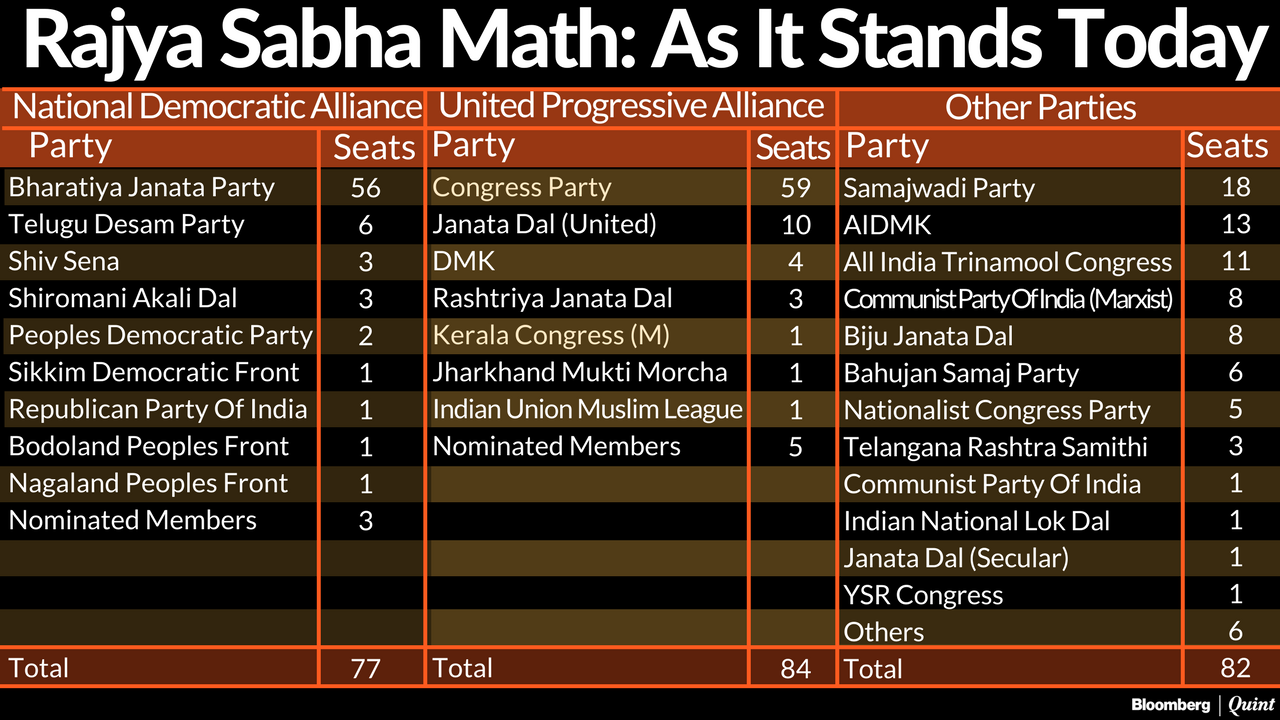
UP is clearly the prize in the RS: it contributes 31 of the upper house's 245 seats, of which ten will have elections in 2018 and another ten in 2020. With a supermajority in the UP state assembly, the BJP is likely to win seven new seats from UP in each round (it already has three RS MPs in UP).
Adding up all the states, the NDA will gain a total of 18 seats in 2017 and 2018 (including two grabbed from the Congress Party in Goa and Manipur), while the Congress Party and its allies' tally will drop by a similar amount.
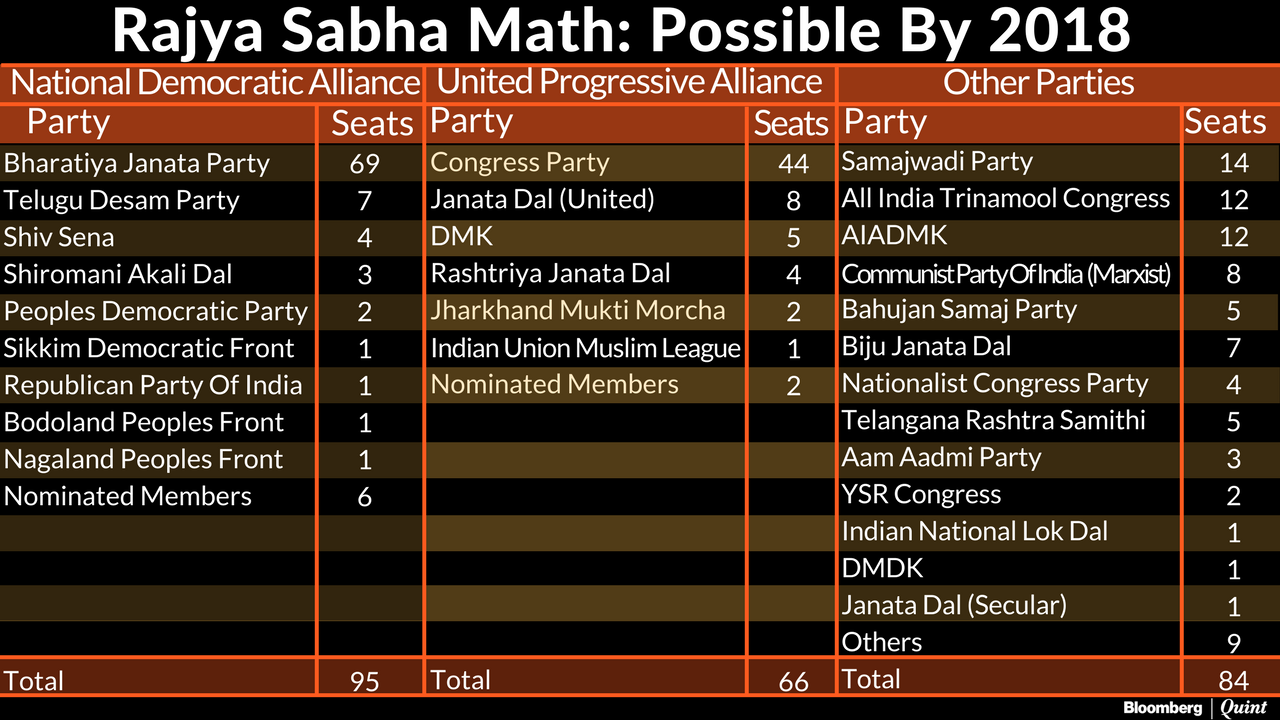
Those are meaningful shifts in seats, but not enough to give the NDA control of the upper house, where it will remain short by about 30 seats (as this blog anticipated in 2014). It will continue to require the support of regional parties like the Trinamool Congress, AIADMK and Samajwadi Party to pass bills through the RS.
Things improve for the NDA in 2019 and 2020. If we assume no major changes in the state elections held in 2018 and 2019 (a strong but unavoidable assumption since we can't predict the future), the NDA approaches an RS majority only in 2020.
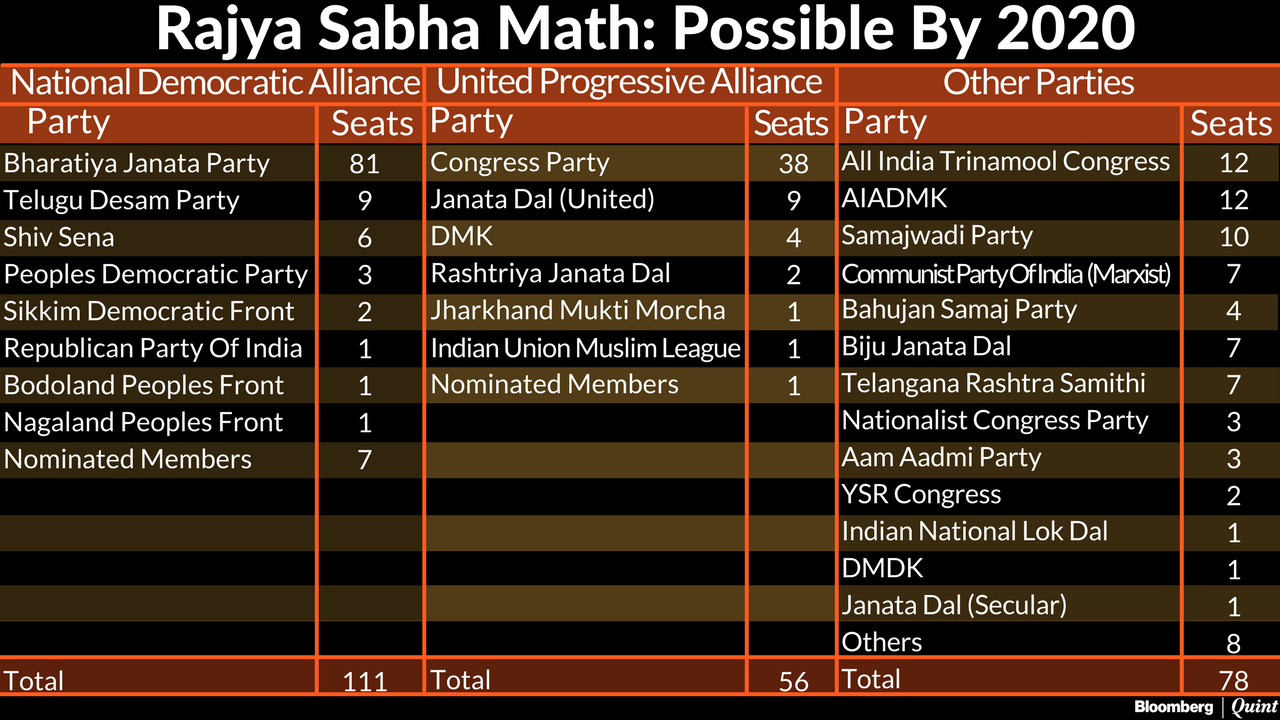
The ruling coalition will still fall a few seats short, but should be able to corral support from a wide selection of regional parties to pass bills. The good news, at least for people wary of the BJP's Hindutva agenda, is that the BJP will lack the power to change India's constitution. But it should be able to push economic reform bills through both houses if its allies are supportive.
The bad news: the BJP has every intention – as revealed by Adityanath's anointment as UP chief minister – to push ahead with hardline Hindutva. And if the environment is polarized enough, there is no guarantee that the BJP's allies won't cave to an aggressive right-wing assertion. Assuming, of course, that 2019 is in the bag for the BJP.
Amitabh Dubey is a consultant analysing Indian policy and politics for global fund managers. This article was originally published on his blog chunauti.org.
The views expressed here are those of the author's and do not necessarily represent the views of BloombergQuint or its editorial team.

-
Getting To Work Costs Women More | The Reason Why

It is not just about women paying more than men. It is about women paying much more in cities than in villages.
-
AI Bias In Investing Cannot Be Eliminated, But It Can Be Governed
Framing is a particularly important example as identical financial information presented in terms of gains rather than losses can lead an LLM to reach a different assessment.
-
Joining The Dots | Dark Skies, Steady Diya: Why Hope Holds This Diwali
With war, a weak rupee and foreign outflows weighing on sentiment, policymakers at the NDTV World Summit and market veterans at NDTV Profit Ignite: Diwali Edition offered the same advice: stay invested and filter out the noise.
-
The Curious Case of Equitas Small Finance Bank And A CEO Who Quit For Stock
PN Vasudevan believes persistent investor concerns over a perceived conflict of interest had become a governance overhang on Equitas Small Finance Bank's stock, even as the lender improved profitability and asset quality.
-
Talking Points This Week: AI Cash Burn, A Tiger Comeback And An India That Still Finds Its Own Path
India is not immune to higher oil or tighter global liquidity, yet its earnings base is broader, its domestic policy levers are still available.
-
Foreign Investors Own Half Of HDFC Bank and ICICI Bank. An LTCG Cut Could Matter Most Here
Foreign portfolio investors have US$115 billion parked in HDFC Bank, ICICI Bank. If the government cuts long-term capital gains tax, Jefferies says returning foreign money could land here first.
-
'Never Seen This Level Of Negativity': Sandeep Tandon Says The Next Rally May Be Closer Than You Think
Veteran investor Sandeep Tandon says foreign selling is easing, large-caps are due a comeback and mid-caps are crowded, while he turns positive on gold, power and pharma this Diwali.
-
Indians Stay With Family, Not In Hotels | The Reason Why
India still lacks enough clean, reliable and affordable hotels for budget-conscious travellers.
-
The Economic Imperative: Analysing The Material Driving Force Behind India-Canada Strategic Reset
This economic complementarity is further reinforced by deep institutional investment ties and talent mobility, which form the bedrock of the bilateral framework.
-
Medicine Pricing: Where Must Profit Stop?
India must confront excessive margins, hidden incentives and regulatory gaps that threaten the integrity of medicine.










