Does The Uttar Pradesh Sweep Mean A 2014 Redux In 2019?

Do most Indians really care about who governs Uttar Pradesh and Punjab? The only reason a Tamilian or a Bengali or a Maharashtrian is excited about the elections in Uttar Pradesh or Punjab is to glean an answer to the question – Will Narendra Modi be the Prime Minister of India again in 2019?
Does the grand sweep of the Uttar Pradesh assembly election by the BJP mean that Prime Minister Modi is set to win an outright majority in 2019 too? We will of course never have definitive answers to these questions but we certainly have a lot more clarity now in the run-up to the 2019 Lok Sabha elections. We can certainly build some scenarios to understand the plausibility of Prime Minister Modi returning to power in 2019 with an outright majority again.
While our frenzied media may want us to believe that every state election is some harbinger for the national elections, the fact is, nearly two-thirds of the 29 states and 7 union territories of India do not matter electorally for the national elections. Just one-third of these 36 states and union territories account for 80 percent of all Lok Sabha seats and half of them for 95 percent. As the chart shows, only the few large states to the left of the line matter while the long tail of states on the right doesn't.

The BJP's stunning victory in 2014 was shaped by a core group of 12 states of Uttar Pradesh, Maharashtra, Madhya Pradesh, Gujarat, Rajasthan, Bihar, Karnataka, Jharkhand, Chattisgarh, Assam, Haryana and Delhi.
The BJP won 254 of its magic tally of 282 Lok Sabha seats in the 2014 national elections from just these 12 states and a mere 28 seats from the remaining states combined!
It won 80 percent of all seats on offer in these 12 core states in 2014. Was this a one-time “black swan” event or can the BJP repeat its astounding success in 2019 in these core states is the main question? It is then important to understand how the BJP has fared in its core states since 2014. One can do that by extrapolating from the state elections that have been held since May 2014 in seven (UP, Maharashtra, Bihar, Assam, Jharkhand, Haryana and Delhi) of the 12 core states of the BJP.
Each Lok Sabha seat is divided into multiple assembly constituencies. To win a Lok Sabha seat, typically but not always, a candidate has to win a majority of the assembly constituencies that fall under that Lok Sabha constituency. The BJP had won a total of 818 assembly segments from these seven states in the 2014 elections. After the spate of state elections between 2014 to 2017, the BJP's tally of assembly segments in these seven core states that went to polls dropped from 818 to 634, primarily due to Bihar and Delhi.
The table below summarises BJP's performance in state elections in its core states.
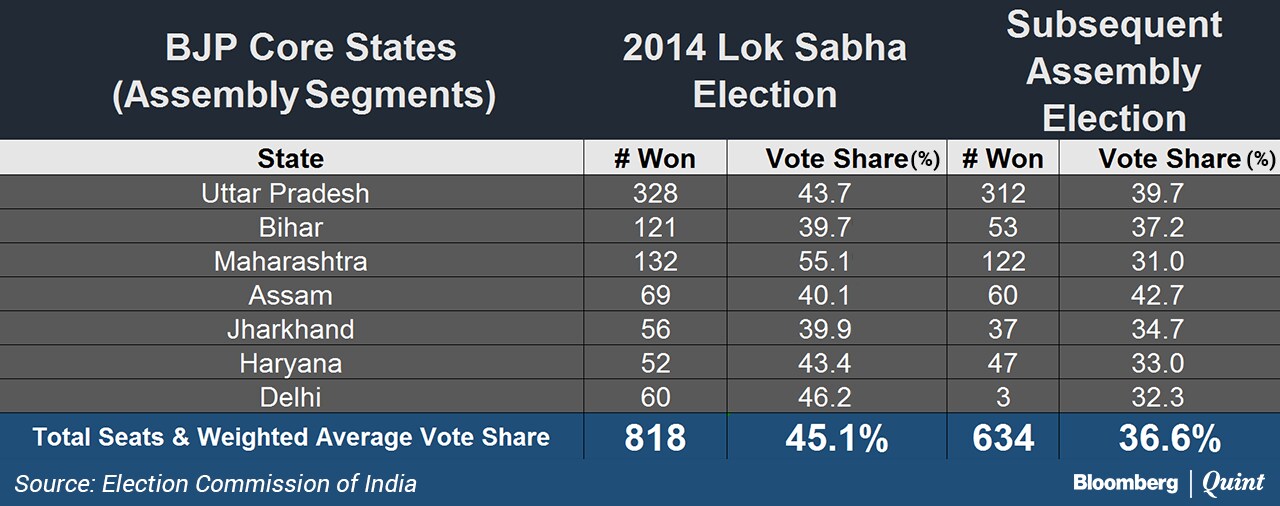
Purely for the purpose of this analysis, one can aggregate these assembly constituencies into Lok Sabha seats to glean how many equivalent Lok Sabha seats the BJP has won in these seven states post 2014.
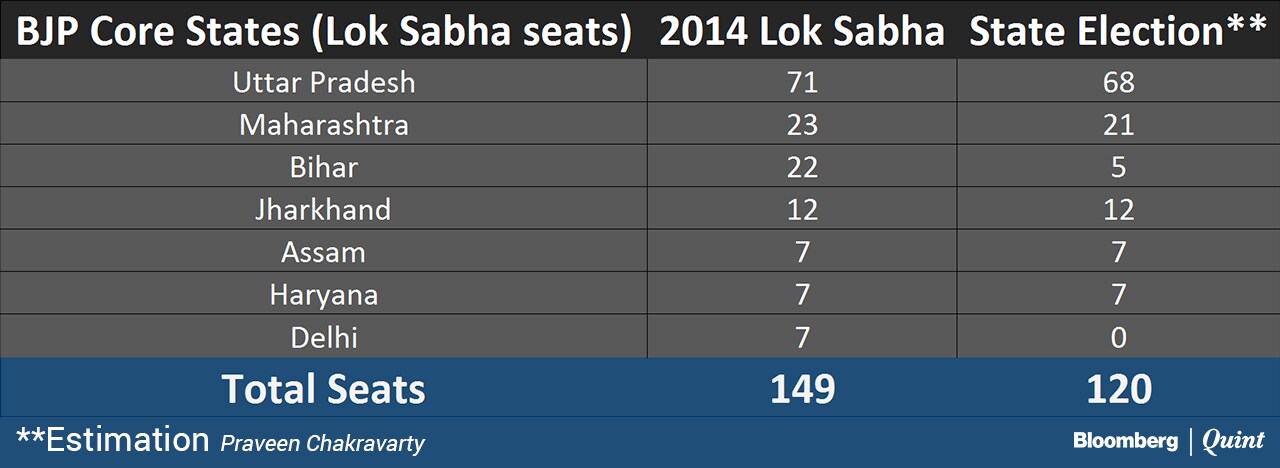
- The BJP won 149 Lok Sabha seats in 2014 in these seven states.
- That's dropped to 120, a decline of 29 equivalent Lok Sabha seats, driven again primarily by Bihar and Delhi and a little bit in UP.
- Thus, in the 12 core states that catapulted the BJP to a majority in 2014, while a large part of the tailwind is still with the BJP, it may have lost an equivalent of 29 Lok Sabha seats in its post 2014 performance in state elections.
- In 2014, the BJP won 282 seats on its own, ten more than the majority mark of 272
- So, for the BJP to win a majority again in 2019, it only needs to make up for 19 out of the loss of 29 equivalent Lok Sabha seats.
The next logical question then is, can the BJP make up for this loss of 19 seats from the other core states?
Five (MP, Karnataka, Gujarat, Rajasthan and Chhattisgarh) of the BJP's core 12 states are yet to hold a post-2014 assembly election. The BJP won 105 of the 119 available Lok Sabha seats in these five states in 2014.
Which means, even if the BJP were to improve its performance in these five states and win an unprecedented 100 percent of all seats on offer, it will only gain another 14 Lok Sabha seats.
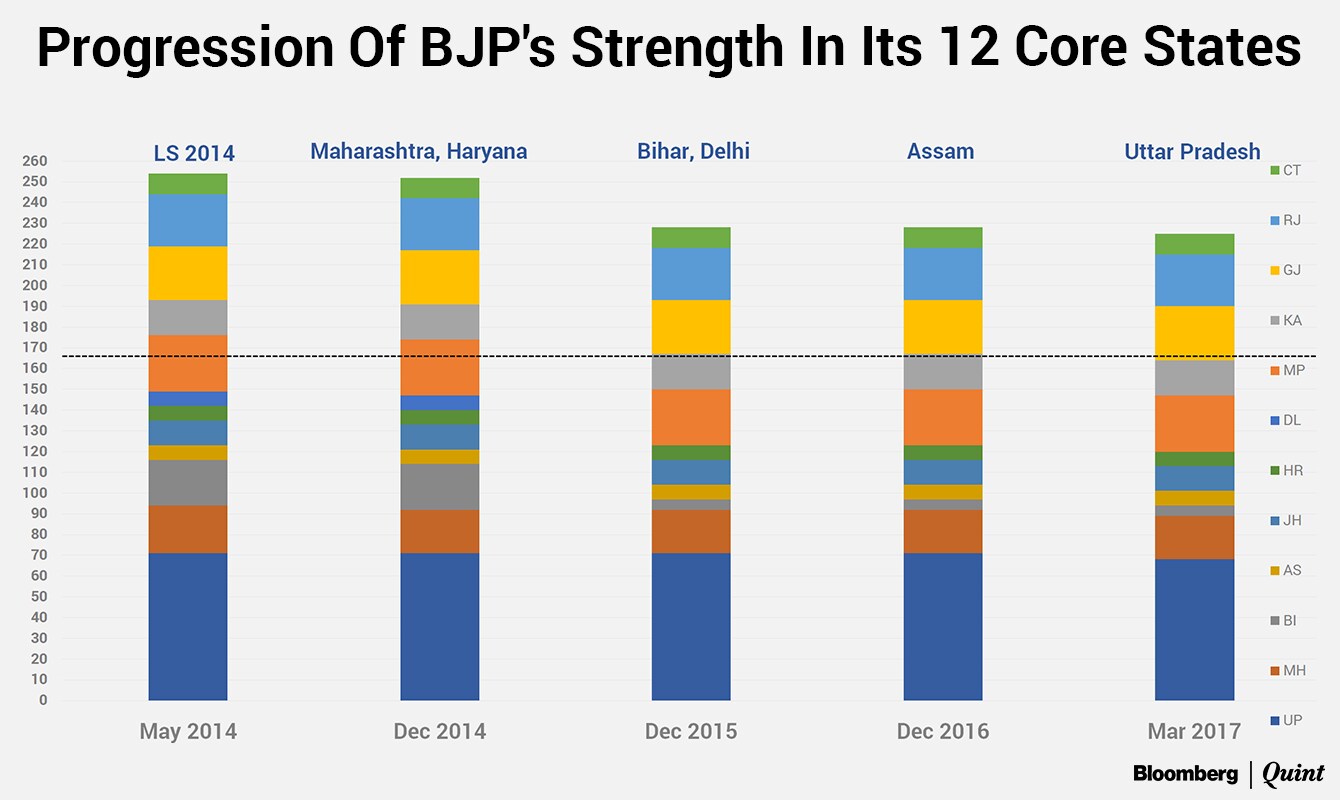
Despite the enormous charisma and public adulation of Prime Minister Modi, it is only fair to presume that it is extremely unlikely for any political party to win 100 percent of all seats in five states. The progression of BJP's estimated Lok Sabha seats in its 12 core states is in the chart below. The dotted line represents the halfway mark. So, the next logical question is can the BJP gain 19 seats from its non-core states to offset its loss in its core states?
Also Read: Why Modi Should Shake Up His Sarkars
There are 24 other states and union territories that were not core-BJP states in 2014. Of these, just seven states of Bengal, Tamil Nadu, Orissa, Andhra Pradesh, Kerala, Telengana and Punjab account for 177 Lok Sabha seats. The others are too small and account for a mere 34 seats combined.
Four (Bengal, TN, Kerala and Punjab) of these seven states have had an election subsequent to the 2014 election and the BJP did not win any equivalent Lok Sabha seat in these states post 2014. In other words, BJP's performance further deteriorated in its four large non-core states post 2014. The table below summarises the BJP's performance in its non-core states.
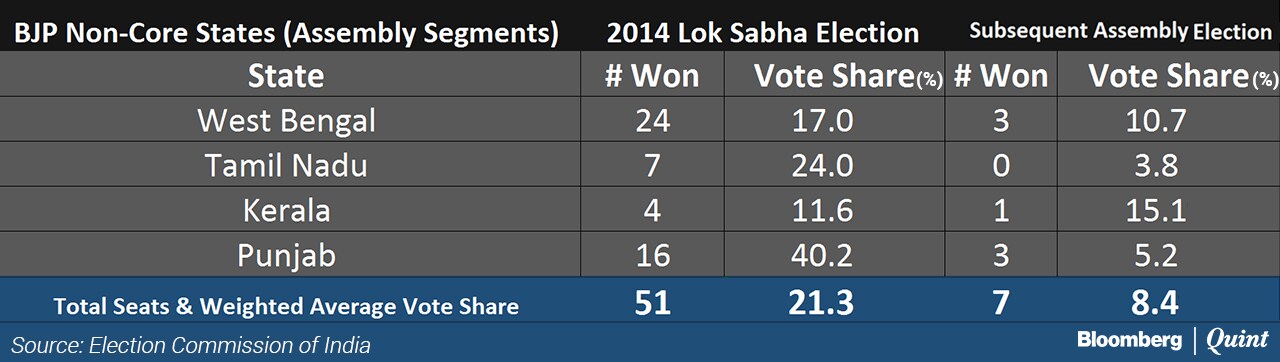
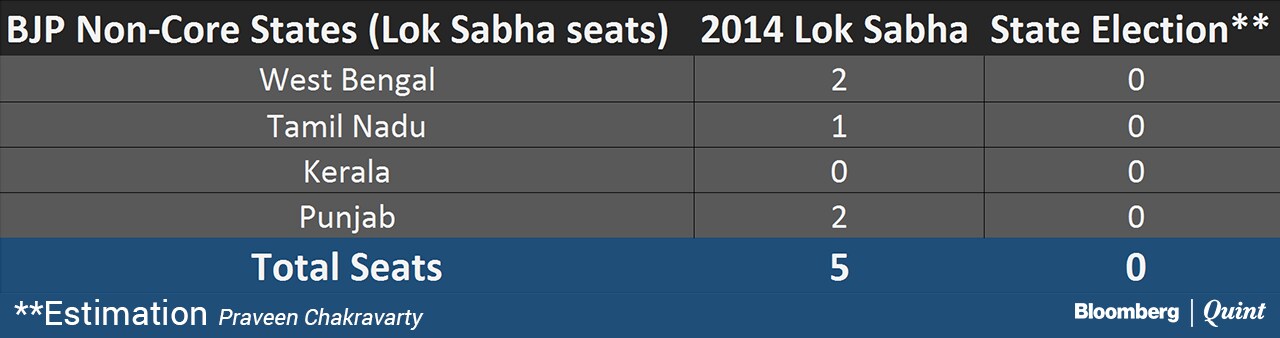
In summary, the BJP's performance thus far in state elections in its core states reveals a shortfall of just 19 seats for an outright majority in 2019 but it is difficult for the BJP to recoup these seats in its non-core states without an alliance.
State elections are interesting lead indicators for national elections despite the prevailing but unproven perception that voter behaviour is different in state elections vis-a-vis national elections. But only a handful of states matter electorally in the national elections. Just as the field of neo-classical economics that espoused ‘rational' human behaviour for several decades and realised its folly belatedly, voter behaviour too cannot be modelled and analysed in a spreadsheet.
Analyses such as these merely help visualise different scenarios under different assumptions. This analysis has focused only on the BJP's own performance and not that of its allies which is usually a big game changer in Indian electoral politics. Under the assumptions that recent state electoral trends will carry forward until 2019, and that the BJP will continue to overwhelmingly dominate in its core states that go to polls next year, Prime Minister Modi may at best be short by about 20 seats of an outright majority of his own in 2019.
Praveen Chakravarty is a Senior Fellow at IDFC Institute, a Mumbai-based think/do tank. His work focuses on financial sector legislation & political economy. Noise to Signal will bring you insights from that.
The author acknowledges the immense contribution of Ishita Trivedi, Research Associate at IDFC Institute.
The views expressed here are those of the author's and do not necessarily represent the views of BloombergQuint or its editorial team.

-
Getting To Work Costs Women More | The Reason Why

It is not just about women paying more than men. It is about women paying much more in cities than in villages.
-
AI Bias In Investing Cannot Be Eliminated, But It Can Be Governed
Framing is a particularly important example as identical financial information presented in terms of gains rather than losses can lead an LLM to reach a different assessment.
-
Joining The Dots | Dark Skies, Steady Diya: Why Hope Holds This Diwali
With war, a weak rupee and foreign outflows weighing on sentiment, policymakers at the NDTV World Summit and market veterans at NDTV Profit Ignite: Diwali Edition offered the same advice: stay invested and filter out the noise.
-
The Curious Case of Equitas Small Finance Bank And A CEO Who Quit For Stock
PN Vasudevan believes persistent investor concerns over a perceived conflict of interest had become a governance overhang on Equitas Small Finance Bank's stock, even as the lender improved profitability and asset quality.
-
Talking Points This Week: AI Cash Burn, A Tiger Comeback And An India That Still Finds Its Own Path
India is not immune to higher oil or tighter global liquidity, yet its earnings base is broader, its domestic policy levers are still available.
-
Foreign Investors Own Half Of HDFC Bank and ICICI Bank. An LTCG Cut Could Matter Most Here
Foreign portfolio investors have US$115 billion parked in HDFC Bank, ICICI Bank. If the government cuts long-term capital gains tax, Jefferies says returning foreign money could land here first.
-
'Never Seen This Level Of Negativity': Sandeep Tandon Says The Next Rally May Be Closer Than You Think
Veteran investor Sandeep Tandon says foreign selling is easing, large-caps are due a comeback and mid-caps are crowded, while he turns positive on gold, power and pharma this Diwali.
-
Indians Stay With Family, Not In Hotels | The Reason Why
India still lacks enough clean, reliable and affordable hotels for budget-conscious travellers.
-
The Economic Imperative: Analysing The Material Driving Force Behind India-Canada Strategic Reset
This economic complementarity is further reinforced by deep institutional investment ties and talent mobility, which form the bedrock of the bilateral framework.
-
Medicine Pricing: Where Must Profit Stop?
India must confront excessive margins, hidden incentives and regulatory gaps that threaten the integrity of medicine.










